
Posted on

Xbox handheld console finally revealed after a decade of speculation

Tom Gerken

Technology reporter

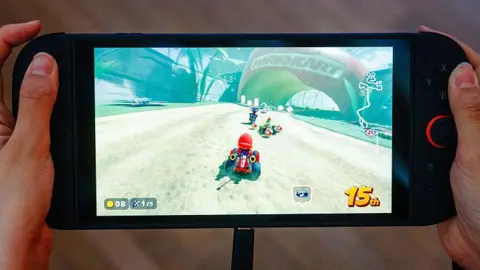
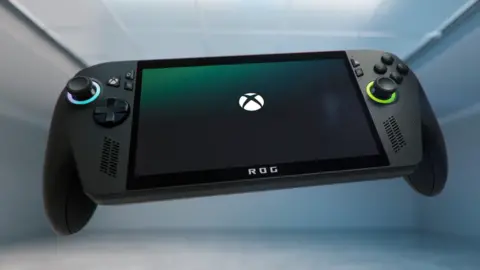
Xbox The Xbox Rog Ally has a large screen with half a controller either side of it - visually very similar to the Nintendo Switch 2 or the Steam Deck.` Xbox

Microsoft has finally revealed its highly-anticipated handheld console, years after it was first rumoured.

The ROG Xbox Ally will let gamers access their Game Pass subscription library on-the-go, in effect meaning members will start off with hundreds of games.

It is being made in partnership with Asus, which has been making handheld gaming devices since 2023, and will be released at the end of 2025 – though it is unknown what it will cost.

Speculation over Microsoft making a handheld Xbox has been widespread for more than a decade, with the company starting and scrapping various efforts over the years.

Microsoft’s announcement comes just three days after the launch of the Switch 2.

Much like its predecessor, the Switch 2 is a hybrid gaming device – meaning it can be both played on-the-go and connect to a TV.

Its success likely led to the design of Valve’s Steam Deck, a handheld PC which gives gamers access to the entire library of titles they’ve bought through game distribution service Steam – though not all the games work on the device.

It means Microsoft may be accused of being slightly late to the game when rivals already exist in the space, but the benefit of native support for Game Pass will likely address a lot of concerns for its 34 million subscribers.

Allow Google YouTube content?

This article contains content provided by Google YouTube. We ask for your permission before anything is loaded, as they may be using cookies and other technologies. You may want to read  and  before accepting. To view this content choose ‘accept and continue’.

Two versions

Microsoft’s new handheld will comes in two flavours, the ROG Xbox Ally and ROG Xbox Ally X.

“Whether you’re at home or on the go, your favorite games should follow you,” said Xbox head of gaming devices Roanne Sones.

“Both handhelds allow players to play natively, via the cloud, or remotely with their Xbox console in another room.”

The two versions both share a 7 inch screen with 1080p resolution.

The base version comes with 16GB memory and 512GB storage, while the “X” version has 24GB memory and double the storage.

The more powerful version of the handheld also has a bigger battery and a more powerful processor.

In both cases, Xbox will be hoping to convince players that it offers something out of the box that its rivals don’t – Microsoft’s operating system.

“Because these handhelds run Windows, you have access to games you can’t get elsewhere, so you can enjoy the full freedom and versatility of PC gaming,” said Ms Sones.

In other words, gamers can leave the Xbox app and launch other gaming platforms – such as Steam and EA Play – through the device.

But all that capability comes at a cost when it comes to weight.

At 670g and 715g respectively, the base and X versions of the Xbox Ally may be heavier than handheld gamers are used to – with Nintendo’s new Switch 2 weighing a fair bit less at 534g.

And there remains one big unanswered question – the price.

Microsoft decided not to reveal how much its new handheld will cost, but it goes without saying the more powerful X version will also be more expensive.

The Switch 2, which has a similar screen, retails at £395 in the UK, while the Steam Deck costs between £349 and £569 depending on the specs.

Games revealed

Part of the success of Game Pass is many highly-anticipated new releases appear on the service on launch day, meaning gamers can save money by subscribing – though you lose access to a game if you cancel your subscription.

At its showcase event where it unveiled the new handheld, Microsoft announced several new games – including a reveal that 17 new titles will come to Game Pass PC & Ultimate on day one.

Many of these are highly-anticipated games such as Tony Hawk’s Pro Skater 3+4, Ninja Gaiden 4 and Outer Worlds 2.

It also includes the new Call of Duty: Black Ops 7 when that releases – likely later this year.

The new game will be a sequel to the critically-acclaimed Black Ops 2, which first released in 2012.

Interestingly, while the game was confirmed for several consoles, there was no mention of the Switch 2 at the event – despite Nintendo previously signing a 10-year deal to bring the series to its consoles in 2022.

But there’s something else which many gaming fans will have been excited to finally see revealed.

The much-anticipated Persona 4 remake, subtitled Revival, is set to be remade 17 years after it was first released on PlayStation 2.

Allow Google YouTube content?

This article contains content provided by Google YouTube. We ask for your permission before anything is loaded, as they may be using cookies and other technologies. You may want to read  and  before accepting. To view this content choose ‘accept and continue’.

The original, which sees a group of friends investigate a series of murders in the Japanese countryside, is considered a gaming classic.

But fans of the series will have to wait, as Sega and Atlus did not share a release date for the remake.

A green promotional banner with black squares and rectangles forming pixels, moving in from the right. The text says: “Tech Decoded: The world’s biggest tech news in your inbox every Monday.”
Posted on

Government considers social media time limits for children

Adam Hale

BBC News

Zoe Kleinman

Technology editor@zsk

Getty Images A young boy stares down at a smartphone.Getty Images

The government is considering introducing tougher online safety measures to limit the amount of time children can spend on social media, the BBC understands.

Proposals include a two-hour cap on the use of individual social media apps and a 22:00 curfew, as first reported by the Sunday People and the Mirror.

Appearing on the BBC’s Sunday with Laura Kuenssberg programme, Technology Secretary Peter Kyle said he was looking at the “addictive nature of some of the apps and smartphones”, when asked whether time limits would be considered.

But an online safety campaigner has accused the government of delaying bringing in new laws to protect children.

Ian Russell, whose daughter, Molly, took her own life at 14 after seeing harmful content online, said: “Every day the government has delayed bringing in tougher online safety laws we’ve seen more young lives lost and damaged because of weak regulation and inaction by big tech.”

Mr Russell, who backed the previous government’s Online Safety Act, said only “stronger and more effective” legislation would “finally change the dial on fundamentally unsafe products and business models that prioritise engagement over safety.”

“Parents up and down the country would be delighted to see the prime minister act decisively to quell the tsunami of harm children face online, but sticking plasters will not do the job,” he added.

Kyle told the BBC he had not been able to speak publicly about the government’s plans to toughen online safety laws because legislation passed by the previous Conservative government in 2023 had yet to be enacted.

“This year we’ve had illegal content that needs to be taken down, but in July, age-appropriate material must be supplied by platforms, otherwise there’ll be criminal sanctions against them,” he told the BBC’s Sunday with Laura Kuenssberg programme.

He said that he had been looking carefully at what government needed to do next to “nail down harder” on safety, “understand what a healthy online life for children” looked like and “stop the barriers” towards achieving that.

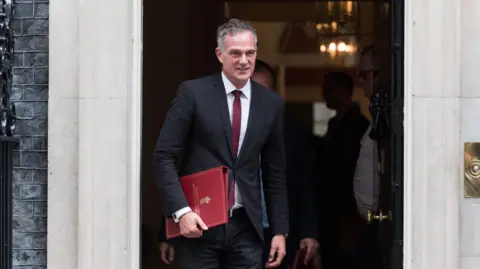
Getty Images Peter Kyle, a middle aged man, is wearing a suit as he walks out of the doors of Number 10 Downing Street.Getty Images

Curfews, along with screen time limits for both apps and devices overall, are already available to parents who use Apple or Google’s parental controls.

TikTok introduced a 60 minute screen time limit by default for under 18s in 2023, although it can be switched off. Instagram invites users of all ages to set their own limit, after which they can opt to be blocked for the rest of the day.

However, it is not known how many people choose to activate these controls. In a speech last year, Sir Nick Clegg – the former director of public affairs at Meta, which owns Facebook and Instagram – said parental take-up of tools designed to help them manage their children’s online activities was low.

Some parents say this is because there are so many offered by individual apps and companies that they find them overwhelming.

England’s children’s commissioner, Dame Rachel de Souza, called on the government to take stronger action to protect children from technological harm.

She said: “Technology is evolving at enormous pace, and this generation of children have never known life without the internet, so we have to be much bolder in how we respond to the risks they face. Children should not be expected to police the online world themselves.

“If companies cannot make online spaces safe for children, then they should not be in them.

“Any amount of time online is too long if the content they see is harmful. I continue to urge the government and Ofcom to strengthen both the Online Safety Act and the Children’s Codes so that profit-making by platforms cannot come at the expense of protection.”

In January, Kyle told the BBC that laws on internet safety were “very uneven” and “unsatisfactory”, following calls from campaigners to tighten the rules.

The minister expressed his “frustration” with the Online Safety Act but did not commit to making changes to the legislation.

A Whitehall source later told the BBC there were no plans to repeal the act.

Another potential problem facing the idea of introducing legal time limits for children on social media is that the vast majority of tech firms are based in the US.

The Trump administration has been highly critical of foreign governments attempting to regulate its tech businesses and punish them for non-compliance.

In 2021, China imposed strict restrictions on online gaming, limiting players below the age of 18 to one hour per day on Fridays, weekends and holidays only. This replaced earlier limits of 90 minutes per day, rising to three hours during holidays.

The country cited concerns about the impact of “excessive” gaming on young people.

It was mulling further restrictions including limits on in-game purchases and daily log-in rewards, but last year the draft update disappeared from the government’s website.

Posted on

Will Musk’s explosive row with Trump help or harm his businesses?

Lily Jamali

North America technology correspondent

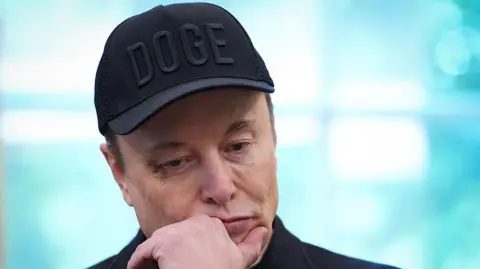
Getty Images A pensive looking MuskGetty Images

When Elon Musk recently announced that he was stepping back from politics, investors hoped that would mean he would step up his involvement in the many tech firms he runs.

His explosive row with US President Donald Trump – and the very public airing of his dirty White House laundry – suggests Musk’s changing priorities might not quite be the salve they had been hoping for.

Instead of Musk retreating somewhat from the public eye and focusing on boosting the fortunes of Tesla and his other enterprises, he now finds himself being threatened with a boycott from one of his main customers – Trump’s federal government.

Tesla shares were sent into freefall on Thursday – falling 14% – as he sounded off about Trump on social media.

They rebounded a little on Friday following some indications tempers were cooling.

Even so, for the investors and analysts who, for months, had made clear they wanted Musk off his phone and back at work, the situation is far from ideal.

‘They’re way behind’

Some argue, though, that the problems for Musk’s businesses run much deeper than this spat – and the controversial role in the Trump administration it has brought a spectacular end to.

For veteran tech journalist Kara Swisher, this is especially so for Tesla.

“Tesla’s finished,” she told the BBC on the sidelines of the San Francisco Media Summit early this week.

“It was a great car company. They could compete in the autonomous taxi space but they’re way behind.”

Tesla has long attempted to play catch-up against rival Waymo, owned by Google’s parent, Alphabet, whose driverless taxis have traversed the streets of San Francisco for years – and now operate in several more cities.

This month, Musk is supposed to be overseeing Tesla’s launch of a batch of autonomous robo-taxis in Austin, Texas.

He posted on X last week that the electric vehicle maker had been testing the Model Y with no drivers on board.

“I believe 90% of the future value of Tesla is going to be autonomous and robotics,” Wedbush Securities analyst Dan Ives told the BBC this week, adding that the Austin launch would be “a watershed moment”.

“The first task at hand is ensuring the autonomous vision gets off to a phenomenal start,” he added.

But with Musk’s attention divided, the project’s odds of success would appear to have lengthened.

And there’s something else to factor in too: Musk’s own motivation.

The talk in Silicon Valley lately centres less on whether Musk can turn things around and more on whether he even cares.

“He’s a really powerful person when he’s focused on something,” said Ross Gerber, President and CEO of Gerber Kawasaki Wealth and Investment Management.

“Before, it was about proving to the world that he would make EVs – the tech that nobody else could do. It was about proving he could make rockets. He had a lot to prove.”

A longtime Tesla investor, Mr Gerber has soured on the stock and has been paring back his holdings since Musk’s foray into right-wing politics. He called Thursday an “extremely painful day”.

“It’s the dumbest thing you could possibly do to think that you have more power than the president of the United States,” Mr Gerber said, referring to Musk’s social media tirade against Trump.

The BBC contacted X, Tesla, and SpaceX seeking comment but did not receive a response.

The Tesla takedown

A particular problem for Musk is that, before he seemingly created an enemy in Trump, he already had one in the grassroots social media campaign against his car-maker.

Protests, collectively dubbed #TeslaTakedown, have played out across the country every weekend since Trump took office.

In April, Tesla reported a 20% drop in car sales for the first three months of the year. Profits plunged more than 70%, and the share price went down with it.

“He should not be deciding the fate of our democracy by disassembling our government piece by piece. It’s not right,” protestor Linda Koistinen told me at a demonstration outside a Berkeley, California Tesla dealership in February.

Ms Koistinen said she wanted to make a “visible stand” against Musk personally.

“Ultimately it’s not about the tech or the Tesla corporation,” said Joan Donovan, a prominent disinformation researcher who co-organised the #TeslaTakedown protests on social media.

“It’s about the way in which the stock of Tesla has been able to be weaponised against the people and it has put Musk in such a position to have an incredible amount of power with no transparency.”

Another aspect of Musk’s empire that has raised the ire of his detractors is X, the social media platform once known as Twitter.

“He bought Twitter so that he had clout and would be able to – at the drop of a hat – reach hundreds of millions of people,” Ms Donovan said.

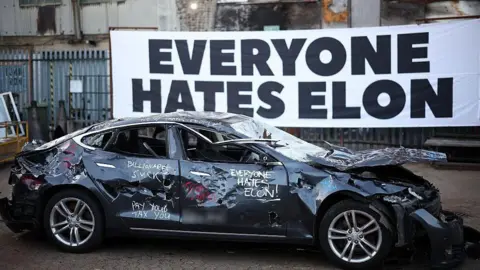
Getty Images A banner reading "everyone hates Elon" behind a smashed up TeslaGetty Images

The personal brand

There is another possibility here though.

Could Musk’s high-profile falling out with Trump help rehabilitate him in the eyes of people who turned against him because of his previous closeness to the president?

Patrick Moorhead, chief analyst at Moor Insights & Strategy, thinks it could.

“We’re a very forgiving country,” he said.

“These things take time,” Mr Moorhead acknowledged, but “it’s not unprecedented”.

Ms Swisher likened Musk’s personal brand to that of Microsoft co-founder Bill Gates more than two decades ago.

She said Gates was once regarded as “the Darth Vader of Silicon Valley” because of his “arrogant and rude” personality.

Today, despite his flaws, Gates has largely rehabilitated his image.

“He learned. He grew up. People can change,” Ms Swisher said, even though Musk is “clearly troubled”.

Space exit

The problem for Musk is the future for him and his companies is not just about what he does – but what Trump decides too.

And while Trump needed Musk in the past, not least to help fund his presidential race, it’s not so clear he does now.

Noah Smith, writer of the Noahpinion Substack, said Trump’s highly lucrative foray into cryptocurrencies – as unseemly as it has been – may have freed him from depending on Musk to carry out his will.

“My guess is that this was so he could get out from under Elon,” he said.

In Trump’s most menacing comment of the day, he suggested cutting Musk’s government contracts, which have an estimated value of $38bn (£28bn).

A significant chunk of that goes to Musk’s rocket company SpaceX – seemingly threatening its future.

However, despite the bluster, Trump’s warning may be a little more hollow than it seems.

That’s because SpaceX’s Dragon spacecraft ferries people and cargo to the International Space Station where three Nasa astronauts are currently posted.

It demonstrates that SpaceX has so entrenched itself in the US space and national security apparatus, that Trump’s threat could be difficult to carry out.

You could make a similar argument about Musk’s internet satellite company, Starlink. Finding an alternative could be easier said than done.

But, if there are limits on what Trump can do, the same is also true of Musk.

In the middle of his row with Trump, he threatened to decommission the Dragon – but it wasn’t long before he was rowing back.

Responding to an X user’s suggestion he that he “cool down”, he wrote: “Good advice. Ok, we won’t decommission Dragon.”

It’s clear Musk and Trump’s friendship is over. It’s less certain their reliance on each other is.

Whatever the future for Musk’s businesses is then, it seems Trump – and his administration’s actions – will continue to have a big say in them.

A green promotional banner with black squares and rectangles forming pixels, moving in from the right. The text says: “Tech Decoded: The world’s biggest tech news in your inbox every Monday.”
Posted on

NatWest fixes app outage which left customers fuming

Tom Gerken

Technology reporter

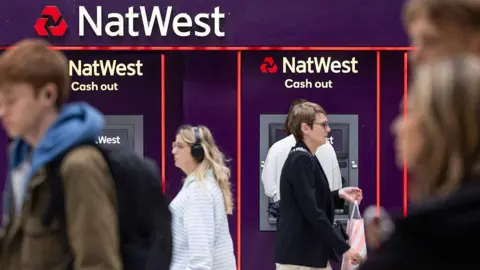
Getty Images People walking outside a NatWest bankGetty Images

NatWest says it has now fixed an issue which left customers unable to use the bank’s mobile app, leaving some unable to access their accounts.

Customers reported problems including being unable to make purchases or pay staff.

NatWest apologised to customers “for any inconvenience caused”, having previously said its web-based online banking service was still working normally – however some customers disputed this.

“We have resolved the issues causing this and customers are now able to log in and make payments as normal,” a spokesperson said.

Problems began to be reported on outage-checking site Downdetector at 0910 GMT.

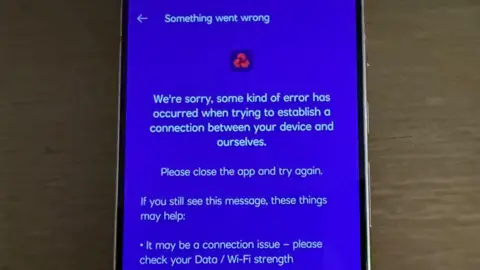
BBC/NatWest A phone displaying an error message with the NatWest logo. It reads: "Something went wrong. We're sorry, some kind of error has occurred when trying to establish a connection between your device and ourselves. Please close the app and try again. If you still see this message, these things may help: It may be a connection issue - please check your Data/Wi-Fi strength."BBC/NatWest

Customers then took to social media to complain about the impact the IT failure was having on them.

One person said they had to “put back my shopping because of it”, while another said they were “waiting to go shopping” but couldn’t transfer money to do so.

Customers were advised to access their accounts in other ways if they can – such as through online banking.

However, some people reported problems with NatWest’s online service too, with one sharing an error message which they said was displayed when they tried to make a payment.

Others have expressed frustration with the bank’s response, with one saying it was “disgraceful” there was no timeframe given for resolving the problem, while another called it “very poor service“.

“What I don’t get is the bank closes loads of branches ‘to save money’ and forcing people to rely on the app and online banking… but clearly hasn’t invested in a system that works properly,” one angry customer said.

A recurring problem

This is the latest in a long line of banking outages.

In May, a number of major banks disclosed that 1.2m people were affected by them in the UK in 2024.

According to a report in March, nine major banks and building societies have had around 803 hours – the equivalent of 33 days – of tech outages since 2023.

Inconvenient for customers, outages come at a cost to the banks, too.

The Commons Treasury Committee found Barclays could face compensation payments of £12.5m over outages since 2023.

Over the same period, Natwest has paid £348,000, HSBC has paid £232,697, and Lloyds has paid £160,000.

Other banks have paid smaller sums.

A green promotional banner with black squares and rectangles forming pixels, moving in from the right. The text says: “Tech Decoded: The world’s biggest tech news in your inbox every Monday.”
Posted on Leave a comment

In-Depth Review of the TCL 40S5400AK Television

In-Depth Review of the TCL 40S5400AK Television

Overview of TCL 40S5400AK Television

The TCL 40S5400AK represents an impressive entry in the television market, designed to cater to a wide audience seeking quality entertainment at an affordable price. With a screen size of 40 inches, this television strikes a balance between a compact form factor suitable for small to medium-sized rooms and vivid display quality. It features a Full HD resolution of 1920 x 1080 pixels, allowing for crisp and detailed visuals that enhance the viewing experience, whether it be for watching movies, streaming shows, or engaging in gaming sessions.

One of the most significant advantages of the TCL 40S5400AK is its advanced display technology. Employing LED backlighting, it ensures vibrant colors and impressive contrast ratios, providing users with an immersive visual experience. Notably, the television incorporates TCL’s proprietary Contrast Control Zone technology, which enhances the overall picture quality by optimizing the brightness and dark areas of the screen, thus delivering a more dynamic image.

The design of the TCL 40S5400AK is sleek and modern, featuring razor-thin bezels that maximize the screen area and contribute to a more contemporary aesthetic. It is easy to fit into various decor styles and can be easily mounted on a wall or placed on a TV stand. As a smart television, it runs on the Roku platform, enabling access to thousands of streaming channels, applications, and services, making it a versatile choice for entertainment enthusiasts.

Connectivity options are abundant, with multiple HDMI ports, USB inputs, and even an Ethernet port, allowing for seamless integration with various external devices such as gaming consoles, sound systems, and more. With its robust set of features and affordable price point, the TCL 40S5400AK stands out as a commendable choice for those looking to upgrade their viewing experience without breaking the bank. As a reputable manufacturer in the television industry, TCL continues to position itself as a leader in providing quality, budget-friendly options for consumers.

Picture and Sound Quality

The TCL 40S5400AK television offers a commendable picture quality that enhances the viewing experience for a variety of content. It is equipped with an LED display featuring a 1080p resolution, which delivers sharp and vibrant images. The color accuracy is noteworthy, ensuring that hues are represented true to life. This is particularly evident in nature documentaries and films that rely heavily on color palettes to convey emotion and depth. The television also performs well in terms of brightness, allowing for clear viewing even in well-lit rooms. Users can expect a sufficient contrast ratio, which significantly contributes to the overall visual performance.

When assessing the performance of the TCL 40S5400AK in different viewing environments, it becomes clear that this model excels in dark settings, where deeper blacks and enhanced detail in shadows are more pronounced. Conversely, in brighter scenarios, the screen maintains a vibrant presence without washed-out colors, making it a versatile choice for diverse lighting conditions. Furthermore, features such as local dimming can help improve the display’s performance, providing even more detail and richness to the imagery presented.

In terms of sound quality, the TCL 40S5400AK presents a balanced audio experience. The built-in speakers deliver clear dialogue, making it easier to follow complex plots. The bass response, while adequate, may not satisfy audiophiles or those seeking a deep cinematic experience. However, the television includes several sound enhancement features, such as virtual surround sound, which adds a dimension to the audio that enhances the viewing experience while watching movies or playing video games. The volume capabilities are impressive, ensuring that sound remains consistent without distortion, even at higher settings.

Smart Features and User Experience

The TCL 40S5400AK television is equipped with an array of smart features that enhance the viewing experience. At the heart of its functionality is the intuitive operating system, which allows users to access a multitude of applications tailored for streaming, news, and entertainment. This smart TV operates on the Android TV platform, known for its seamless integration with Google services, ensuring that users can enjoy popular streaming platforms such as Netflix, Hulu, and Disney+. The TV’s interface is designed for ease of navigation, providing quick access to various content through a user-friendly layout.

The remote control that accompanies the TCL 40S5400AK is another noteworthy aspect of its user experience. It features dedicated buttons for popular streaming services, thereby reducing the time spent searching for apps. The remote is ergonomically designed, making it comfortable to hold during extended viewing sessions. Furthermore, this television supports voice control through Google Assistant, allowing users to operate the device hands-free. Voice command functionality enables activities such as changing channels or searching for specific content with simple verbal instructions, enhancing overall usability.

Additionally, the television offers screen mirroring capabilities, allowing users to share content from their smartphones or tablets directly to the TCL 40S5400AK. This feature is valuable for users who wish to display photos, videos, or applications on a larger screen. Reviews from users indicate a general satisfaction with the TV’s smart features and the overall responsiveness of the system. Many reported that app loading times were minimal, and the performance during high-definition streaming was robust, with minimal lag or buffering issues. Overall, the combination of a well-thought-out user interface, effective remote control design, and responsive smart features contributes significantly to a positive user experience with the TCL 40S5400AK television.

Value for Money and Conclusion

When evaluating the TCL 40S5400AK television, it is crucial to assess its value for money in relation to its pricing and features. This model is competitively priced within the mid-range category of televisions, making it accessible to a broad spectrum of consumers. The price point is reflective of its features, which include a full HD display, smart capabilities, and support for popular streaming services. Such offerings are becoming standard in televisions today, but the TCL 40S5400AK aims to deliver these features without overextending its pricing, which is often appreciated by budget-conscious buyers.

In terms of feature comparisons, the TCL 40S5400AK stands shoulder to shoulder with many similarly priced alternatives from other brands. While other models may offer ultra HD resolution, the TCL’s performance in color accuracy and sound quality ensures that it does not significantly lag behind its competitors. The integration of various smart platforms allows for seamless access to content, which caters well to the modern viewer. Moreover, consumers frequently express commendation for TCL’s customer service and warranty policies, adding an additional layer of assurance when investing in this television.

However, potential buyers should note that while the TCL 40S5400AK excels in many areas, it may not offer the advanced gaming options or premium design elements that high-end models possess. Users seeking these features might need to explore higher-priced alternatives. Nevertheless, the balance of quality and affordability makes the TCL 40S5400AK a solid choice for those who prioritize cost-effectiveness without sacrificing essential features. Ultimately, this television is a commendable option for consumers who wish to enhance their home entertainment experience without overspending.

Posted on

Tesla shares tumble as Trump-Musk feud erupts

Natalie Sherman

BBC News

Investors sold off shares in Tesla on Thursday, as tensions erupted between boss Elon Musk and US President Donald Trump.

Shares in the electric car company dropped 14%, wiping out roughly $150bn in market value in one of the worst days in months.

The losses were an indication of what might be at stake for Musk, as he breaks with a White House known for wielding the power of government against what it sees as enemies.

As the dispute devolved, Trump threatened to cut off government contracts to Musk’s companies, including rocket firm SpaceX, which has contracts worth tens of billions of dollars with the government.

“Go ahead, make my day,” Musk fired back in response to the threat.

The stark turn in the relationship between the two men played out live on social media, quickly spiralling from policy disagreements into personal insults.

Analyst Dan Ives of Wedbush Securities, a longtime Tesla cheerleader, called it “jaw dropping and a shock to the market”,

He said the clash had sparked fear among investors about what it might mean for regulation of the company, which is seeking to expand self-driving and robotics and had hoped for a more relaxed regulatory approach under the Trump administration.

“This must start to be calmed down,” Mr Ives wrote in a note, adding that it “put a fly in the ointment of the Trump regulatory framework going forward”.

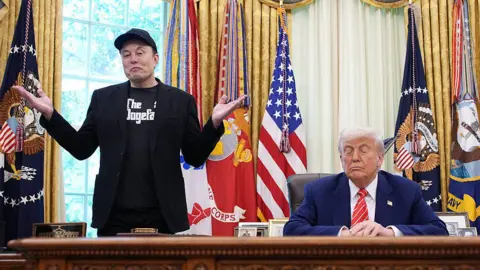
Getty Images Tesla CEO Elon Musk speaks alongside U.S. President Donald Trump to reporters in the Oval Office of the White House on May 30, 2025 in Washington, DC. Musk, who served as an adviser to Trump and led the Department of Government Efficiency, announced he would leave his role in the Trump administration to refocus on his businesses.Getty Images

Musk’s foray into government has already proven a wild ride for Tesla investors.

Shares had surged last year, on hopes his alliance with Trump would benefit the company.

But investor sentiment soured this year, as Musk’s alliance with Trump and his role leading controversial cuts to government spending proved a lightning rod, sparking backlash and hurting sales, especially in Europe.

Investors were also concerned that Musk – who had been fighting for a record-breaking pay package – was not focused on the company.

Last month, the head of Tesla’s board was forced to publicly deny a report that the company had started to look for someone else to lead the firm.

Musk’s pledge on an investor call that he would be stepping back from his role leading Doge had prompted an upswing in the stock. He formally left the government at the end of last month.

But Tesla now finds itself back in the political crossfire.

The breach with Trump was sparked by Musk’s criticism of a Trump-backed spending bill.

Musk has sought to rally opposition, arguing that it will add too much the government’s debt load. He has also been critical of Trump’s tariffs, which he said on Thursday would cause an economic recession in the second half of the year.

Trump said Musk’s welcome at the White House was wearing thin and accused him of being unhappy about the elimination of a tax credit for electric vehicles, which has been key to Tesla’s sales in the US.

The two men have also clashed over Trump’s decision to withdraw his nomination of Jared Isaacman, a Musk ally, to lead Nasa.

Thursday’s fall put the company’s share price at its lowest level since May, erasing gains that had been made on hopes that Musk would refocus attention on the company.

As the two men went at it, investors watched in disbelief.

“Can someone please take the phone away from him,” wrote investor Ross Gerber, who has been vocal about his concerns about the impact of Musk’s politics on Tesla and cut back his holdings. “Tesla is getting destroyed.”

Posted on

Stores open at midnight as fans rush to buy Nintendo Switch 2

Tom Gerken

Technology reporter

Peter Gillibrand

Newsbeat reporter

Getty Images A person playing Mario Kart World on a Switch 2 consoleGetty Images

The Nintendo Switch 2 has been released worldwide, with stores opening at midnight so fans could get their hands on the long-awaited console the moment it became available.

Some shops have the devices available to buy off the shelf – but in most cases customers have been picking up consoles they had ordered in advance, with UK retailer Currys calling it its “biggest gaming pre-order ever.”

Despite the excitement there have been some setbacks, with one supplier, Game, cancelling some pre-orders.

In the US, Nintendo briefly pulled Switch 2 pre-orders in April over concerns around tariffs before starting again a few weeks later.

There are also questions over whether the Switch 2 will match the success of its predecessor – the third-best selling console in history – because of its high game prices.

A physical copy of its most high-profile game, Mario Kart World, comes in at £74.99 – £15 more expensive than a typical Switch title.

The early signs though are that there is considerable customer interest.

Currys told the BBC it had sold 30,000 units – which it attributed to the “incredible excitement” associated with the launch.

‘It’s a big deal’

The original Nintendo Switch has shifted more than 150 million units since its 2017 release.

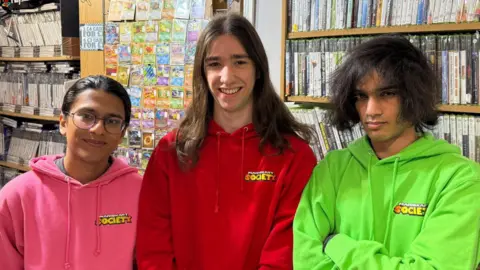
A successor has been in the works for years – so perhaps unsurprisingly Tushar Sandarka, the President of the University of York’s Mario Kart society, is among those excited about the launch, and the new version of Mario coming with it.

“It’s coming out with Mario Kart World – which is the first since 2014 – it’s a big deal for us,” the 19-year-old said.

“Securing a pre-order was such a tough decision because it’s so expensive.

“Even if it’s a bit higher than I would have wanted to pay for it, it’s going to serve me well for the next 7 or 8 years.”

Three people in a vintage gaming shop with Pokemon cards and physical video games on shelves behind them. Tushar is on the left with long hair in a ponytail. He’s wearing glasses and smiling, wearing a bright pink “Mario Kart Society” hoodie. Edward is smiling too. He has long hair and wears a red hoodie. Hasan is in a green hoodie and has long ruffled hair. He has a serious look with his arms folded.

But not everyone the BBC spoke to said they would be picking up the console on launch.

Mae and Lottie, both students in York, said they would stick to the original Switch because of the cost.

“It’s quite spenny,” Mae said. “What we’ve got is fine.”

Lottie agreed, but said she was disappointed not to play on the new Mario Kart game – which she said could cost her as much as “a day’s pay”.

“I’m not spending that on a game,” she said.

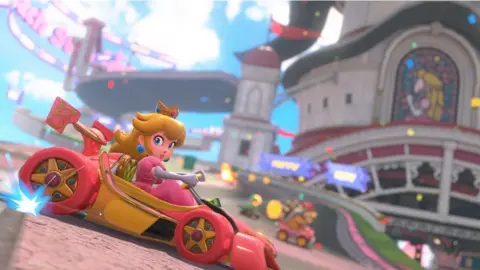
Nintendo Super Mario character Peach driving a pink F1 style racing car. In the background is her iconic castle building from Super Mario 64.Nintendo

For Nintendo, the Switch 2 represents a change in strategy – in the past its new devices have been given an entirely new name.

“This is the first time Nintendo has ever launched a straight sequel,” GamesRadar+ brand director Sam Loveridge told the BBC.

“It’s a clear proposition for consumers – they know exactly what they’re getting from this console if they are familiar with the original Switch.”

She said “everything is pointing to” pre-orders having sold well.

“When pre-orders first went live, it was an absolute scramble to find any stock, but Nintendo was clearly prepared and since those early weeks, it’s been a lot easier to secure yourself a console for launch day,” she said.

A solid release line-up

I was one of the lucky few to get my hands on the Switch 2 at an event in April.

Like its predecessor, it is a “hybrid” console – a handheld device which can also be plugged into a TV to play on the big screen.

But it has a bigger and brighter screen, along with lots more power and storage.

It still has a bit of innovation – you can use the controller like a computer mouse by twisting it on its side, making PC games such as Civilization VII a more enjoyable experience than using joysticks.

But many of the showcase Nintendo games on display at that event – including Metroid Prime 4, Donkey Kong: Bananza, and Super Mario Party Jamboree TV – won’t be available at launch.

Instead the only new Nintendo game on the new console will be Mario Kart World, barring a small title called Welcome Tour which showcases some of the new hardware.

“It might seem like an odd bet, but with the original Mario Kart 8 being the best-selling Wii U game and Mario Kart 8 Deluxe being the best-selling Nintendo Switch game, there’s a very established audience there,” Ms Loveridge said.

The gaming giant is also releasing on day one upgraded versions of the Switch’s Legend of Zelda games, Breath of the Wild and Tears of the Kingdom, which take advantage of the console’s greater power.

Beyond that, gamers will have to look to third-party games for alternatives on launch.

The range of games includes Rune Factory: Guardians of Azuma, Cyberpunk 2077, and Bravely Default.

Marvelous An anime character stands in a farm. Surrounding them are crops of turnips. Behind is an old Japanese-style building, a sleeping cow and a person. There are trees and cherry blossoms. It is all animated in a Japanese style with bright vibrant colours.Marvelous

“This more powerful console offers plenty of opportunities for third-party games publishers bringing Nintendo into more direct competition with Sony and Microsoft,” said Katie Holt, senior games industry research analyst at Ampere Analysis .

And fans can expect more from third-party games as the console develops too – with Nintendo senior director Takuhiro Dohta telling me he expected games to get even better.

“When there are software titles set for the launch of the hardware, the developers still don’t fully know the capabilities and hardware well enough,” he said.

“As developers continue to develop, they start to understand how it works and what it’s capable of, so I think we can expect improvements not only in graphics but in gameplay too.”

A green promotional banner with black squares and rectangles forming pixels, moving in from the right. The text says: “Tech Decoded: The world’s biggest tech news in your inbox every Monday.”
Posted on

TikTok blocks searches for extreme thinness ‘skinnytok’ hashtag

TikTok is preventing users searching for “skinnytok” – a hashtag which critics say directs people towards content which “idolises extreme thinness.”

Content associated with the hashtag includes videos showing people’s work-out routines or what they eat in a day.

TikTok said it had “blocked search results for #skinnytok since it has become linked to unhealthy weight loss content.”

People using the hashtag will now be redirected to mental health support resources instead.

Tom Quinn, from the eating disorder charity, Beat, welcomed the move saying “skinnytok” and related content could have “devastating” impacts on “struggling” people.

However, he stressed there was more to do.

“We know that users will very often find workarounds to content blocks and there will still be damaging content which isn’t shared under the “skinnytok” umbrella, which TikTok and other social media platforms must now address,” he told BBC News.

According to the US-based National Alliance for Eating Disorders, the skinnytok hashtag has more than half a million posts associated with it.

It says the hashtag includes content such as low-calorie recipes which on the face of it appear to promote healthy lifestyle advice.

But the organisation says, in reality, it “glorifies thinness and vilifies weight gain” and “promotes disordered eating behaviours.”

The trend has caused particular alarm in France, where experts have warned of how social media can push vulnerable young people towards developing eating disorders.

“The patients are completely indoctrinated — and my 45-minute weekly consultation is no match for spending hours every day on TikTok,” the nutritionist Carole Copti told the AFP news agency.

The blocking of the hashtag has been celebrated by France’s digital minister, who wrote on social media that “skinnytok is over” thanks to lobbying by European politicians.

In its statement, TikTok said it regularly reviewed its safety measures to “address evolving risks”.

“We continue to restrict videos from teen accounts and provide health experts and information in TikTok Search,” it added.

It is not the first time TikTok has been forced to take action over content which raised body image concerns.

In March, it blocked so-called “chubby filters” – a viral tool which made people appear overweight.

Posted on

Government AI copyright plan suffers fourth House of Lords defeat

Zoe Kleinman

Technology editor@zsk

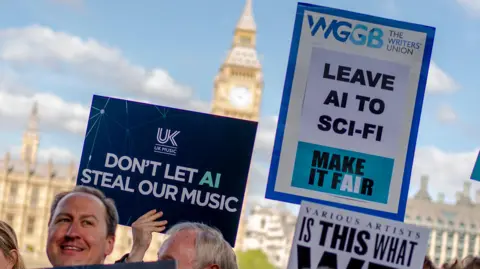
PA Media Creatives in the music industry protest outside UK Parliament. A dark blue placard from trade association UK Music reads: "Don't let AI steal our music". Another beside it, from The Writer's Union, says: "Leave AI to sci-fi". PA Media

The House of Lords has dealt a fourth defeat to the government over its plans to allow tech companies to use copyrighted material to train their models.

The Lords, who are looking for more protections for artists from AI, rejected the latest amendment to the Data (Use and Access) Bill on Monday.

Peers backed calls for greater transparency after musicians such as Sir Elton John warned of the threat to creative industries.

It will now be returned to the Commons where it could be discussed as soon as Tuesday – though that has not been confirmed.

Defiant peers again voted 242 to 116 to a change to the legislation that would introduce transparency requirements, aimed at ensuring copyright holders are able to see when their work has been used and by whom.

This is despite similar measures being repeatedly rejected by MPs in the Commons, where the Government has a majority.

It’s highly unusual that neither side has backed down by now or shown any sign of compromise; in fact if anything support for those opposing the government is growing rather than tailing off.

This is “uncharted territory”, one source in the peers’ camp told me.

The argument is over how best to balance the demands of two huge industries: the tech and creative sectors.

More specifically, it’s about the fairest way to allow AI developers access to creative content in order to make better AI tools – without undermining the livelihoods of the people who make that content in the first place.

What’s sparked it is the Data (Use and Access) Bill.

This proposed legislation was broadly expected to finish its long journey through parliament this week and sail off into the law books.

Instead, it is currently stuck in limbo, ping-ponging between the House of Lords and the House of Commons.

A government consultation proposes AI developers should have access to all content unless its individual owners choose to opt out.

But 242 members of the House of Lords disagree with the bill in its current form.

They think AI firms should be forced to disclose which copyrighted material they use to train their tools, with a view to licensing it.

Sir Nick Clegg, former president of global affairs at Meta, is among those broadly in support of the government’s plans on AI and copyright. He has argued that asking permission from all copyright holders would “kill the AI industry in this country”.

Those against include Baroness Beeban Kidron, a crossbench peer and former film director, best known for making films such as Bridget Jones: The Edge of Reason.

She says ministers would be “knowingly throwing UK designers, artists, authors, musicians, media and nascent AI companies under the bus” if they don’t move to protect their output from what she describes as “state sanctioned theft” from a UK industry worth £124bn.

She’s asking for an amendment to the bill which would include Technology Secretary Peter Kyle giving a report to the House of Commons about the impact of the new law on the creative industries within 15 months of the Bill becoming law.

Getty Images Baroness Beeban Kidron, wearing a black and white patterned shirt, is shown speaking at a discussion about AI and copyright in April.Getty Images

Mr Kyle also appears to have changed his views about UK copyright law.

He said copyright law was once “very certain”, but is now “not fit for purpose”.

Perhaps to an extent both those things are true.

The Department for Science, Innovation and Technology say that they’re carrying out a wider consultation on these issues and will not consider changes to the Bill unless they’re completely satisfied that they work for creators.

If the “ping pong” between the two Houses continues, there’s a small chance the entire bill could be shelved; I’m told it’s unlikely but not impossible.

If it does, some other important elements would go along with it, simply because they are part of the same bill.

It also includes proposed rules on the rights of bereaved parents to access their children’s data if they die, changes to allow NHS trusts to share patient data more easily, and even a 3D underground map of the UK’s pipes and cables, aimed at improving the efficiency of roadworks (I told you it was a big bill).

There is no easy answer.

How did we get here?

Here’s how it all started.

Initially, before AI exploded into our lives, AI developers scraped enormous quantities of content from the internet, arguing that it was in the public domain already and therefore freely available.

We are talking about big, mainly US, tech firms here doing the scraping, and not paying for anything they hoovered up.

Then, they used that data to train the same AI tools now used by millions to write copy, create pictures and videos in seconds.

These tools can also mimic popular musicians, writers, artists.

For example, a recent viral trend saw people merrily sharing AI images generated in the style of the Japanese animation firm Studio Ghibli.

The founder of that studio meanwhile, had once described the use of AI in animation as “an insult to life itself”. Needless to say, he was not a fan.

There has been a massive backlash from many content creators and owners including household names like Sir Elton John, Sir Paul McCartney and Dua Lipa.

They have argued that taking their work in this way, without consent, credit or payment, amounted to theft. And that artists are now losing work because AI tools can churn out similar content freely and quickly instead.

Sir Elton John didn’t hold back in a recent interview with the BBC’s Laura Kuenssberg.

He argued that the government was on course to “rob young people of their legacy and their income”, and described the current administration as “absolute losers”.

Others though point out that material made by the likes of Sir Elton is available worldwide.

And if you make it too hard for AI companies to access it in the UK they’ll simply do it elsewhere instead, taking much needed investment and job opportunities with them.

Two opposing positions, no obvious compromise.

A green promotional banner with black squares and rectangles forming pixels, moving in from the right. The text says: “Tech Decoded: The world’s biggest tech news in your inbox every Monday.”
Posted on

This cheap projector has a gimbal stand and smart auto adjustments so it’s easy to stream Netflix and Prime Video anywhere

The Dangbei N2 mini is available now, priced at $179 / £159 )about AU$330) 1080p, 200 ISO Lumens, up to 120-inch display ‘AI’ auto picture adustments, 190º tilt for easy projection anywhere Dangbei’s new entry level LED projector, the Dangbei N2 mini, delivers 1080p HD and has native apps for Netflix, YouTube and Prime Video – plus a built-in gimbal and automatic picture adjustment tech (with the obligatory claim of ‘AI’ powers) that should make it easy to place it anywhere and get a well-aligned display. It’s also very keenly priced, with an introductory offer of $179 / £159 (about AU$330). That’s roughly 20% off the normal list price, and it’s less than half what you’d pay for our current best portable projector pick, the XGIMI MoGo 3 Pro. (Image credit: Dangbei) Dangbei N2 mini: key features The most obvious difference between the N2 mini and more expensive models is brightness: where the XGIMI is 450 ISO Lumens, the N2 mini is rated at 200 ISO Lumens, so this isn’t one for brightly lit spaces. But it’s exceptionally portable, weighing just 3.78 lb (1.72 kg), and it comes with a host of automatic features for easy setup and operation. There’s also a 6W speaker system with Dolby Audio support. You may like The recommended display size is 100 inches, but the N2 mini is capable of projecting from 40 to 120 inches. The integrated gimbal enables smooth and accurate positioning on floors, walls or ceilings and the power port is base-mounted to avoid interference. The optical system is sealed to keep dust out, which Dangbei says delivers 30% longer life – although it doesn’t say what that lifespan actually is. Bluetooth is 5.2 and the N2 mini has Wi-Fi 6. The N2 mini has nearly 300 apps to choose from, and the pre-installed Netflix, Prime Video and YouTube apps are all given their own buttons on the remote. The Dangbei N2 mini is available now. Sign up for breaking news, reviews, opinion, top tech deals, and more. You might also like