BOE,
a
consumer
electronics
maker
that
is
also
one
of
the
world’s
biggest
display
manufacturers
from
China,
has
released
a
new
OLED
prototype
that
can
show
95%
of
the
Rec.2020
(also
known
as
BT.2020)
color
gamut,
which
is
better
than
LG
and
Samsung
OLED
displays.
According
to
OLED-Info,
the
new
prototype,
which
is
currently
intended
for
phones,
tablets
and
laptops,
was
shown
off
at
the
company’s
Innovation
Partner
Conference
on
September
4.
As
you
can
see
from
the
below
post
on
X
(formerly
Twitter),
the
new
OLED
tech
improves
the
accuracy
and
richness
of
the
colors
displayed
significantly.
BOE
shows
its
first
TADF
OLED
prototype,
with
a
green
hyperfluorescence
emitter
system
and
a
tandem
architecture:https://t.co/6F9KLKlYN7#OLED
pic.twitter.com/zlac760zDISeptember
5,
2024
To
give
some
numbers
(like
FlatpanelsHD
first
pointed
out),
LG’s
W-OLED,
found
in
TVs
like
the
LG
B4,
shows
about
70%
of
the
Rec.2020
color
gamut.
Meanwhile,
Samsung’s
AMOLED
tech,
found
in
some
of
its
smartphones
such
as
the
Samsung
Galaxy
S24
Ultra,
displays
roughly
70-80%
and
its
QD-OLED
tech
shows
up
to
90%,
which
we
found
to
be
the
case
when
we
tested
one
of
its
best
TVs,
the
Samsung
S95D
–
it
achieved
a
result
of
87.9%.
At
the
time
of
writing,
BOE’s
OLED
screens
can
be
found
in
some
of
the
best
phones
on
the
market,
such
as
the
Honor
Magic
V3,
which
uses
BOE’s
f-OLED
(flexible
folding
display
screen)
tech.
There
is
currently
no
word
as
to
whether
this
new
OLED
prototype
will
come
to
TVs,
but
BOE
is
also
a
TV
display
manufacturer,
covering
sizes
from
26-
to
110-inches
including
8K
Super
IPS-ADS
technology,
so
hopefully
it
may
look
to
expand
this
new
tech
into
its
larger
display
screens.
More
colorful
TVs?
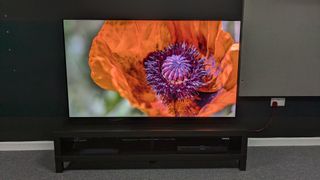
The
Samsung
S95D
(pictured)
currently
hits
the
highest
Rec.2020
color
gamut
coverage
we’ve
measured.
(Image
credit:
Future)
The
Rec.2020
color
space,
which
we
refer
to
as
BT.2020
in
our
TV
reviews,
is
said
to
show
more
color
visible
to
the
human
eye
than
both
the
older
Rec.709
and
DCI-P3
color
spaces,
which
we
refer
to
as
UHDA-P3
in
our
TV
testing
–
the
latter
is
used
in
the
movie
industry.
In
general,
most
TVs
display
below
75%
of
the
Rec.2020
color
space.
For
instance,
some
of
the
best
OLED
TVs
such
as
the
LG
C4
hit
72.7%
in
our
tests.
Even
budget
mini-LED
TVs
like
the
the
Hisense
U6N
hit
73.1%,
while
8K
TVs
such
as
the
Samsung
QN900D
hit
lower
than
75%,
with
the
QN900D
tapping
out
at
70.5%.
The
Samsung
S95D,
which
uses
QD-OLED
technology,
hits
over
87%
as
we’ve
stated
above
and
this
is
just
one
contributing
factor
to
why
it
earned
five
stars
out
of
five
in
our
review,
with
its
bold,
vibrant
colors
being
one
of
its
highlights.
It
proves
that
good
color
gamut
coverage
can
add
an
extra
layer
to
a
TV.
Although
BOE
hasn’t
said
whether
its
95%
Rec.2020
OLED
displays
are
coming
to
TVs,
we’re
hoping
it
will.
OLED
is
already
the
arguably
most
popular
TV
panel
tech
available
and
the
possibility
of
adding
even
more
color
into
its
already
dynamic
picture
is
only
good
news.
At
the
very
least,
BOE’s
colorful
displays
could
encourage
LG
and
Samsung
to
improve
on
its
own
OLED
tech,
although
QD-OLED
is
close
already.
Hopefully,
we
may
see
the
likes
of
more
entry-level
OLEDs
like
the
LG
B4
displaying
even
more
vivid
colors.
There’s
nothing
wrong
with
a
bit
of
healthy
competition.