Posted on

Tesla robotaxi ‘low-key’ launch in Texas

Tesla’s long-awaited robotaxis rolled out for the first time on roads in Austin, Texas on Sunday.

In videos shared by Tesla on X, a small group of invited analysts, influencers and shareholders were shown participating in paid rides.

The small number of vehicles deployed had a human safety operator in the passenger seat, according to reports.

Analysts said the “low-key” robotaxi launch highlights Tesla’s big bid to compete with existing self-driving taxi operators in the US and China, as the sector grows.

Musk congratulated Tesla’s artificial intelligence and chip design teams on the launch in a post on X, writing that it was “culmination of a decade of hard work”.

“Both the AI chip and software teams were built from scratch within Tesla,” he added.

Ahead of Sunday’s pilot, he said in a jokey post that customers would pay “a $4.20 flat fee” for rides in Tesla robotaxis.

The small fleet of vehicles do not yet include the Cybercab – the futuristic car concept unveiled by Musk at Tesla’s “We, Robot” event in October – which Musk says will be the company’s driverless taxi in the future.

Instead it was existing Tesla vehicles, with a small “robotaxi” logo on the side, that took to Austin streets on Sunday.

Forrester analyst Paul Miller described the launch of the pilot as a “low-key affair”.

“As expected, only a handful of vehicles are available right now, they only operate in a small part of the city and there’s a safety driver in the vehicle in case it encounters situations it cannot handle autonomously,” he said.

But he added that the move highlighted the company’s ambitions to rival firms already offering driverless ride-hailing in the US and around the world.

Waymo, owned by Google parent Alphabet, along with Amazon’s Zoox, already offer self-driving taxi rides in Austin, as well as in San Francisco, California, and Phoenix, Arizona.

Meanwhile Uber, which recently announced it would bring forward trials of driverless taxis in the UK, has partnered with Chinese firms Pony.AI, WeRide and Momenta to bring autonomous ride-hailing to more cities outside the US and China.

Mr Miller said Tesla is betting that the volume of cars it delivers, data it has from vehicles and cheaper, camera-based self-driving tech “will allow it to come from behind and pull ahead” of rivals.

But he added that its ability to compete, particularly with Chinese firms dominating the sector, will depend on improvement of its advanced assisted driving system – which Tesla calls Full Self-Driving (FSD).

FSD has been subject to probes by US auto regulators and complaints from customers about its safety.

“If that FSD system isn’t a big leap forward from the driver assistance tech that buyers of regular Teslas already use in some countries, it’s going to need a lot of remote monitoring and control from an army of teleoperating safety drivers,” Mr Miller said.

“This will add to Tesla’s costs, and offer plenty of opportunities for embarrassing videos of Tesla robotaxis doing weird things.”

It comes as a number of operators eye the growing market for driverless taxis.

German car maker Volkswagen believes it could swell to €450bn in size by 2035, according to a recent report by Fortune magazine.

But the rise of self-driving cars and ride-hailing services on US roads has also been met with some scepticism over their safety.

Tesla said in a post on its X account on Monday that its robotaxi service “will greatly increase safety for vulnerable road users, such as pedestrians & cyclists”.

The US National Highway Traffic Safety Administration is reportedly reviewing information from Tesla regarding the safety of its self-driving taxis in bad weather, following a request in May.

General Motors pulled the plug on its Cruise robotaxi project in December after accidents involving its self-driving vehicles.

The company also cited the increasingly competitive market as a reason for suspending its ride-hailing initiative.


Posted on

BBC threatens AI firm with legal action over unauthorised content use

Liv McMahon

Technology reporter

Getty Images A silhoutted figure is shown holding their smartphone and looking at it in front of a white background displaying the Perplexity logo.Getty Images

The BBC is threatening to take legal action against an artificial intelligence (AI) firm whose chatbot the corporation says is reproducing BBC content “verbatim” without its permission.

The BBC has written to Perplexity, which is based in the US, demanding it immediately stops using BBC content, deletes any it holds, and proposes financial compensation for the material it has already used.

It is the first time that the BBC – one of the world’s largest news organisations – has taken such action against an AI company.

In a statement, Perplexity said: “The BBC’s claims are just one more part of the overwhelming evidence that the BBC will do anything to preserve Google’s illegal monopoly.”

It did not explain what it believed the relevance of Google was to the BBC’s position, or offer any further comment.

The BBC’s legal threat has been made in a letter to Perplexity’s boss Aravind Srinivas.

“This constitutes copyright infringement in the UK and breach of the BBC’s terms of use,” the letter says.

The BBC also cited its research published earlier this year that found four popular AI chatbots – including Perplexity AI – were inaccurately summarising news stories, including some BBC content.

Pointing to findings of significant issues with representation of BBC content in some Perplexity AI responses analysed, it said such output fell short of BBC Editorial Guidelines around the provision of impartial and accurate news.

“It is therefore highly damaging to the BBC, injuring the BBC’s reputation with audiences – including UK licence fee payers who fund the BBC – and undermining their trust in the BBC,” it added.

Web scraping scrutiny

Chatbots and image generators that can generate content response to simple text or voice prompts in seconds have swelled in popularity since OpenAI launched ChatGPT in late 2022.

But their rapid growth and improving capabilities has prompted questions about their use of existing material without permission.

Much of the material used to develop generative AI models has been pulled from a massive range of web sources using bots and crawlers, which automatically extract site data.

The rise in this activity, known as web scraping, recently prompted British media publishers to join calls by creatives for the UK government to uphold protections around copyrighted content.

In response to the BBC’s letter, the Professional Publishers Association (PPA) – which represents over 300 media brands – said it was “deeply concerned that AI platforms are currently failing to uphold UK copyright law.”

It said bots were being used to “illegally scrape publishers’ content to train their models without permission or payment.”

It added: “This practice directly threatens the UK’s £4.4 billion publishing industry and the 55,000 people it employs.”

Many organisations, including the BBC, use a file called “robots.txt” in their website code to try to block bots and automated tools from extracting data en masse for AI.

It instructs bots and web crawlers to not access certain pages and material, where present.

But compliance with the directive remains voluntary and, according to some reports, bots do not always respect it.

The BBC said in its letter that while it disallowed two of Perplexity’s crawlers, the company “is clearly not respecting robots.txt”.

Mr Srinivas denied accusations that its crawlers ignored robots.txt instructions in an interview with Fast Company last June.

Perplexity also says that because it does not build foundation models, it does not use website content for AI model pre-training.

‘Answer engine’

The company’s AI chatbot has become a popular destination for people looking for answers to common or complex questions, describing itself as an “answer engine”.

It says on its website that it does this by “searching the web, identifying trusted sources and synthesising information into clear, up-to-date responses”.

It also advises users to double check responses for accuracy – a common caveat accompanying AI chatbots, which can be known to state false information in a matter of fact, convincing way.

In January Apple suspended an AI feature that generated false headlines for BBC News app notifications when summarising groups of them for iPhones users, following BBC complaints.

A green promotional banner with black squares and rectangles forming pixels, moving in from the right. The text says: “Tech Decoded: The world’s biggest tech news in your inbox every Monday.”
Posted on

Trump confirms further delay to TikTok ban or sale deadline

President Donald Trump has extended the deadline for TikTok’s sale in the US for a further 90 days.

The video-sharing app has faced questions over its future after the US passed a law last year requiring the app to be banned unless sold by its Chinese parent company, ByteDance.

Lawmakers said it posed a risk to national security – something TikTok denies.

Trump, who vowed to save TikTok during his presidential campaign, signed an executive order on Thursday which has delayed the date for enforcing the law for a third time.

In a statement, TikTok said it was “grateful for President Trump’s leadership and support” in keeping the app online for its 170m US users.

“We continue to work with Vice President Vance’s Office,” it added.

A deal for the sale of TikTok in the US by ByteDance must now be reached by 17 September, Trump said in a post on his platform Truth Social.

The further delay was an expected development in the long-running process of securing a buyer for TikTok.

It is thought the authorities in Beijing will need to approve any sale or part sale of the app by its parent company.

The law was prompted by fears in the US that TikTok or ByteDance could be forced to hand over data on US users by the Chinese government.

Trump said on Tuesday he expected there would be a further delay.

White House press secretary Karoline Leavitt said on Wednesday that a further 90-day extension would “ensure this deal is closed so that the American people can continue to use TikTok with the assurance that their data is safe and secure.”

Trump tried to force a sale of TikTok to an American buyer in 2020, during his first term in office.

But last year, he signalled he’d had a change of heart, saying the platform had helped him win the 2024 presidential election.

“I have a warm spot in my heart for TikTok, because I won youth by 34 points,” Trump said in December, although most young voters backed the Democratic candidate Kamala Harris.

The law was supposed to take effect on 19 January, a day before Trump’s inauguration to a second term in office.

TikTok challenged its constitutionality in the courts. The Supreme Court upheld the law days before it was due to take effect.

Senate Select Committee on Intelligence Vice Chairman Mark Warner, a Democrat, criticized Trump’s decision.

“Once again, the Trump administration is flouting the law and ignoring its own national security findings about the risks posed by a PRC-controlled TikTok,” Warner said in a statement.

“An executive order can’t sidestep the law, but that’s exactly what the president is trying to do,” Warner added.

Posted on

OpenAI boss: Meta offering $100m plus to poach my staff

Imran Rahman-Jones

Technology reporter

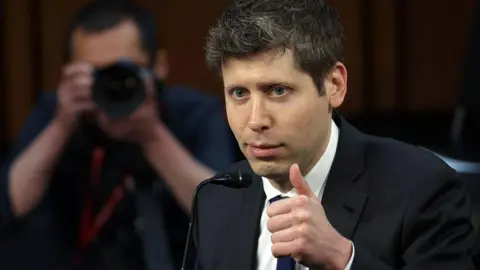
Getty Images Sam Altman wearing a dark suit and tie, giving a thumbs upGetty Images

The boss of OpenAI, Sam Altman, says members of his team have been getting “giant offers” from rival tech firm Meta, including $100m (£74.3m) “signing bonuses.”

Meta – which owns Facebook, Instagram and WhatsApp – is attempting to boost the artificial intelligence (AI) side of its business, including recently spending $14bn (£10.4bn) to buy 49% of the startup, Scale AI.

However Mr Altman said “at least so far” none of his “best people” had been persuaded to jump ship.

BBC News has contacted Meta for a response.

Indranil Bandyopadhyay, principal analyst at Forrester, said the figures reflected the belief within the tech industry that “a handful of elite researchers and engineers can provide a decisive competitive advantage.”

With investment in AI running at extraordinary levels talent acquisition is a “high-risk, high-reward gamble,” he told the BBC.

“Whether this intense level of investment is sustainable remains to be seen, but for now, the AI gold rush continues at a breakneck pace, with talent as its most precious and fiercely contested resource.”

Culture versus compensation

Speaking on his brother Jack’s podcast, Sam Altman said he respected Meta’s aggression in competing with OpenAI, which makes the world’s best known AI-powered product, ChatGPT.

He said in addition to the signing bonuses, Meta was offering more than that in “compensation per year”, though did not spell out whether that was in wages or stock options and other incentives.

But Mr Altman said he thought people were staying at OpenAI because of its “really special culture” and “mission” of creating superintelligence and the “economic awards and everything else flowing from that”.

OpenAI and other AI firms think artificial general intelligence (AGI) is not far off, which would mean AI systems can perform as well as – or better than – humans.

Superintelligence is the next step, where the aim is to create AI which can vastly outperform human cognitive abilities.

“There’s many things I respect about Meta as a company, but I don’t think they’re a company that’s, like, great at innovation,” Mr Altman told his brother.

Big tech firms are spending vast amounts of money researching and developing AI.

For example, in January OpenAI announced a joint deal with other funders to spend $500bn on a number of new data centres – which power AI – in the US.

The amount of money being spent on AI “reflects a belief… that we’re at the dawn of a transformative shift that will reshape almost every business sector,” Edward Keelan, partner at Octopus Ventures, a venture capital fund based in the UK, said.

“The very top talent has the potential to define the future of AI models and infrastructure, and can attract extraordinary offers as a result,” he added.

Tech bros and their barbs

Sam Altman’s comments are just the latest example of the leading figures in tech offering opinions on what their rivals are doing, with podcasts being a popular medium for these sometimes unflattering appraisals.

On Joe Rogan’s podcast in January, Meta founder Mark Zuckerberg praised Apple’s iPhone as “obviously one of the most important inventions probably of all time.”

But he added the company had recently “been so off their game in terms of not really releasing many innovative things.”

However, that put down is as nothing compared to Mr Zuckerberg’s stormy relationship with fellow tech titan Elon Musk, with the pair threatening to fight each other in a cage.

Musk is also currently involved in a legal battle with Sam Altman over the founding of OpenAI.

Posted on

Amazon boss says AI will replace jobs at tech giant

Amazon boss Andy Jassy has told staff to embrace artificial intelligence (AI) and warned the technology will lead to a smaller corporate workforce in the next few years.

He shared the prediction in a memo to staff on Tuesday, which urged employees to “be curious about AI”.

The tech giant is the latest firm to set out its plans for using AI amid concerns the technology will lead to rapid job losses across the world.

Mr Jassy said he expected AI to lead to “efficiency gains” that would allow the firm to reduce its corporate workforce.

“We will need fewer people doing some of the jobs that are being done today, and more people doing other types of jobs,” he wrote.

“It’s hard to know exactly where this nets out over time, but in the next few years, we expect that this will reduce our total corporate workforce as we get efficiency gains from using AI extensively across the company.”

Companies, especially in the tech sector, have been investing heavily in AI in recent years, spurred on by technological advances that have made it easier than ever for chatbots to create code, images and text with limited instruction.

But as the new tools gain traction, they have sparked warnings from some tech leaders of job losses, especially in entry-level office roles.

Dario Amodei, chief executive of AI-firm Anthropic, told news website Axios last month that the technology could wipe out half of entry-level white collar jobs.

Geoffrey Hinton, whose work on AI, including at Google, has earned him the moniker “Godfather of AI”, echoed those warnings on a recent podcast.

“This is a very different kind of technology,” he said, pushing back against arguments that job losses from AI will be outweighed as the technology creates new kinds of positions, in a pattern seen with earlier technological leaps.

“If it can do all mundane human intellectual labor, then what new jobs is it going to create? You’d have to be very skilled to have a job that it couldn’t just do.”

Amazon directly employed more than 1.5 million people around the world at the end of last year.

The majority of those staff are in the US, where it ranks as the country’s second-largest employer after Walmart.

While many staff the firm’s e-commerce warehouses, about 350,000 people also serve the company in office roles.

In his memo, Mr Jassy said Amazon was using AI in “virtually every corner of the company” and he expected the technology to eventually perform routine tasks, such as shopping and daily chores.

“Many of these agents have yet to be built, but make no mistake, they’re coming and coming fast,” he wrote, saying staff who embraced such changes would be “well-positioned” at the company.

He said half a million of the sellers on its platforms were already using the company’s AI tools to create information about their products, while advertisers were also adopting its AI offerings.

Posted on

WhatsApp to start showing more adverts in messaging app

WhatsApp is launching three new ad features in a global roll-out across the messaging app.

The Meta-owned platform says the new ads will not be shown in the same place as people’s private chats, nor will the contents of their messages – which are encrypted – be used to decide which ads to display.

WhatsApp will instead use the country, city and language of the user, as well as how they interact with other ads and which channels they follow, to drive suggested content.

But people who have chosen to link their WhatsApp account to Facebook or Instagram will see more personalised ads.

The new ad features will appear in a section called Updates, which is a separate tab at the bottom of the app.

WhatsApp claims to have 1.5 billion users globally.

Businesses with channels will be able to choose to promote ads in the Updates section to attract new followers, and also charge a subscription to access extra content.

WhatsApp will eventually take a 10% commission of that fee, and there may also be extra costs on top of that taken at the app store level depending on the size of the business.

Firms will also be able to advertise in the form of a status update, which looks similar to an Instagram story and will link through to start a chat if clicked on.

Social media expert Matt Navarra told the BBC that Meta is “laying the foundation for WhatsApp to finally become a monetisable platform at scale”.

But “monetising the periphery” of WhatsApp, while keeping personal chats private, would not be without risk for the company, he added.

This could particularly be the case in markets like the UK and Europe, he said, where the app is viewed primarily as a messaging tool with less appetite for content feeds or adverts.

“Any perception that the app is becoming noisy or Facebook-ified will spark backlash,” he said.

It’s no coincidence that the new features bring WhatsApp more in line with Meta’s other platforms Facebook and Instagram.

“Obviously there’s overlap,” said WhatsApp boss Will Cathcart.

“We have stories on Instagram and stories on WhatsApp, and we now have a way for businesses to promote themselves in both, and we think that’s a good thing.”

He said he believed the move was a “natural extension of messaging services” and not dissimilar to features of rival apps such as Snapchat and Telegram.

For Mr Navarra, it also reflects a wider shift in the social media landscape.

“The feed is dying, public sharing is down, people are retreating into DMs and Stories in small groups,” he said.

“Meta’s trying to turn WhatsApp into a platform without users realising it and if they move too fast or it starts to feel like another ad network, people might disengage or maybe worse, distrust the app.”

WhatsApp angered users recently with the introduction of a permanent button for Meta’s AI tool, which cannot be deactivated or deleted, and Mr Cathcart said users who did not want to see ads or follow channels would not be forced to.

“I want to stress this won’t affect your inbox,” he said.

“If you’re only using WhatsApp for messaging, you’re not going to see this.”

He said the Update section of the app was “not particularly popular” in the UK but was used more in other parts of the world, and the firm would “look at the feedback” about the unremovable AI tool – but there were many other features of the app which were also permanent.

“You can’t delete the channels button, you can’t delete the Updates button, you can’t delete the calls button,” he said.

“I mean, we also don’t want to have a service that has lots of settings… that’s complexity too.”

Posted on

Meta AI searches made public – but do all its users realise?

How would you feel if your internet search history was put online for others to see?

That may be happening to some users of Meta AI without them realising, as people’s prompts to the artificial intelligence tool – and the results – are posted on a public feed.

One internet safety expert said it was “a huge user experience and security problem” as some posts are easily traceable to social media accounts.

This means some people may be unwittingly telling the world about their searches – such as asking the AI to generate scantily-clad characters or help them cheat on tests.

Meta says chats are private by default, and if users make a post public they can choose to withdraw it later.

Before a post is shared, a message pops up which says: “Prompts you post are public and visible to everyone… Avoid sharing personal or sensitive information.”

However – given the private nature of some of the queries – it is not clear if the users understand their searches are being posted into a public “Discover” feed on the Meta AI app and website, and that these could be traced to their other social accounts through usernames and profile pictures.

The BBC found several examples of people uploading photos of school or university test questions, and asking Meta AI for answers.

One of the chats is titled “Generative AI tackles math problems with ease”.

Another user’s conversation which was posted publicly was about them exploring questions around their gender and whether they should transition.

There were also searches for women and anthropomorphic animal characters wearing very little clothing.

One search, which could be traced back to a person’s Instagram account because of their username and profile picture, asked Meta AI to generate an image of an animated character lying outside wearing only underwear.

Meta AI, launched earlier this year, can be accessed through its social media platforms Facebook, Instagram and Whatsapp.

It is also available as a standalone product which has a public “Discover” feed.

Users can opt to make their searches private in their account settings.

Meta AI is currently available in the UK through a browser, while in the US it can be used through an app.

In a press release from April which announced Meta AI, the company said there would be “a Discover feed, a place to share and explore how others are using AI”.

“You’re in control: nothing is shared to your feed unless you choose to post it,” it said.

But Rachel Tobac, chief executive of US cyber security company Social Proof Security, posted on X saying: “If a user’s expectations about how a tool functions don’t match reality, you’ve got yourself a huge user experience and security problem.”

She added that people do not expect their AI chatbot interactions to be made public on a feed normally associated with social media.

“Because of this, users are inadvertently posting sensitive info to a public feed with their identity linked,” she said.

Posted on

Data bill opposed by Sir Elton John and Dua Lipa finally passes

A bill which sparked an extraordinary stand-off between some of the UK’s most high-profile artists – and their backers in the House of Lords – has finally been passed.

Peers wanted an amendment to the drably-titled Data (Use and Access) Bill which would have forced tech companies to declare their use of copyright material when training AI tools.

Without it, they argued, tech firms would be given free rein to help themselves to UK content without paying for it, and then train their AI products to mimic it, putting human artists out of work.

That would be “committing theft, thievery on a high scale”, Sir Elton John told the BBC.

He was one of a number of household names from the UK creative industries, including Sir Paul McCartney and Dua Lipa to oppose the government.

The government refused the amendment. It says it is already carrying out a separate consultation around copyright and it wants to wait for the outcome of that.

In addition there are plans for a separate AI bill. Critics of the peers’ proposal say it would stifle the AI industry and result in the UK getting left behind in this lucrative and booming sector.

So, this left the bill in limbo, pingponging between the Houses of Commons and Lords for a month.

But it has now finally been passed, without the amendment, and will become law once royal assent is given.

“We can only do so much here. I believe we’ve done it. It’s up to the government and the other place (the Commons) now to listen,” said composer and broadcaster Lord Berkeley.

The government has welcomed the wide-ranging bill passing.

“This Bill is about using data to grow the economy and improve people’s lives, from health to infrastructure and we can now get on with the job of doing that”, a Department for Science, Innovation and Technology (DSIT) spokesperson said.

Caught in the crossfire of this row were other useful proposals contained within the bill, including:

  • New rules on the rights of bereaved parents to access their children’s data if they die
  • Changes to allow NHS trusts to share patient data more easily
  • A 3D underground map of the UK’s pipes and cables, aimed at improving the efficiency of roadworks by minimising the possibility of them being accidentally dug up.

“So this is good news for NHS workers and the police who will be freed from over a million hours of time spent doing admin, bereaved parents who will be supported to get the answers they deserve, and people who will be kept safer online thanks to new offences for deepfake abuse,” DSIT said.

But even though the Lords have decided they had made their point on AI, the argument has not gone away.

Those who fought the battle have not changed their minds. Baroness Kidron, a film maker who led the charge for the amendment, told me the passing of the bill was “a pyrrhic victory at best” for the government, meaning it would lose more than it gains.

That cost, she argues, is the giving away of UK assets, in the form of creative content, to largely US-based AI developers.

There are many who remain defiant and they believe strongly that the UK’s £124bn creative industry is under threat if the government doesn’t actively engage with their demands

Owen Meredith, chief executive of the News Media Association which supported the Lords said the bill sent a “clear message” to the government “that Parliament, and the UK’s 2.4 million creative workers, will fight tirelessly to ensure our world-renowned copyright law is enforced”.

“We keep being told that AI will change everything, which, I’m afraid, means that we will discuss this during debates on every bill,” said Baroness Dido Harding in the House of Lords, recorded in Hansard. “We will prevail in the end.”

Posted on

WhatsApp tells BBC it backs Apple in legal row with UK over user data

Zoe Kleinman

Technology editor@zsk

Getty Images The WhatsApp app displayed on a phone screenGetty Images

WhatsApp has told the BBC it is supporting fellow tech giant Apple in its legal fight against the UK Home Office over the privacy of its users’ data.

The messaging app’s boss, Will Cathcart, said the case “could set a dangerous precedent” by “emboldening other nations” to seek to break encryption, which is how tech firms keep customers’ information private.

Apple went to the courts after receiving a notice from the Home Office demanding the right to access the data of its global customers if required in the interests of national security.

It and other critics of the government’s position say the request compromises the privacy of millions of users.

The Home Office told the BBC it would not comment on ongoing legal proceedings.

“But more broadly, the UK has a longstanding position of protecting our citizens from the very worst crimes, such as child sex abuse and terrorism, at the same time as protecting people’s privacy,” it said in a statement.

Awkward row

WhatsApp has applied to submit evidence to the court which is hearing Apple’s bid to have the Home Office request overturned.

Mr Cathcart said: “WhatsApp would challenge any law or government request that seeks to weaken the encryption of our services and will continue to stand up for people’s right to a private conversation online.”

This intervention from the Meta-owned platform represents a major escalation in what was an already extremely high-profile and awkward dispute between the UK and the US.

Apple’s row with the UK government erupted in February, when it emerged ministers were seeking the right to be able to access information secured by its Advanced Data Protection (ADP) system.

The argument intensified in the weeks that followed, with Apple first pulling ADP in the UK, and then taking legal action against the Home Office.

It also sparked outrage among US politicians, with some saying it was a “dangerous attack on US cybersecurity” and urging the US government to rethink its intelligence-sharing arrangements with the UK if the notice was not withdrawn.

Tulsi Gabbard, the director of US National Intelligence, described it as an “egregious violation” of US citizens’ privacy.

Civil liberties groups also attacked the UK government, saying what it was demanding had privacy and security implications for people around the world.

The campaign organisation Open Rights Group welcomed WhatsApp seeking to become involved in the case.

“WhatsApp’s intervention shows the breadth of concern about the threat to privacy and security,” said Jim Killock, its executive director.

“It’s important that the court hears from as many companies and organisations as possible so they understand the full impact of what the Home Office is trying to do,” he added.

Privacy versus national security

Apple’s ADP applies end-to-encryption (E2EE) to files such as photos and notes stored on the iCloud, meaning only the user has the “key” required to view them.

The same technology protects a number of messaging services, including WhatsApp.

That makes them very secure but poses a problem for law enforcement agencies.

They can ask to see data with lower levels of protection – if they have a court warrant – but tech firms currently have no way to provide access to E2EE files, because no such mechanism currently exists.

Tech companies have traditionally resisted creating such a mechanism not just because they say it would compromise users’ privacy but because there would be no way of preventing it eventually being exploited by criminals.

In 2023, WhatsApp said it would rather be blocked as a service than weaken E2EE.

When Apple pulled ADP in the UK it said it did not want to create a “backdoor” that “bad actors” could take advantage of.

Further complicating the argument is that the Home Office has submitted its request to Apple via what it is known as a Technical Capability Notice (TCN), something which by law is secret

Neither Apple nor the Home Office has confirmed its existence. WhatsApp says so far it has not received a TCN.

When the matter came to court, government lawyers argued that the case should not be made in public in any way for national security reasons.

However, in April, a judge agreed with a number of news organisations, including the BBC, and said certain details should be made public.

“It would have been a truly extraordinary step to conduct a hearing entirely in secret without any public revelation of the fact that a hearing was taking place,” his ruling stated.

In its statement to the BBC, the Home Office said: “The UK has robust safeguards and independent oversight to protect privacy and these specific powers are only used on an exceptional basis, in relation to the most serious crimes and only when it is necessary and proportionate to do so.”

A green promotional banner with black squares and rectangles forming pixels, moving in from the right. The text says: “Tech Decoded: The world’s biggest tech news in your inbox every Monday.”
Posted on

4chan and porn site investigated by Ofcom over online safety

Imran Rahman-Jones

Technology reporter

Getty Images A phone screen with the 4chan logo, a green four leaf clover. Getty Images

The online message board 4chan is being investigated by the UK communications regulator over failure to comply with recently introduced online safety rules.

Ofcom says it has received complaints over potential illegal content on the website, which has not responded to its requests for information.

Under the Online Safety Act, online services must assess the risk of UK users encountering illegal content and activity on their platforms, and take steps to protect them from it.

Ofcom is also investigating porn provider First Time Videos over its age verification checks, and seven file sharing services over potential child sexual abuse material.

4chan has been contacted for comment.

Ofcom says it requested 4chan’s risk assessment in April but has not had any response.

The regulator will now investigate whether the platform “has failed, or is failing, to comply with its duties to protect its users from illegal content”.

It would not say what kind of illegal content it is investigating.

Ofcom has the power to fine companies up to 10% of their global revenues, or £18m – whichever is the greater number.

4chan has often been at the heart of online controversies in its 22 years, including misogynistic campaigns and conspiracy theories.

Users are anonymous, which can often lead to extreme content being posted.

It was the subject of an alleged hack earlier this year, which took parts of the website down for over a week.

Seven file sharing services also failed to respond to requests for information from the regulator.

They are Im.ge, Krakenfiles, Nippybox, Nippydrive, Nippyshare, Nippyspace and Yolobit.

Ofcom also says it has received complaints over potential child sexual abuse material being shared on these platforms.

Separately, porn provider First Time Videos, which runs two websites, is being investigated into whether it has adequate age checks in place to stop under-18s accessing its sites.

Platforms which host age-restricted content must have “robust” age checks in place by July.

Ofcom does not specify exactly what this means, but some platforms have been trialling age verification using facial scanning to estimate a user’s age.

Social media expert Matt Navarra told BBC News earlier this year facial scanning could become the norm in the UK.

A green promotional banner with black squares and rectangles forming pixels, moving in from the right. The text says: “Tech Decoded: The world’s biggest tech news in your inbox every Monday.”