
Posted on

Why don’t we trust technology in sport?

Anastasia Pavlyuchenkova shows her frustration at WimbledonGetty Images
Posted on

Minister tells Turing AI institute to focus on defence

Science and Technology Secretary Peter Kyle has written to the UK’s national institute for artificial intelligence (AI) to tell its bosses to refocus on defence and security.

In a letter, Kyle said boosting the UK’s AI capabilities was “critical” to national security and should be at the core of the Alan Turing Institute’s activities.

Kyle suggested the institute should overhaul its leadership team to reflect its “renewed purpose”.

The cabinet minister said further government investment in the institute would depend on the “delivery of the vision” he had outlined in the letter.

A spokesperson for the Alan Turing Institute said it welcomed “the recognition of our critical role and will continue to work closely with the government to support its priorities”.

“The Turing is focussing on high-impact missions that support the UK’s sovereign AI capabilities, including in defence and national security,” the spokesperson said.

“We share the government’s vision of AI transforming the UK for the better.”

The letter comes after Prime Minister Sir Keir Starmer committed to a Nato alliance target of increasing UK defence spending to 5% of national income by 2035 and invest more in military uses of AI technology.

A recent government review of UK defence said “an immediate priority for force transformation should be a shift towards greater use of autonomy and artificial intelligence”.

Set up under Prime Minister David Cameron’s government as the National Institute for Data Science in 2015, the institute added AI to its remit two years later.

It receives public funding and was given a grant of £100m by the previous Conservative government last year.

The Turing institute’s work has focused on AI and data science research in three main areas – environmental sustainability, health and national security.

Lately, the institute has focused more on responsible AI and ethics, and one of its recent reports was on the increasing use of the tech by romance scammers.

But Kyle’s letter suggests the government wants the Turing institute to make defence its main priority, which would be a significant pivot for the organisation.

“There is an opportunity for the ATI to seize this moment,” Kyle wrote in the letter to the institute’s chairman, Dr Douglas Gurr.

“I believe the institute should build on its existing strengths, and reform itself further to prioritise its defence, national security and sovereign capabilities.”

It’s been a turbulent few months for the institute, which finds itself in survival mode in 2025.

A review last year by UK Research and Innovation, the government funding body, found “a clear need for the governance and leadership structure of the Institute to evolve”.

At the end of 2024, 93 members of staff signed a letter expressing lack of confidence in its leadership team.

In March, Jean Innes, who was appointed chief executive in July 2023, said the Turing needed to modernise and focus on AI projects, in an interview with the Financial Times.

She said “a big strategic shift to a much more focused agenda on a small number of problems that have an impact in the real world”.

In April, Chief Scientist Mark Girolami said in an interview the organisation would be taking forward just 22 projects out of a portfolio of 104.

Kyle’s letter said the institute “should continue to receive the funding needed to implement reforms and deliver Turing 2.0”.

But he said there could be a review of the ATI’s “longer-term funding arrangement” next year.

The use of AI in defence is as powerful as it is controversial.

Google’s parent company Alphabet faced criticism earlier this year for removing a self-imposed ban on developing AI weapons.

Meanwhile, the British military and other forces are already investing in AI-enabled tools.

The government’s defence review said AI technologies “would provide greater accuracy, lethality, and cheaper capabilities”.

The review said “uncrewed and autonomous systems” could be used within the UK’s conventional forces within the next five years.

In one example, the review said the Royal Navy could use “acoustic detection systems powered by artificial intelligence” to monitor the “growing underwater threat from a modernising Russian submarine force”.

The Nato spending target the UK has committed to involves spending at least 3.5% on core defence, and up to 1.5% on security-related investments.

Asked whether any government funding that goes to the Alan Turing Institute would now count towards the defence spending target, Downing Street said the 1.5% security element would include “investments that raise the overall resilience of our society”.

The tech firm Palantir has provided data operations software to the UK’s armed forces.

Louis Mosley, the head of Palantir UK, told the BBC that shift the institute’s focus to AI defence technologies was a good idea.

He said: “Right now we face a daunting combination of darkening geopolitics and technological revolution – with the world becoming a more dangerous place right at the moment when artificial intelligence is changing the face of war and deterrence.

“What that means in practice is that we are now in an AI arms race against our adversaries.

“And the government is right that we need to put all the resources we have into staying ahead – because that is our best path to preserving peace.”

Additional reporting by Chris Vallance, senior technology reporter

Posted on

Viral band finds itself at the centre of AI claims and hoaxes

A band called The Velvet Sundown has had its tracks played hundreds of thousands of times on Spotify since appearing several weeks ago – without anyone knowing for sure what it is.

The band has a verified page on the music streaming platform, with more than 850,000 monthly listeners.

However, none of the four named musicians in the band have given any interviews or appear to have individual social media accounts, and there are no records of any live performances.

It has prompted accusations that they and their music are artificial intelligence (AI) generated – something the band denies on social media.

It did not respond to the BBC’s request for an interview.

Further confusing the story, Rolling Stone US reported that the band’s spokesman had admitted The Velvet Sundown’s music had been generated using an AI tool called Suno – only for the magazine to report shortly afterwards that the spokesman was himself a hoax.

The man, who goes by the name of Andrew Frelon, said it was a deliberate plot to hoax the media.

A statement on the band’s Spotify page says that the group has “no affiliation with this individual, nor any evidence confirming their identity or existence.”

An account on X which claims to be the band’s official channel, is also fake, it added.

Professor Gina Neff, from the Minderoo Centre for Technology and Democracy at the University of Cambridge, says it points to a problem which affects much more than just one band.

“Whether this is an AI band may not seem important,” she told me.

“But increasingly, our collective grip on reality seems shaky. The Velvet Sundown story plays into the fears we have of losing control of AI and shows how important protecting online information is.”

The Velvet Sundown’s indie ballads, with guitar music and male vocals, is fairly easy, if bland, on the ear.

With lyrics such as “eyes like film in faded light, dreams walk barefoot into the night” and “ash and velvet, smoke and flame, calling out in freedom’s name”, it could all feasibly be either AI-generated or penned by humans.

Deezer, a rival music streaming platform, said that its AI detector tool had flagged the music as being “100% AI generated”.

Spotify did not respond to a request for comment.

CEO Daniel Ek has previously told the BBC that he did not intend to ban AI-generated music from the platform but added that he did not agree with using the tech to mimic real artists.

Many in the creative arts industry are deeply concerned about the impact of AI.

Hundreds of musicians have protested about the use of their content in the training of AI tools to create music.

Sir Elton John and Dua Lipa joined many members of the House of Lords in fighting for the UK government to include AI and copyright in a new set of laws regarding data use and access. Their campaign was ultimately unsuccessful.

The government says it is carrying out a separate consultation about AI and copyright.

Ed Newton Rex, founder of Fairly Trained, which campaigns for AI firms to respect creators’ rights, said the questions around the The Velvet Sundown bore out musicians’ concerns.

“This is exactly what artists have been worried about, it’s theft dressed up as competition,” he said.

“AI companies steal artists’ work to build their products, then flood the market with knock-offs, meaning less money goes to human musicians.”

Sophie Jones, chief strategy officer at BPI, said it illustrated the need for government action.

“This discussion reinforces many of the concerns raised by the music industry and artist community in recent months on the critical issues of AI and music rights.

Posted on

‘There is a problem’: Meta users complain of being shut out of their accounts

Graham Fraser & Imran Rahman-Jones

Technology reporters

Brittany Watson Brittany Watson, who started a petition looking in Meta cancelling accountsBrittany Watson

Meta blamed a “technical error” when, last week, it admitted wrongly suspending some Facebook Groups.

Since then, users of the world’s most popular social media platform have got in touch with the BBC to say how, for them, it is much more than a technical issue.

Some say they have been shut out of pages that are key to their working lives, while others highlight the digital connections to loved ones that have been cut.

As well as anger, there is frustration that – despite Meta saying it is fixing the problem – there is often no human to speak to about an issue they suspect is caused by moderation decisions powered by artificial intelligence (AI).

They have also described how Instagram accounts have been affected, despite Meta saying it does not have evidence of a problem on its platforms more widely.

However, more than 25,000 people have signed a petition in the last few weeks which says the problem is being experienced across Facebook, Instagram, and WhatsApp.

Reddit forums are dedicated to the subject, many users are posting on social media about being banned by Meta, and some say they plan on taking a class action lawsuit against the social media giant.

Here’s what people have told the BBC about what it means to them to be locked out of their social media accounts.

‘More than just an app’

The online petition about this issue was started by Brittany Watson, a 32-year-old from Ontario, in Canada.

She decided to act after her Facebook account was disabled for nine days in May before it was reinstated. She claims her page was cancelled over “account integrity“, and Meta has not provided her with any answers as to why.

“Facebook wasn’t just an app for me,” she told BBC News. “It was where I kept years of memories, connected with family and friends, followed pages that brought me joy, and found support communities for mental health.”

Getty Images A woman looking at a phone with emojis representing social mediaGetty Images

When her account was banned, Brittany said she felt “ashamed, embarrassed and anxiety-stricken”.

“The weight of feeling exiled from everyone takes a pretty strong hold on you,” she added.

She quickly discovered she wasn’t the only one affected – thousands have signed the petition she started.

“There is a problem – it is personal accounts, it is business accounts, Facebook pages and Groups. I can’t believe they [Meta] are only saying it is just Groups.”

Meta has told BBC News that it takes action on accounts that violate our policies, and “people can appeal if they think we’ve made a mistake”.

It has also outlined in detail how it moderates accounts using a combination of people and technology to find and remove accounts that broke its rules.

It says it is not aware of a spike in erroneous account suspension.

‘There is no customer service’

John Dale John DaleJohn Dale

Another user who recently lost access to his Facebook account is John Dale, a former journalist who runs a local news group in West London with over 5,000 members.

His account was first suspended on 30 May for breaking community standards, and the page he administers has briefly come back twice since then.

He has no idea why.

As he was the only administrator of the group, he currently cannot approve new posts. Additionally, his own posts have been removed from the group.

“It’s frozen in time, [while] quite a lot of material has been deleted,” he told BBC News.

Mr Dale is appealing his suspension, but if he loses his appeal his account will be permanently deleted. He says he has received limited information on why he was banned.

“There is no customer service,” he said.

‘My income has taken a huge hit’

Michelle DeMalo Michelle DeMaloMichelle DeMalo

Michelle DeMalo, who is also from Canada, says she has suffered financially since her Facebook and Instagram accounts were suspended in the middle of June. They were reinstated on Wednesday, a day after the BBC contacted Meta about her case.

She runs several pages, with some associated with her businesses in digital marketing, and also uses Facebook Marketplace to buy and sell goods.

All her accounts are linked, so when her personal Instagram page was suspended for “violating the terms” of a Meta policy, it triggered all of her pages to be suspended.

“My income’s taken a huge hit in the past couple of weeks,” she told BBC News from her home in Niagara Falls.

“People think I blocked them or think something happened to me.”

Michelle can’t think of anything which triggered the suspension, and was worried about the reputational hit as some of her clients can no longer contact her.

She struggled to find a Meta employee to take up her case with.

“There’s no customer service. There’s no human being you can talk to.”

AI suspicions

Another person left frustrated at Meta’s moderation policies and its appeal process is Sam Tall, a 21-year-old from Bournemouth.

He told BBC News that he discovered his Instagram page was suspended last week for breaching “community standards”.

He decided to appeal, and it was rejected two minutes later – making Sam suspect the process was entirely handled by AI.

“There is absolutely no way that was seen by a human,” he told BBC News.

“All the memories, all my friends who I can no longer talk to because I don’t have them on any other platform – gone”.

As his Facebook account was linked, that was removed too.

“No explanation. I’m a bit baffled, to be honest.”

Sam says it is time for some serious action from Meta – and not just for his sake.

“If I know it is quite a few people, then there is a chance of Meta waking up and realising ‘oh, this actually is an issue – let’s reinstate them all.'”

A green promotional banner with black squares and rectangles forming pixels, moving in from the right. The text says: “Tech Decoded: The world’s biggest tech news in your inbox every Monday.”
Posted on

Millions of websites to get ‘game-changing’ AI bot blocker

Chris Vallance

Senior Technology Reporter

Getty Images Cloudflare logo on a phoneGetty Images

Millions of websites – including Sky News, The Associated Press and Buzzfeed – will now be able to block artificial intelligence (AI) bots from accessing their content without permission.

The new system is being rolled out by internet infrastructure firm, Cloudflare, which hosts around a fifth of the internet.

Eventually, sites will be able to ask for payment from AI firms in return for having their content scraped.

Many prominent writers, artists, musicians and actors have accused AI firms of training systems on their work without permission or payment.

In the UK, it led to a furious row between the government and artists including Sir Elton John over how to protect copyright.

Cloudflare’s tech targets AI firm bots – also known as crawlers – programmes that explore the web, indexing and collecting data as they go. They are important to the way AI firms build, train and operate their systems.

So far, Cloudflare says its tech is active on a million websites.

Roger Lynch, chief executive of Condé Nast, whose print titles include GQ, Vogue, and The New Yorker, said the move was “a game-changer” for publishers.

“This is a critical step toward creating a fair value exchange on the Internet that protects creators, supports quality journalism and holds AI companies accountable”, he wrote in a statement.

However, other experts say stronger legal protections will still be needed.

‘Surviving the age of AI’

Initially the system will apply by default to new users of Cloudflare services, plus sites that participated in an earlier effort to block crawlers.

Many publishers accuse AI firms of using their content without permission.

Recently the BBC threatened to take legal action against US based AI firm Perplexity, demanding it immediately stopped using BBC content, and paid compensation for material already used.

However publishers are generally happy to allow crawlers from search engines, like Google, to access their sites, so that the search companies can in return can direct people to their content.

Perplexity accused the BBC of seeking to preserve “Google’s monopoly”.

But Cloudflare argues AI breaks the unwritten agreement between publishers and crawlers. AI crawlers, it argues, collect content like text, articles, and images to generate answers, without sending visitors to the original source—depriving content creators of revenue.

“If the Internet is going to survive the age of AI, we need to give publishers the control they deserve and build a new economic model that works for everyone,” wrote the firm’s chief executive Matthew Prince.

To that end the company is developing a “Pay Per Crawl” system, which would give content creators the option to request payment from AI companies for utilising their original content.

Battle the bots

According to Cloudflare there has been an explosion of AI bot activity.

“AI Crawlers generate more than 50 billion requests to the Cloudflare network every day”, the company wrote in March.

And there is growing concern that some AI crawlers are disregarding existing protocols for excluding bots.

In an effort to counter the worst offenders Cloudflare previously developed a system where the worst miscreants would be sent to a “Labyrinth” of web pages filled with AI generated junk.

The new system attempts to use technology to protect the content of websites and to give sites the option to charge AI firms a fee to access it.

In the UK there is an intense legislative battle between government, creators and the AI firms over the extent to which the creative industries should be protected from AI firms using their works to train systems without permission or payment.

And, on both sides of the Atlantic, content creators, licensors and owners have gone to court in an effort to prevent what they see as AI firms encroachment on creative rights.

Ed Newton-Rex, the founder of Fairly Trained which certifies that AI companies have trained their systems on properly licensed data, said it was a welcome development – but there was “only so much” one company could do

“This is really only a sticking plaster when what’s required is major surgery,” he told the BBC.

“It will only offer protection for people on websites they control – it’s like having body armour that stops working when you leave your house,” he added.

“The only real way to protect people’s content from theft by AI companies is through the law.”

Filmmaker Baroness Beeban Kidron, who is campaigning for more protection for the creative industries, welcomed the news saying the company had shown leadership.

“Cloudflare sits at the heart of the digital world and it is exciting to see them take decisive action,” she told the BBC.

“If we want a vibrant public sphere we need AI companies to contribute to the communities in which they operate, that means paying their fair share of tax, settling with those whose work they have stolen to build their products, and, as Cloudflare has just shown, using tech creatively to ensure equity between digital and human creators on an ongoing basis.”

Posted on

Tech firms face demands to stop illegal content going viral

Tech platforms could be forced to prevent illegal content from going viral and limit the ability for people to send virtual gifts to or record a child’s livestream, under more online safety measures proposed by Ofcom.

The UK regulator published a consultation on Monday seeking views on further protections to keep citizens, particularly children, safer online.

These could also include making some larger platforms assess whether they need to proactively detect terrorist material under further online safety measures.

Oliver Griffiths, online safety group director at Ofcom, said its proposed measures seek to build on existing UK online safety rules but keep up with “constantly evolving” risks.

“We’re holding platforms to account and launching swift enforcement action where we have concerns,” he said.

“But technology and harms are constantly evolving, and we’re always looking at how we can make life safer online.”

The consultation highlighted three main areas in which Ofcom thinks more could be done:

  • stopping illegal content going viral
  • tackling harms at source
  • giving further protections to children

The BBC has approached TikTok, livestreaming platform Twitch and Meta – which owns Instagram, Facebook and Threads – for comment.

Ofcom’s range of proposals target a number of issues – from intimate image abuse to the danger of people witnessing physical harm on livestreams – and vary in what type or size of platform they could apply to.

For example, proposals that providers have a mechanism to let users report a livestream if its content “depicts the risk of imminent physical harm” would apply to all user-to-user sites that allow a single user to livestream to many, where there may be a risk of showing illegal activity.

Meanwhile potential requirements for platforms to use proactive technology to detect content deemed harmful to children, would only apply to the largest tech firms which present higher risks of relevant harms.

The proposals put forward by Ofcom look to expand upon the measures already in place to try and improve online safety.

Some platforms have already taken steps to try and clamp down on features that experts have warned may expose children to grooming, such as through livestreaming.

In 2022, TikTok banned children raised its minimum age for going live on the platform from 16 to 18 – shortly after a BBC investigation found hundreds of accounts going live from Syrian refugee camps with children begging for donations.

YouTube recently said it would increase its threshold for users to livestream to 16, from 22 July.

But some groups say the regulator’s potential new requirements highlight core issues with the Online Safety Act – the UK’s sweeping rules that Ofcom is tasked with enforcing.

“Further measures are always welcome but they will not address either the systemic weaknesses in the Online Safety Act,” said Ian Russell, chair of the Molly Rose Foundation – an organisation set up in memory of his 14-year-old daughter Molly Russell, who took her own life after viewing thousands of images promoting suicide and self-harm.

“As long as the focus is on sticking plasters not comprehensive solutions, regulation will fail to keep up with current levels of harm and major new suicide and self-harm threats,” Mr Russell said.

He added that Ofcom showed a “lack of ambition” in its approach to regulation.

“It’s time for the prime minister to intervene and introduce a strengthened Online Safety Act that can tackle preventable harm head on by fully compelling companies to identify and fix all the risks posed by their platforms.”

Leanda Barrington-Leach, executive director of children’s rights charity 5Rights, said the regulator should require companies to “think more holistically” about safeguards for children, rather than mandate “incremental changes”.

“Children’s safety should be embedded into tech companies’ design of features and functionalities from the outset,” she said.

But the NSPCC’s Rani Govender said Ofcom’s move to require more safeguards for livestreaming “could make a real difference to protecting children in these high-risk spaces”.

The consultation is open until 20 October 2025 and Ofcom hopes to get feedback from service providers, civil society, law enforcement and members of the public.

Additional reporting by Chris Vallance

Posted on

Trump says he has ‘a group of very wealthy people’ to buy TikTok

President Donald Trump has said he has a buyer for TikTok, the video-sharing app that was banned in the US amid claims it posed a national security risk.

In a Fox News interview, Trump said he had a group of “very wealthy people” willing to acquire the platform. “I’ll tell you in about two weeks,” he teased.

A sale would need approval from the Chinese government, but Trump told Fox he thought President Xi Jinping “will probably do it”.

This month Trump delayed for a third time the enforcement of a law mandating TikTok’s sale.

The latest extension requires parent company ByteDance to reach a deal to sell the platform by 17 September.

The BBC has contacted TikTok for comment.

A previous deal to sell TikTok to an American buyer fell apart in April, when the White House clashed with China over Trump’s tariffs.

It is not clear if the current buyer Trump says he has has lined up is the same as the one who was waiting in the wings three months ago.

The US Congress passed a law forcing TikTok’s sale in April last year, with lawmakers citing fears that the app or its parent company could hand over US user data to the Chinese government, which TikTok denied.

Trump had criticised the app during his first term, but came to see it as a factor in his 2024 election win and now supports its continued use in the US.

The law was supposed to take effect on 19 January, but Trump has repeatedly delayed its enforcement through executive actions, moves that have drawn criticism for overruling congressional lawmakers.

TikTok challenged the constitutionality of the law, but lost its appeal to the US Supreme Court.

Posted on

Should we be letting flies eat our food waste?

MaryLou Costa

Technology Reporter

Reporting fromVilnius, Lithuania

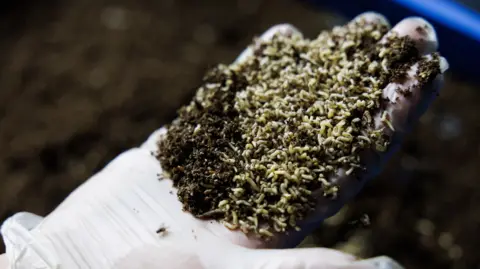
Energesman A hand holding fly larvaeEnergesman

Most people are inclined to shoo flies away from food, and the thought of maggots in your bins is enough to make anyone’s stomach turn.

But a handful of city councils have embraced maggots – more formally known as fly larvae – and their taste for rotting food.

In Vilnius, capital of the Baltic state of Lithuania, fly larvae have officially been given the job of processing the 2,700 tonnes of food waste the city’s 607,000 residents put out for collection each year, alongside that of the six neighbouring councils.

Energesman, the waste management company that began relieving Vilnius of its food waste earlier this year, doesn’t actually charge the city for this service.

That is saving the city the city up to €2m (£1.7m; $2.3m) per year, based on a target of processing 12,000 tonnes in 2026 says the company’s chief executive, Algirda Blazgys.

Energesman has rolled out new orange food waste bags to residents, alongside an influencer marketing campaign to encourage more Vilniečiai to separate their food waste, as the 2,700 tonnes collected is only a fraction of the 40,000 tonnes of household waste the city is thought to generate.

Last year it become mandatory for councils to collect food waste, so the city needs to find ways to deal with it.

Energesman, meanwhile, has plans to turn the fattened fly larvae into a new income stream.

It houses around six million flies in a special zone within its Vilnius plant, who mate around every six hours, according to CEO Algirdas Blazgys.

A female fly can lay around 500 eggs in her average 21-day lifespan, so Mr Blazgys and his team are dealing with more than three million larvae a month, who can consume more than 11 tonnes of food waste in the first, hungriest days of their lives.

Energesman A pile of food wasteEnergesman

It’s the huge appetites of these tiny creatures that make them such excellent candidates for food waste processing. This study shows a swarm of them demolishing a 16 inch pizza in just two hours.

The trick is to cull them before they transform into mature flies. That way the protein rich fly larvae can be converted into protein products for use in animal feed or industrial use, for example as an ingredient in paint, glue, lamp shades and furniture covers.

Also, their manure, known as frass, can be used as fertiliser.

Energesman has already set up supply trials with partners in the paint, glue and furniture industries, but Mr Blazgys acknowledges it’s proving more complicated than he anticipated.

The sample paint produced using Energesman-reared fly larvae didn’t quite come out in the right colour, but the lamp shades created look promising.

He also has university partnerships in place to supply fly larvae for research purposes and for feeding bacteria. And of course, the larvae are in demand from the local fishing industry to use as bait.

But EU health and safety regulations mean fly larvae fed with kitchen waste can’t be used in edible insect products for human consumption, as there could be cross contamination from meat and fish scraps.

“We came up with some crazy ideas, then we started looking for other people that could also come with some crazy ideas about what we could do,” says Mr Blazgys.

“As it’s still very new, some people are still looking to see if we’re going to fail, so they don’t want to brag about it yet. But I think we’re going to come up with something good.”

While there are numerous cases around the world of fly larvae being used in food waste management, and being harvested as a protein ingredient, it’s largely on a commercial basis, for example, a private contract between a hotel or apartment building owner and a fly larvae rearer.

In Kenya, Project Mila is a social enterprise using fly larvae to tackle Mombasa’s mounting food waste problem, while also supplying frass as fertiliser to local farmers.

Yet there are just a handful of city councils that have adopted this way of processing food waste.

Goterra in Australia has used fly larvae to help Sydney get through its food waste, as part of a limited trial which began this year.

For the past three years, Goterra has also been working with three townships that are part of the neighbouring Queanbeyan-Palerang Regional Council, recycling around 10 tonnes of food waste.

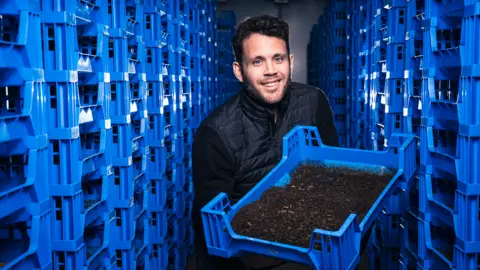
Flybox Larry Kotch holds a blue container full of fly larvaeFlybox

Whether we will see UK councils start shipping in millions of flies, so their larvae can munch through the 6.4 million tonnes of household food waste produced here yearly, is only a matter of time.

That’s the optimistic view of Larry Kotch. He’s the CEO and co-founder of insect waste management company Flybox, which he says operates more insect waste processing sites than any other company in the UK, working largely with private food manufacturers and supermarkets.

Flybox is also a founding member of the Insect Bioconversion Association, an industry body representing companies in the space.

UK councils are interested, Mr Kotch believes, especially because weekly household food waste collections will become mandatory in England from March 2026.

Around 148 of England’s 317 local authorities still don’t offer this, according to the Local Authority Recycling Advisory Committee.

Flybox A hand holding fly larvaeFlybox

But regulations set by the Department for Environment, Food and Rural Affairs (DEFRA) are currently barring councils from using fly larvae to process food waste.

If regulation could move in line with science, Mr Kotch argues that “the UK could see its first council-contracted insect plant within two years”.

“Unfortunately, with government it’s always safer to say no… Everyone we’ve spoken to in UK councils are very excited about insect protein and would much rather work with insect farms than alternative technologies.”

DEFRA confirmed to the BBC that the Animal By-Product Regulations restrict insects from being used to process organic waste streams.

It says there are currently no plans to review these regulations. “Our waste management regulations play a crucial role in protecting UK biosecurity and reducing the risk of disease,” the spokesperson said.

The current alternative for sending food waste to landfill is anaerobic digestion (AD), a breakdown process which creates biogas.

However, Mr Kotch says current AD plants aren’t enough to cope with the anticipated influx of household food waste.

“Globally, over 1.3 billion tonnes of food is wasted every year. We believe up to 40% of that could be upcycled using insect waste management. And not only does it avoid disposal costs and methane emissions, but it also produces valuable protein and organic fertiliser,” says Mr Kotch.

More Technology of Business
Posted on

Three network phone calls down but data still working

The mobile operator Three has confirmed some users are currently unable to make phone calls.

In a post on X, the network said there was “an issue affecting voice services” but did not say how many of its 11 million customers are affected.

Outage website DownDetector reported a spike in issues at 09:30 BST on Wednesday, with over 9,000 reports made by users.

Data services such as 4G and 5G are working as normal, according to Three.

The company recently completed a merger with Vodafone to create the UK’s largest phone network with around 27 million customers.

Vodafone services are running as normal.

However, other phone companies which piggyback off Three’s network are affected.

ID Mobile posted on its service status page: “Please bear with us, our technical teams are working hard with our network partner Three UK to fix this issue and full service will be restored as soon as possible.”

Smarty said it was “aware of an issue affecting voice services” and was working to fix it.

Some customers have posted on social media saying they have been unable to return missed calls from the hospital, or to call a car breakdown service.

Others also said on Wednesday morning they did not have access to data services – though in a statement, Three has said data is “working normally”.

In January, Three announced an investigation into a small number of users not being able to call 999 during a network outage.

Posted on

‘Fast tech’ warning as demand for cheap gadgets heats up

Chris Vallance

Senior Technology Reporter

Getty Images An asian woman with red dyed hair wearing sunglasses holds a pink mini-fanGetty Images

Demand for so-called “fast tech” – cheap electronic items often quickly binned or abandoned in drawers – is growing, a not-for-profit that works to reduce electronic waste has warned.

Material Focus singled out heatwave-fuelled demand for battery powered mini-fans as an example of the problem, suggesting over seven million were purchased last year.

Nearly £8m was spent on light-up toilet seats, mini karaoke machines and LED balloons, the group’s calculations also suggested.

Overall, consumer spending on fast tech has quadrupled to £11.6bn since 2023, surveys carried out for Material Focus suggested.

The boom could be as rapid as the growth in fast fashion with a “similar negative impact”, Professor Cathrine Jansson-Boyd wrote in the announcement of the findings.

Although fast tech can cost less than a pound, valuable materials can still be locked up in the cut-price gadgets.

A previous report by Material Focus looking at tech lurking in so-called “drawers of doom” suggested in total the junk could contain over 38,000 tonnes of copper.

The mining of materials used by tech gadgets can be environmentally damaging, and yet, experts say, such elements will be crucial as nations seek to transition to low carbon technologies.

Material Focus, whose board includes trade bodies representing manufacturers of domestic appliances, and lighting manufactures, argued that consumers needed to be more thoughtful,

“We had fast food, then fast fashion, now fast tech”, Scott Butler, the group’s executive director wrote.

He urged consumers to “think before you buy your latest fast tech item, and if you do really need it”.

Unwanted tech should always be recycled, Mr Butler argued. However, surveys carried out for the group suggest that over half of fast tech ends up in the bin or unused.

Repair and recycle

Joe Iles of the Ellen MacArthur Foundation which promotes the idea of a “circular economy” based on reuse and recycling said the charity believed the problem of fast tech could be fixed.

“It’s easy to think of these patterns of rapid use, disposal as inevitable, but they’re a recent symptom that has accelerated in the past 50 years or so”, he told the BBC.

There was already a booming market for some durable, reused, and refurbished electronics, he added.

And policy tools such as Right to Repair and Extended Producer Responsibility could encourage better design, as well as new practices in collection, repair, and resale, he said.

Others highlight how goods need to be manufactured in a way that helps consumers make sustainable choices.

Laura Burley, plastics campaign lead at Greenpeace UK told the BBC that the combination of plastic and electrical components made fast tech “a toxic cocktail that is very hard to recycle”.

The fact that so much cheap tech is not built to be repaired or to last exacerbated the problem she said.

When plastic and electronic waste is thrown away it often ends up being dumped on poorer countries.

The solution was “a circular economy where producers are responsible for the full life cycle of their products, and incentivised to make them easier to repair”.

Consumers could help by not buying fast tech – “manual fans or an open window work just as well” she noted.