Posted on

Massive Steam Plume Spotted at Alaska’s Mount Spurr as Volcano May Erupt Soon

A large steam plume has been seen emerging from Mount Spurr in Alaska, signalling increased volcanic activity. Images shared by the Alaska Volcano Observatory (AVO) on March 28 confirmed steam and gas emissions visible from the volcano’s summit and a northern vent. The volcano is located around 80 miles west of Anchorage and stands at 11,070 feet high. The experts have revealed that there could be a possible eruption in the coming weeks or months. However, nothing is certain yet.

Increased Signs of Unrest Reported

According to the latest update by the Alaska Volcano Observatory steam was observed rising from the summit on March 26. A smaller plume was also recorded from a fumarole on the volcano’s northern flank. No immediate changes in seismic activity or gas levels were detected during these observations as per the AVO statement.

The AVO had earlier mentioned in a March 11 update that a noticeable rise in gas emissions indicates fresh magma has moved into the crust beneath Mount Spurr. This has led scientists to assess the chance of an eruption in the near future. The observatory clarified that the exact timing of any eruption cannot be predicted yet.

Hazards and Possible Alerts

The observatory has cautioned that the volcano’s alert level might be raised if there are further signs of escalation. According to AVO, this may include persistent seismic tremors, increased gas emissions or visible surface changes. If an eruption occurs, possible hazards include ash clouds impacting flights, ashfall across nearby areas, pyroclastic flows and mudflows known as lahars.

The volcano last erupted in 1992. That eruption resulted in heavy ashfall and affected air travel in the region. AVO has advised residents and visitors to stay informed and follow safety instructions if alerts are raised.

Posted on

NASA’s SPHEREx Mission Sends First Space Images Before Full Sky Survey

NASA’s SPHEREx mission has sent back its first images from space. This marks an important step before it begins the full survey of the sky. The space telescope, which was launched on March 11, 2025, is designed to scan millions of galaxies and collect data in infrared light. On March 27, its detectors captured uncalibrated images that show thousands of light sources, including distant stars and galaxies. The images, processed with added colours for infrared wavelengths, confirm that SPHEREx is operating as expected. Once fully operational, the telescope will take 600 exposures daily and map the entire sky four times during its two-year mission.

Recorded Images Reveals Interesting Details

According to NASA’s SPHEREx mission, the observatory’s six detectors recorded images of the same area of the sky, providing a wide field of view. The top three images represent one portion of the sky, while the bottom three cover the same section. As per the report, the SPHEREx catpured each image with around 100,000 light sources. As per multiple reports, scientists can now learn more about what celestial objects and its distance from Earth with the help of infrared wavelengths. The data from SPHEREx will also help researchers to explore the origins of water in the Milky Way. Moreover, it might also help the scientists to find more clues about the universe’s earliest moments.

Olivier Doré, SPHEREx project scientist at NASA’s Jet Propulsion Laboratory (JPL) and Caltech, told NASA that the telescope is functioning as intended. The infrared light detected by SPHEREx is invisible to human eyes, but colour mapping enables researchers to visualise and analyse it. The observatory’s unique design includes 17 infrared wavelength bands for each detector, creating a total of 102 hues in every six-image capture.

How the Telescope Works

Unlike Hubble or the James Webb Space Telescope, which focuses on specific areas of space, SPHEREx is built for large-scale surveys. It uses spectroscopy to break down light and identify chemical compositions and distances of celestial bodies. Light entering the telescope is divided into two paths, each leading to three detectors. Specialised filters process the incoming wavelengths, allowing for detailed observations of millions of cosmic sources.

Beth Fabinsky, deputy project manager at JPL, said in NASA’s official statement that the successful image capture represents a major milestone. The telescope has also reached its target operating temperature of minus 350 degrees Fahrenheit, crucial for detecting faint infrared signals. Since focusing cannot be adjusted after launch, mission engineers verified the accuracy of the telescope’s optics before sending it into space.

Jamie Bock, principal investigator at JPL and Caltech, confirmed in NASA’s report that the telescope is performing as expected. Engineers will continue testing before the observatory begins routine operations in late April.

Posted on

James Webb Space Telescope Reveals a Stunning Einstein Ring in Hydrus

James Webb Space Telescope has recently captured a detailed image of an unusual cosmic occurrence. The latest images released by European Space Agency shows a glowing ring in the depths of space. It also reveals an effect that is caused by a massive galaxy bending light from another galaxy hidden behind it. The phenomenon has been recorded in the constellation Hydrus. It has been observed that light from the background galaxy forms a ring due to gravitational bending.

Formation of the Einstein Ring

According to the European Space Agency and the Canadian Space Agency the sight captured is known as an Einstein ring. It was reported that the effect is caused when a massive object bends light from another galaxy located behind it. The report further highlights that the foreground galaxy shown in the images belongs to a cluster known as SMACSJ0028.2-7537. The light from a distant spiral galaxy is being curved by the gravitational pull of the elliptical galaxy in front.

As per the official statement from ESA, the effect is a classic case of Albert Einstein’s theory of general relativity. The agency highlighted that the large objects in space can warp space-time, which in turn, forces light to travel around them in curved paths. The report further mentioned that when the observer, the light source and the massive object align perfectly, the light appears as a full ring.

Significance of Gravitational Lensing

The image was shared as part of the March picture of the month initiative by the space agencies. The images were capture using the Near Infrared Camera instrument on the James Webb Space Telescope with the help of Hubble Space Telescope’s Wide Field Camera 3 and Advanced Camera for Surveys.

It is also reported that such lensing phenomena assist astronomers in studying distant galaxies that would otherwise be too faint to observe. The ESA further noted that the magnification effect helps reveal the structure and composition of galaxies that existed shortly after the Big Bang

For the latest tech news and reviews, follow Gadgets 360 on X, Facebook, WhatsApp, Threads and Google News. For the latest videos on gadgets and tech, subscribe to our YouTube channel. If you want to know everything about top influencers, follow our in-house Who’sThat360 on Instagram and YouTube.

Scientists Spot a Key Difference in Matter and Antimatter Decay

Two New Exoplanets Found Orbiting a Star in Draco Constellation

Related Stories

Posted on

T Corona Borealis May Erupt Soon: Rare Nova Could Be Visible to Naked Eye

T Corona Borealis is a binary star system in the Northern Crown constellation which is being monitored closely by astronomers worldwide for signs of a rare stellar eruption. The system consists of a white dwarf and a red giant orbiting each other with the white dwarf pulling material from its companion. The gradual accumulation of matter on the surface of dwarf white planet can lead to a thermonuclear explosion, known as a Nova. Scientists recorded the last erupted Nova in 1946. Now, there have been some indications that we might experience another nova outburst in the near future.

The researchers have recorded a brightening event in 2015 followed by a dimming in 2023, which has mirrored the pattern seen in the last eruption. This leads the experts to believe that there might be another nova outburt. If an eruption occurs T Corona Borealis could become visible to the naked eye and shine as brightly as the most prominent stars.

Accretion Activity and Expert Predictions

According to a study published in the Monthly Notices of the Royal Astronomical Society, the system has exhibited behaviour similar to the years leading up to its previous eruption. T Corona Borealis is one of only eleven recurrent novae observed in recorded history with eruptions noted in 1217, 1787, 1866 and 1946. As per the latest data available with the researchers, the accretion disc surrounding the white dwarf has became highly active and bright between 2015 and 2023. The study reveals that this heightened activity could trigger an eruption within a year or two.

There are multiple predictions from the scientists based on orbital analysis suggesting possible eruption dates. As per multiple reports, the Nova outburst might take place between March 27 or November 10 this year or June 25, 2026. The researchers has also suggested a theory regarding a potential third object influencing the binary system. Astronomers like Dr Léa Planquart of Université de Strasbourg and Dr Jeremy Shears of the British Astronomical Association have dismissed this theory citing the absence of supporting evidence. Both experts believe the activity of the accretion disc remains the most likely cause of an impending eruption.

For the latest tech news and reviews, follow Gadgets 360 on X, Facebook, WhatsApp, Threads and Google News. For the latest videos on gadgets and tech, subscribe to our YouTube channel. If you want to know everything about top influencers, follow our in-house Who’sThat360 on Instagram and YouTube.

Vivo X200 Ultra Confirmed to Feature Dedicated Camera Control Button; Design Teased

Facebook Introduces Friends Tab Without Recommended Content as Part of ‘OG’ Revamp

Related Stories

Posted on

Archaeologists May Have Found 2,100-Year-Old Roman Canal Built by Gaius Marius in Southern France

A Roman canal dated back more than 2,100 years may have been located in southern France. The structure is believed to be the Marius Canal. It is thought to have been built between 104 and 102 B.C. during the Cimbrian Wars. The Romans had been engaged in battles against the Cimbri and Teutones, two migrating Celtic tribes. The waterway was said to have been ordered by Roman general Gaius Marius to improve supply routes. If confirmed, this would be the first major Roman hydraulic engineering project in Gaul.

Study Suggests Ancient Canal Matches Roman Construction Patterns

According to a study published in the Journal of Archaeological Science: Reports, the canal’s remains were found south of Arles within the Rhône River delta. The research team which was led by Joé Juncker, a geoarchaeologist at the University of Strasbourg, conducted sediment core analysis and radiocarbon dating. These tests indicate that the site was used between the first century B.C. and third century A.D. The dimensions of the canal which measured approximately 98 feet in width, aligns with Roman engineering standards.

Archaeological Evidence Points to Roman Use

Finding from the site includes 69 pieces of Roman ceramics. It  has two ancient wooden stakes, and large cobblestone platforms. Radiocarbon analysis of the stakes suggests they date back to the first to fourth century A.D. Simon Loseby, an honorary lecturer at the University of Sheffield, told Live Science that the discovery adds to evidence of Roman large-scale infrastructure projects. He noted that further excavations may reveal quays or towpaths, which could provide stronger confirmation of the canal’s purpose and duration of use.

Further Excavations Needed to Confirm Identity of Canal

The last historical mention of the Marius Canal was recorded by Pliny the Elder in the first century A.D. Juncker cautioned that without additional archaeological verification, definitive attribution to Marius remains uncertain. Research at the site continues.

For the latest tech news and reviews, follow Gadgets 360 on X, Facebook, WhatsApp, Threads and Google News. For the latest videos on gadgets and tech, subscribe to our YouTube channel. If you want to know everything about top influencers, follow our in-house Who’sThat360 on Instagram and YouTube.

OpenAI Close to Finalising $40 Billion SoftBank-Led Funding

Infinix Note 50X 5G With MediaTek Dimensity 7300 Ultimate Chipset Launched in India: Price, Specifications

Related Stories

Posted on

Study Finds grey Seals Can Track Blood Oxygen to Prevent Drowning

Marine mammals rely on oxygen to survive, yet some species stay underwater for long periods without breathing. Scientists at the University of St Andrews wanted to understand how gray seals manage their time underwater without relying on carbon dioxide buildup as a signal. Six adult gray seals were placed in a controlled environment to observe their diving patterns. The seals were only allowed to surface at a designated chamber, where researchers adjusted oxygen and carbon dioxide levels to test their responses.

Research Confirms Oxygen as the Primary Trigger

According to the study published in Science, different air compositions were tested to measure their effect on dive times. The air in the breathing chamber was adjusted across four conditions: normal air, increased oxygen, reduced oxygen, and heightened carbon dioxide levels. When oxygen levels were increased, seals stayed underwater for longer. When oxygen was reduced, they surfaced sooner. Carbon dioxide changes did not alter their behavior, suggesting that oxygen, not carbon dioxide, determines when they come up for air.

Unique Adaptation in Marine Mammals

Researchers says that grey seals have an internal system to track oxygen levels. This allows them to surface before reaching dangerous limits. This ability prevents drowning and may be common among other marine species. Since deep-diving mammals must manage oxygen carefully, similar mechanisms could be present in whales, dolphins and other seals.

Experts Weigh in on the Discovery

Lucy Hawkes from the University of Exeter and Jessica Kendall-Bar from the University of California, San Diego, discussed the study’s impact. They noted that understanding this adaptation sheds light on how marine mammals survive in extreme underwater conditions. Further research could explore how this system works in different species and environments.

For the latest tech news and reviews, follow Gadgets 360 on X, Facebook, WhatsApp, Threads and Google News. For the latest videos on gadgets and tech, subscribe to our YouTube channel. If you want to know everything about top influencers, follow our in-house Who’sThat360 on Instagram and YouTube.

iQOO Z10 Colour Options, Design Teased Ahead of April 11 India Launch

Netflix Now Supports Streaming HDR10+ Content on AV1-Enabled TVs, Streaming Devices

Posted on

New Research Suggests Dark Energy Is Evolving, Challenging Cosmology Models

New research suggests that dark energy, the unknown force driving the accelerated expansion of the universe, may not be behaving as previously believed. Observations from a large-scale 3D map indicate that this force could be evolving over time, contradicting long-standing models of cosmology. The data, derived from extensive observations of millions of galaxies, provides fresh insights into the fundamental workings of the universe. Scientists are now questioning whether the standard model, which assumes a constant dark energy force, remains valid in explaining the cosmos.

Evidence from DESI’s 3D Mapping Project

According to the Dark Energy Spectroscopic Instrument (DESI), which operates from the Nicholas U. Mayall 4-Meter Telescope at Kitt Peak National Observatory, findings suggest that dark energy may not be a fixed force. The analysis is based on data collected over three years, covering nearly 15 million galaxies and quasars. DESI’s ability to simultaneously capture light from 5,000 galaxies allows researchers to examine large-scale cosmic structures and measure how the universe’s expansion rate has changed over time.

Comparisons with Other Cosmic Observations

As reported, inconsistencies arise when DESI’s findings are compared with measurements from the cosmic microwave background (CMB) and type Ia supernovae. The CMB consists of fossil light from the early universe, has been used to track the expansion history of the cosmos. Similar to thaf type Ia supernovae, often called “standard candles” for their uniform brightness, have provided key distance measurements. The DESI data suggests that dark energy’s influence may have weakened over time, a deviation from the accepted cosmological model that assumes it remains unchanged.

Implications for Future Research

Speaking in an official press release, DESI Project Scientist Arjun Dey stated that these findings could redefine humanity’s understanding of the universe. The instrument’s ongoing observations will continue to refine knowledge of dark energy’s role. Scientists anticipate that by the project’s conclusion, further data will offer a clearer picture of whether dark energy fluctuates, potentially reshaping existing theories of cosmic evolution.

Posted on

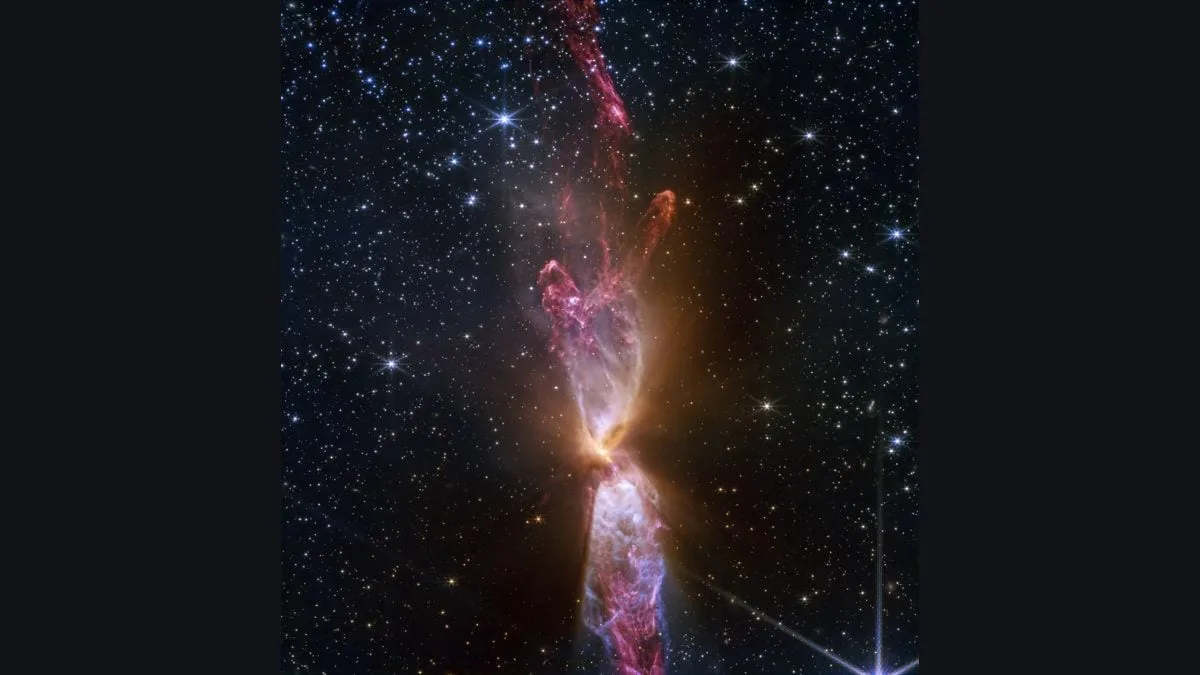
James Webb Space Telescope Captures Hourglass Nebula LBN 483 in Stunning Detail

A striking nebula shaped by the dynamic interactions of two young stars has been observed in unprecedented detail by the James Webb Space Telescope (JWST). The structure, identified as Lynds 483 (LBN 483), is located approximately 650 light-years away. The nebula’s intricate shape is a result of powerful outflows generated by the formation of a binary star system. As material from a collapsing molecular cloud feeds these stars, bursts of gas and dust are expelled, shaping the surrounding nebulosity into a striking hourglass-like formation. The interaction of these stellar winds and jets with surrounding matter continues to sculpt the nebula over time, providing valuable insight into the mechanisms of star formation.

Star Formation and Nebular Evolution

According to reports, the two protostars at the core of LBN 483 play a crucial role in shaping the nebula. The presence of a lower-mass companion star, identified in 2022 through observations by the Atacama Large Millimeter/submillimeter Array (ALMA), suggests complex interactions within the system. Material accreted onto the stars periodically fuels energetic outflows, which in turn crash into the surrounding gas and dust. The JWST’s infrared imaging has revealed intricate structures within these lobes, including dense pillars and shock fronts where ejected material meets older expelled gas.

Impact of Magnetic Fields on Nebular Shape

Radio observations from ALMA have detected polarised emissions from cold dust within the nebula. These emissions indicate the presence of a magnetic field, which influences the direction and structure of the outflows. The study highlights a distinct 45-degree kink in the field at a distance of approximately 1,000 astronomical units from the stars. This deviation is attributed to the migration of the secondary star over time, altering the system’s angular momentum and consequently shaping the nebular outflows.

Implications for Star Formation Studies

LBN 483 presents a unique opportunity for astronomers to study star formation outside of massive stellar nurseries such as the Orion Nebula. The nebula’s isolation allows researchers to examine the formation process without interference from external stellar activity. Findings from this study contribute to refining theoretical models of star formation by integrating real observational data into numerical simulations. Scientists continue to analyse such systems to gain a deeper understanding of how stars, including the Sun, evolved from collapsing clouds of gas billions of years ago.

For the latest tech news and reviews, follow Gadgets 360 on X, Facebook, WhatsApp, Threads and Google News. For the latest videos on gadgets and tech, subscribe to our YouTube channel. If you want to know everything about top influencers, follow our in-house Who’sThat360 on Instagram and YouTube.

Samsung Galaxy S25 Edge Price in Europe, Storage and Colour Options Leaked

Crime Patrol Now Streaming on Netflix, New Episodes Every Monday

Related Stories

Posted on

SpaceX Crew-10 Launches to ISS, Relieving Stranded NASA Starliner Crew

SpaceX has launched the Crew-10 mission from NASA’s Kennedy Space Center, sending four astronauts to the ISS. The team will replace Crew-9 members, two of whom have been stranded since June due to Boeing’s Starliner delays. The Falcon 9 rocket lifted off successfully on March 14, and Crew-10 is expected to dock with the ISS in about 28 hours. The six-month mission…
Posted on

Life on Mars? Studies Suggest Bacteria-Like Organisms Could Exist

The search for extraterrestrial life continues, with Mars remaining a primary focus due to its geological features and past evidence of water. While no living organisms have been found, compounds and minerals suggest conditions that may have once supported microbial life. Scientists are also investigating other locations, including the icy moons of Jupiter and Saturn, which are believed to contain vast subsurface oceans. The study of extremophiles—organisms thriving in extreme environments on Earth—has further expanded possibilities for where life could exist beyond our planet.

Exploring Mars and Beyond

As reported, according to research on Mars’ surface, data from NASA’s Perseverance and Curiosity rovers indicate that the planet’s past climate may have been suitable for microbial life. Despite its current barren landscape, interest remains high due to the discovery of organic molecules. Beyond Mars, celestial bodies such as Europa and Enceladus are being closely studied. These moons contain subsurface oceans beneath thick ice layers, where conditions may allow for microbial survival. Over 5,500 exoplanets have also been identified, with a select few considered potentially habitable.

Life in Extreme Environments

The possibility of life in extreme conditions gained momentum after the discovery of thermophilic bacteria in Yellowstone National Park’s hot springs. Microorganisms have since been found in highly acidic rivers, deep-sea trenches, and even within human bodies. These findings have reshaped theories about the limits of life and influenced the study of extraterrestrial habitability.

Microbial Life in the Human Stomach

Research conducted by Australian doctors Barry Marshall and Robin Warren in the 1980s led to the identification of Helicobacter pylori, a bacterium thriving in the highly acidic environment of the human stomach. Their findings, which earned them the 2005 Nobel Prize in Physiology or Medicine, demonstrated that life can persist in conditions once thought uninhabitable. The study of such microbes continues to inform the search for life in extreme environments beyond Earth.