Posted on

AI can make us UK’s biggest firm, Rolls-Royce says

Simon Jack

Business editor

Rolls-Royce Artist's impression of a small nuclear power stationRolls-Royce

Rolls-Royce’s plan to power artificial intelligence (AI) with its nuclear reactors could make it the UK’s most valuable company, its boss has said.

The engineering firm has signed deals to provide small modular reactors (SMRs) to the UK and Czech governments to power AI-driven data centres.

AI has boomed in popularity since 2022, but the technology use lots of energy, something which has raised practical and environmental concerns.

Rolls-Royce chief executive Tufan Erginbilgic told the BBC it has the “potential” to become the UK’s highest-valued company by overtaking the largest firms on the London Stock Exchange thanks to its SMR deals.

“There is no private company in the world with the nuclear capability we have. If we are not market leader globally, we did something wrong,” he said.

Tufan Erginbilgic has overseen a ten-fold increase in Rolls-Royce’s share price since taking over in January 2023.

However, he has ruled out the idea of Rolls-Royce seeking to list its shares in New York as British chip designer Arm has done and the likes of Shell and AstraZeneca have considered in the search for higher valuations.

This is despite the fact that 50% of its shareholders and customers are US-based.

“It’s not in our plan,” said Mr Erginbilgic, a Turkish energy industry veteran. “I don’t agree with the idea you can only perform in the US. That’s not true and hopefully we have demonstrated that.”

AI investment

Rolls-Royce already supplies the reactors that power dozens of nuclear submarines. Mr Erginbilgic said the company has a massive advantage in the future market of bringing that technology on land in the form of SMRs.

SMRs are not only smaller but quicker to build than traditional nuclear plants, with costs likely to come down as units are rolled out.

He estimates that the world will need 400 SMRs by 2050. At a cost of up to $3bn (£2.2bn) each, that’s another trillion dollar-plus market he wants and expects Rolls-Royce to dominate.

The company has signed a deal to develop six SMRs for the Czech Republic and is developing three for the UK.

But it remains an unproven technology. Mr Erginbilgic conceded he could not currently point to a working SMR example but said he was confident in its future potential.

There are also concerns about the demands on water supplies from the data centre and SMR cooling systems.

In response, companies including Google, Microsoft and Meta have signed deals to take energy from SMRs in the US when they are available.

Next generation aircraft

Rolls-Royce sees SMRs as key to its future, but its biggest business is aircraft engines.

Already dominant in supplying engines to wide-bodied aircraft like Boeing 787 and Airbus A350, it plans to break into the next generation of narrow-bodied aircraft like the Boeing 737 and Airbus A320. This market is worth $1.6tn – nine times that of the wide-bodied .

Rolls-Royce is a bit player in a market that has powerful and successful leaders, and that rival Pratt and Witney lost $8bn trying and failing to break into.

The market is dominated by CFM International – a joint venture between US-based GE Aerospace and French company Safran Aerospace Engines.

Industry veterans told the BBC that market leaders can and will drop prices to airline customers long enough to see off a new assault on their market dominance.

But Mr Erginbilgic said this is not just the biggest business opportunity for Rolls-Royce. Rather, it is “for industrial strategy… the single biggest opportunity for the UK for economic growth”.

“No other UK opportunity, I challenge, will match that,” he said.

Share price up ten-fold

Although Rolls-Royce sold its car making business to BMW nearly 30 years ago, the name of the company is still synonymous with British engineering excellence.

But in the early part of this decade that shine had worn off. The company was heavily indebted, its profit margins were non-existent, and thousands of staff were being laid off.

When Mr Erginbilgic took over in January 2023, he likened the company to “a burning platform”.

“Our cost of capital was 12%, our return was 4% so every time we invested we destroyed value,” he said.

Two and a half years later, the company expects to make a profit of over £3bn, its debt levels have fallen and shares have risen over 1,000% – a ten-fold rise.

So how did that happen? And is Mr Erginbilgic right to think that Rolls-Royce’s roll is only just starting?

‘Grudging respect’

The timing of his appointment was fortunate according to some industry veterans.

Rolls-Royce’s biggest business – supplying engines to commercial airlines – has rebounded strongly from the Covid pandemic.

The company’s most successful product – the Trent series of aircraft engines – are at the sweet spot of profitability as the returns on investment in their development over a decade ago begin to pour into company coffers.

Russia’s full-scale invasion of Ukraine in 2022 arguably made it almost inevitable that its defence business would see higher spending from European governments – which has been confirmed by recent announcements.

Unions have not always been fans of Mr Erginbilgic’s hard-charging approach.

In October 2023, one of his first major move was cutting jobs, which drew criticism from Sharon Graham, the boss of the Unite union.

“This announcement appears to be about appeasing the markets and its shareholders while ignoring its workers,” she said at the time.

However, overall global headcount has grown from 43,000 to 45,000 since 2023 and union sources say there is “grudging respect” for Mr Erginbilgic.

Those sources give him one third of the credit for the turnaround around in the company’s fortunes, with a third credited to market conditions and a third to his predecessor Warren East for “steadying the ship”.

So does Mr Erginbilgic really believe that Rolls-Royce can be the UK’s most valuable company – overtaking the likes of AstraZeneca, HSBC, and Shell?

“We are now number five in the FTSE. I believe the growth potential we created in the company right now, in our existing business and our new businesses, actually yes – we have that potential.”

Rolls-Royce is undoubtedly a company with the wind at its back – and Tufan Ergenbilgic certainly believes he has set the sails just right.

Posted on

Wikipedia loses challenge against Online Safety Act verification rules

Wikipedia has lost a legal challenge to new Online Safety Act rules which it says could threaten the human rights and safety of its volunteer editors.

The Wikimedia Foundation – the non-profit which supports the online encyclopaedia – wanted a judicial review of regulations which could mean Wikipedia has to verify the identities of its users.

But it said despite the loss, the judgement “emphasized the responsibility of Ofcom and the UK government to ensure Wikipedia is protected”.

The government told the BBC it welcomed the High Court’s judgment, “which will help us continue our work implementing the Online Safety Act to create a safer online world for everyone”.

Judicial reviews challenge the lawfulness of the way in which a decision has been made by a public body.

In this case the Wikimedia Foundation and a Wikipedia editor tried to challenge the way in which the government decided to make regulations covering which sites should be classed “Category 1” under the Online Safety Act – the strictest rules sites must follow.

It argued the rules were logically flawed and too broad, meaning a policy intended to impose extra rules on large social media companies would instead apply to Wikipedia.

In particular the foundation is concerned the extra duties required – if Wikipedia was classed as Category 1 – would mean it would have to verify the identity of its contributors, undermining their privacy and safety.

The only way it could avoid being classed as Category 1 would be to cut the number of people in the UK who could access the online encyclopaedia by about three-quarters, or disable key functions on the site.

The government’s lawyers argued that ministers had considered whether Wikipedia should be exempt from the regulations but had reasonably rejected the idea.

In the end, the court rejected Wikimedia’s arguments.

But Phil Bradley-Schmieg, Lead Counsel at the Wikimedia Foundation, said the judgment did not give Ofcom and the Secretary of State, in Mr Justice Johnson’s words, “a green light to implement a regime that would significantly impede Wikipedia’s operations”.

And the judgement makes it clear other legal challenges could be possible.

Wikimedia could potentially challenge Ofcom’s decision making if the regulator did ultimately decide to classify the site as Category 1.

And if the effect of making Wikipedia Category 1 meant it could not continue to operate, then other legal challenges could follow.

“Wikipedia has been caught in the stricter regulations due to its size and user created content even though it argues (convincingly) that it differs significantly from other user-to-user platforms,” said Mona Schroedel, data protection litigation specialist at law firm Freeths.

“The court’s decision has left the door open for Wikipedia to be exempt from the stricter rules upon review.”

The communications regulator Ofcom, which will enforce the act, told the BBC: “We note the court’s judgment and will continue to progress our work in relation to categorised services and the associated extra online safety rules for those companies.”

Posted on

Elon Musk’s AI accused of making explicit AI Taylor Swift videos

Imran Rahman-Jones

Technology reporter

Getty Images Taylor Swift smiling wearing a black beanie hat and black jacket.Getty Images

Elon Musk’s AI video generator has been accused of making “a deliberate choice” to create sexually explicit clips of Taylor Swift without prompting, says an expert in online abuse.

“This is not misogyny by accident, it is by design,” said Clare McGlynn, a law professor who has helped draft a law which would make pornographic deepfakes illegal.

According to a report by The Verge, Grok Imagine’s new “spicy” mode “didn’t hesitate to spit out fully uncensored topless videos” of the pop star without being asked to make explicit content.

The report also said proper age verification methods – which became law in July – were not in place.

XAI, the company behind Grok, has been approached for comment.

XAI’s own acceptable use policy prohibits “depicting likenesses of persons in a pornographic manner”.

“That this content is produced without prompting demonstrates the misogynistic bias of much AI technology,” said Prof McGlynn of Durham University.

“Platforms like X could have prevented this if they had chosen to, but they have made a deliberate choice not to,” she added.

This is not the first time Taylor Swift’s image has been used in this way.

Sexually explicit deepfakes using her face went viral and were viewed millions of times on X and Telegram in January 2024.

Deepfakes are computer-generated images which replace the face of one person with another.

‘Completely uncensored, completely exposed’

In testing the guardrails of Grok Imagine, The Verge news writer Jess Weatherbed entered the prompt: “Taylor Swift celebrating Coachella with the boys”.

Grok generated still images of Swift wearing a dress with a group of men behind her.

This could then be animated into short video clips under four different settings: “normal”, “fun”, “custom” or “spicy”.

“She ripped [the dress] off immediately, had nothing but a tasselled thong underneath, and started dancing, completely uncensored, completely exposed,” Ms Weatherbed told BBC News.

She added: “It was shocking how fast I was just met with it – I in no way asked it to remove her clothing, all I did was select the ‘spicy’ option.”

Gizmodo reported similarly explicit results of famous women, though some searches also returned blurred videos or with a “video moderated” message.

The BBC has been unable to independently verify the results of the AI video generations.

Ms Weatherbed said she signed up to the paid version of Grok Imagine, which cost £30, using a brand new Apple account.

Grok asked for her date of birth but there was no other age verification in place, she said.

Under new UK laws which entered into force at the end of July, platforms which show explicit images must verify users’ ages using methods which are “technically accurate, robust, reliable and fair”.

“Sites and apps that include Generative AI tools that can generate pornographic material are regulated under the Act,” the media regulator Ofcom told BBC News.

“We are aware of the increasing and fast-developing risk GenAI tools may pose in the online space, especially to children, and we are working to ensure platforms put appropriate safeguards in place to mitigate these risks,” it said in a statement.

New UK laws

Currently, generating pornographic deepfakes is illegal when used in revenge porn or depicts children.

Prof McGlynn helped draft an amendment to the law which would make generating or requesting all non-consensual pornographic deepfakes illegal.

The government has committed to making this amendment law, but it is yet to come into force.

“Every woman should have the right to choose who owns intimate images of her,” said Baroness Owen, who proposed the amendment in the House of Lords.

“It is essential that these models are not used in such a way that violates a woman’s right to consent whether she be a celebrity or not,” Lady Owen continued in a statement given to BBC News.

“This case is a clear example of why the Government must not delay any further in its implementation of the Lords amendments,” she added.

A Ministry of Justice spokesperson said: “Sexually explicit deepfakes created without consent are degrading and harmful.

“We refuse to tolerate the violence against women and girls that stains our society which is why we have passed legislation to ban their creation as quickly as possible.”

When pornographic deepfakes using Taylor Swift’s face went viral in 2024, X temporarily blocked searches for her name on the platform.

At the time, X said it was “actively removing” the images and taking “appropriate actions” against the accounts involved in spreading them.

Ms Weatherbed said the team at The Verge chose Taylor Swift to test the Grok Imagine feature because of this incident.

“We assumed – wrongly now – that if they had put any kind of safeguards in place to prevent them from emulating the likeness of celebrities, that she would be first on the list, given the issues that they’ve had,” she said.

Taylor Swift’s representatives have been contacted for comment.

A green promotional banner with black squares and rectangles forming pixels, moving in from the right. The text says: “Tech Decoded: The world’s biggest tech news in your inbox every Monday.”
Posted on

OpenAI claims GPT-5 model boosts ChatGPT to ‘PhD level’

Lily Jamali

North America Technology correspondent

Liv McMahon

Technology reporter

Getty Images Sam Altman hearing a headset microphone on stage at an eventGetty Images

ChatGPT-maker OpenAI has unveiled the long-awaited latest version of its artificial intelligence (AI) chatbot, GPT-5, saying it can provide PhD-level expertise.

Billed as “smarter, faster, and more useful,” OpenAI co-founder and chief executive Sam Altman lauded the company’s new model as ushering in a new era of ChatGPT.

“I think having something like GPT-5 would be pretty much unimaginable at any previous time in human history,” he said ahead of Thursday’s launch.

GPT-5’s release and claims of its “PhD-level” abilities in areas such as coding and writing come as tech firms continue to compete to have the most advanced AI chatbot.

Elon Musk recently made similar claims of his own AI chatbot, Grok, which has been plugged into X (formerly Twitter).

During the launch of Grok’s latest iteration last month, Musk said it was “better than PhD level in everything” and called it the world’s “smartest AI”.

Meanwhile, Altman said OpenAI’s new model would suffer from fewer hallucinations – the phenomenon whereby large language models make up answers- and be less deceptive.

OpenAI is also pitching GPT-5 to coders as a proficient assistant, following a trend among major American AI developers, including Anthropic whose Claude Code targets the same market.

What can GPT-5 do?

OpenAI has highlighted GPT-5’s ability to create software in its entirety and demonstrate better reasoning capabilities – with answers that show workings, logic and inference.

The company claims it has been trained to be more honest, provide users with more accurate responses and says that, overall, it feels more human.

According to Altman, the model is “significantly better” than its predecessors.

“GPT-3 sort of felt to me like talking to a high school student… 4 felt like you’re kind of talking to a college student,” he said in a briefing ahead of Thursday’s launch.

“GPT-5 is the first time that it really feels like talking to an expert in any topic, like a PhD-level expert.”

For Prof Carissa Véliz of the Institute for Ethics in AI, however, GPT-5’s launch may not be as significant as its marketing may suggest.

“These systems, as impressive as they are, haven’t been able to be really profitable,” she said, also noting that they can only mimic – rather than truly emulate – human reasoning abilities.

“There is a fear that we need to keep up the hype, or else the bubble might burst, and so it might be that it’s mostly marketing.”

One ethics expert said the launch of GPT-5 reinforced the growing gap between AI’s capabilities and our ability to govern it in the way the public expects.

“As these models become more capable, the need for comprehensive regulation becomes even more urgent,” said Gaia Marcus, Director of the Ada Lovelace Institute.

The BBC’s AI Correspondent Marc Cieslak gained exclusive access to GPT-5 before it’s official launch.

“Apart from minor cosmetic differences the experience was similar to using the older chatbot: give it tasks or ask it questions by typing a text prompt.

It’s now powered by what’s called a reasoning model which essentially means it thinks harder about solving problems, but this seems more like an evolution than revolution for the tech.”

GPT-5’s rollout also has implications for commercial enterprises concerned about the use of their content.

“As AI content becomes more convincing, we need to ask ourselves – are we protecting the people and creativity behind what we see every day?”, said Grant Farhall, chief product officer at Getty Images. “Authenticity matters – but it doesn’t come for free.”

Farhall said it was important to scrutinize exactly how AI models are being trained, and ensure that creators are being compensated if their work is being used.

The company will roll out the model to all users from Thursday.

In the coming days it will become a lot clearer whether it really is as good as Sam Altman claims it is.

Clash with other AI firm

Anthropic recently revoked OpenAI’s access to its application programming interface (API), claiming the company was violating its terms of service by using its coding tools ahead of GPT-5’s launch.

An OpenAI spokesperson said it was “industry standard” to evaluate other AI systems to assess their own progress and safety.

“While we respect Anthropic’s decision to cut off our API access, it’s disappointing considering our API remains available to them,” they added.

With a free tier for its new model, the company may be signalling a potential move away from the proprietary models that have previously dominated its offerings.

ChatGPT changes

On Monday, OpenAI revealed it was making changes to promote a healthier relationship between users and ChatGPT.

In a blog post, it said: “AI can feel more responsive and personal than prior technologies, especially for vulnerable individuals experiencing mental or emotional distress.”

It said it would not give a definitive answer to questions such as, “Should I break up with my boyfriend?”

Instead, it would “help you think it through – asking questions, weighing pros and cons”, according to the blog post.

In May, OpenAI pulled a heavily-criticised update which made ChatGPT “overly flattering”, according to Sam Altman.

On a recent episode of OpenAI’s own podcast, Mr Altman said he was thinking about how people interact with his products.

“This is not all going to be good, there will still be problems,” he said.

“People will develop these somewhat problematic, or maybe very problematic, parasocial relationships [with AI]. Society will have to figure out new guardrails. But the upsides will be tremendous.”

Mr Altman is known to be a fan of the 2013 film Her, where a man develops a relationship with an AI companion.

In 2024, actress Scarlett Johansson, who voiced the AI companion in the film, said she was left “shocked” and “angered” after OpenAI launched a chatbot with an “eerily similar” voice to her own.

A green promotional banner with black squares and rectangles forming pixels, moving in from the right. The text says: “Tech Decoded: The world’s biggest tech news in your inbox every Monday.”
Posted on

Woman awarded £150,000 after LG phone sparks fire in her home

A woman has successfully sued former phone manufacturer LG for nearly £150,000 after one of its devices sparked a fire in her home in North Lanarkshire.

Denise Parks and her husband Robert were in bed at their house in Coatbridge when a fire broke out in the living room at about 03:00 on 31 October 2018.

At Edinburgh Sheriff Court, a judge ruled that an LG phone, supplied to Ms Parks by her employer North Lanarkshire Council, was the source of the fire.

The majority of the money won has been allocated to an insurance company through a subrogated loss claim.

This is when an insurer, after paying out for a claim, inherits the rights of the insured to claim against the responsible party.

In his judgement, Sheriff Robert Fife said: “At the time the fire started, the LG was in normal use, being charged by a suitable charger, and in circumstances in which a standard product would not have failed.”

“The court was entitled to draw an inference that the LG was defective.

“The LG did not meet the standard of safety that persons generally are entitled to expect.”

The court heard Ms Parks was treated for smoke inhalation after the fire.

She had a history of panic attacks and anxiety which worsened after the incident.

As a result of the fire, she was off work between 2 November in 2018 and 7 February 2019.

She raised an action against LG Electronics UK Ltd at the personal injury court at Edinburgh Sheriff Court seeking damages.

The court heard that a laptop and two mobile phones, a Samsung Galaxy S7 and LG K8, were left charging on a couch before the couple went to bed.

Liability for the fire was contested, but the sheriff ruled on the balance of probabilities that the LG phone ignited the fire.

He found that there was a defect in the LG phone and that Ms Parks had successfully established liability against the makers.

He also found that she had proved she sustained injury because of the fire.

The sheriff ruled that Ms Parks was entitled to £149,496 in damages, with more than £140,000 of that sum going to her insurer.

In 2021 LG announced that it was shutting down its smartphone division after struggling to compete with other brands.

Posted on

Jobs in video games dried up, so we made our own

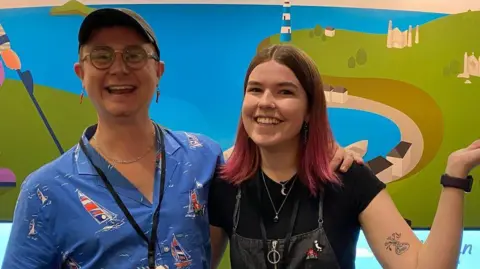
Studio Morgan A young man and young woman stand in front of a large, colourful cartoon picture of a shoreline. Both are smiling. The young man wears glasses, a shirt with a windsurfer pattern on it and a baseball cap. The woman wears dungarees over a black t-shirt. The ends of her hair are dyed pink.Studio Morgan

When Holly Hudson enrolled on a university video game design course, she imagined a job at a studio would be waiting at the end of it.

Her dream was to work as a 3D artist, but the reality has been different.

“I’ve applied to so many jobs this year,” says the 25-year-old.

“But it’s just, it’s really tough.”

Holly graduated in 2023, just as a wave of layoffs and studio closures began to sweep across the industry she hoped to enter.

It’s a trend that’s continued and, in 2025, the picture is still fairly bleak for those looking for jobs in gaming.

According to industry body UKIE, as of June this year, there were just under 700 active vacancies in UK game development.

Fewer than 5% of those were in junior positions, it said.

But Holly and others like her are finding ways to follow their passions and get their creations out there.

Despite struggling to find a full-time job in the industry, Holly has just released her first commercial game alongside uni course mate Harvey Hayman.

Morgan: Metal Detective – a “cosy” slow-paced adventure game set in Cornwall -began life as their end-of-year project.

Players take on the role of Morgan, a young girl who uses her late grandfather’s metal detector to find lost items and return them to residents on a small island.

Holly and Harvey tell BBC Newsbeat it’s a personal project for both of them, inspired by childhood holidays in south-west England, but one they’ve had to work hard to get over the line.

Funding for new video games has also declined in the past two years, so the project has been largely self-financed.

“It’s basically Holly and I trying to pick up contracting work where we can,” says Harvey, who also has a job at a TV production company.

“And so it’s like having to balance these different things,” he says.

“We really want to release this game, but also we need some money to live on and make sandwiches.”

Studio Morgan Screenshot from Morgan Metal Detective shows a panoramic view of a coastline with a picturesque village and a blue and white lighthouse in the distance. In the foreground a hand reaches up to remove a photo from a Polaroid camera.Studio Morgan

The most recent figures from the UK Parliament show that 4,800 students began video game-related degrees in 2021.

Holly believes that the route she and Harvey have taken is “quite common” among their peers.

“There’s a couple of us that have gone on to start our own studios,” she says.

Other young people are finding success via Roblox and Fortnite – using in-game tools to create levels and experiences to share with others.

For those willing to put the hours in, it can be lucrative.

Sonny Tranter, 23, started making maps in Minecraft before moving over to Fortnite, where his creations caught on and found an audience.

This led to partnerships with well-known brands, and Sonny, better known as Driz, has recently set up his own studio dedicated to building Fortnite content.

Epic Games, which makes the multiplayer hit, says 40% of net revenue from the game’s item shop is shared among creators according to the level of engagement they generate.

If an “island” – as the creations are known – attracts new players, brings back lapsed fans or gets regular return visits, it will generate more money for its makers.

Sonny says Fortnite uses an algorithm based on these metrics, similar to YouTube, to decide which ones to promote to users.

He admits that can make it difficult for newcomers to make a mark and push more unique creations.

“If you want to make a game that’s different, but still does well, I think the best strategy is probably build off what’s already popular and make it unique in your own way,” he says.

Driz A screenshot showing an aerial view of a city scene from Fornite's level editor. Several tall office buildings overlook an intersection. The city scene itself appears to be housed inside a giant garage.Driz

Developers like Holly and Harvey face a similar problem of visibility.

With thousands of new games released each year – getting yours seen is another huge challenge for independents.

“We’ve tried as hard as we can without spending a lot of money,” says Harvey.

“Because there’s one way to guarantee game sales – have a load of cash so you can just put marketing on the side of buses.

“But we don’t have that.”

Harvey says he and Holly have taken opportunities to showcase the game whenever they’ve arisen – even being flown out the USA.

He says each appearance usually leads to a bump in wishlists – where potential players can register their interest on online stores – which have “built up slowly over time”.

UKIE, which represents the games industry, says there are “more routes than ever” into gaming careers but access to entry level jobs remains “challenging”.

“We’re seeing the tools and knowledge needed to build a game become more accessible every year, which is helping to democratise entry into the industry,” a spokesperson said.

They said UKIE was in discussions with the government about ways apprenticeships and similar programmes can “provide pathways for new entrants and help upskill the current workforce”.

Scott Alsworth, from the IWGB Union’s game workers’ branch, said the UK games industry faced “apocalyptic conditions” after years of mass layoffs, overspending “and AI-driven displacement”.

He said workers at all levels of also struggled to find stable employment in the current climate, on top of the outlook for graduates or new entrants.

“Aspiring working-class developers have it particularly bad,” he said, adding that the UK’s gaming workforce lagged behind industries such as film and TV in terms of representation.

Despite this, both Holly and Harvey wouldn’t discourage those with a passion for games from following it.

Holly says the games industry is “so friendly” and supportive and meeting others in the same situation has made the past two years “more manageable” for her.

She expects more young developers to launch their own studios in the coming years.

“It’s quite an interesting path to take rather than just being rejected over and over again,” she says.

“But I think hopefully it’s quite inspiring and it shows people that actually there are different ways to make games rather than getting a publisher and finding money that way.”

A footer logo for BBC Newsbeat. It has the BBC logo and the word Newsbeat in white over a colorful background of violet, purple and orange shapes. At the bottom a black square reading "Listen on Sounds" is visible.

Listen to Newsbeat live at 12:45 and 17:45 weekdays – or listen back here.

Posted on Leave a comment

Finding the Best TV Brand: Picture and Sound Quality, Features, and More

Finding the Best TV Brand: Picture and Sound Quality, Features, and More

Introduction to TV Quality and Features

In the modern landscape of home entertainment, the choice of television can significantly impact the overall viewing experience. The importance of picture and sound quality is paramount, as they are the primary mediums through which content is delivered to the audience. A television with superior picture quality allows viewers to witness vibrant colors, sharp contrasts, and lifelike details, making movies, sports, and shows more engaging. Similarly, high sound quality enhances the audio experience, allowing for clearer dialogue, richer sound effects, and an immersive atmosphere that transports viewers into the heart of the action.

Beyond these foundational attributes, the significance of additional features cannot be overlooked. Contemporary televisions now come equipped with a range of functionalities designed to maximize user satisfaction. Smart technology has become prevalent, providing users with access to streaming services, applications, and internet browsing capabilities directly from their televisions. Features such as HDR (High Dynamic Range), 4K resolution, and various connectivity options (like HDMI and USB ports) further enrich the viewing experience, allowing for greater flexibility and adaptability to diverse entertainment needs.

As consumers navigate the landscape of television brands, it is essential to assess the quality of both picture and sound, along with these additional features. Various manufacturers distinguish themselves by excelling in one or more of these aspects. By understanding the importance of these elements, consumers are better equipped to make informed decisions when selecting a television that aligns with their preferences and enhances their overall home entertainment experience. The following sections will delve into specific brands that stand out in delivering exceptional quality and features, reinforcing the importance of careful consideration when choosing a television.

Understanding Picture Quality

Picture quality is one of the most critical factors to consider when selecting a television. It encompasses several key components including resolution, color accuracy, brightness, contrast ratio, and High Dynamic Range (HDR), each of which plays a significant role in defining the overall viewing experience.

Resolution refers to the number of pixels that comprise the image displayed on the screen. Higher resolutions, such as 4K and 8K, yield sharper, more detailed images, which enhance the clarity and the overall immersion. This is particularly important for larger screens, where lower resolutions may cause pixelation and diminish visual quality.

Color accuracy is another essential element, as it determines how closely the colors displayed on the screen match those in the real world. A television with superior color accuracy offers more vibrant and lifelike images. Different brands utilize various technologies and calibration techniques to achieve this, contributing to their reputation for delivering authentic color reproduction.

Brightness influences how well the image can be perceived in different lighting conditions. A bright display can perform better in well-lit environments, ensuring that the details remain visible and the colors pop. On the other hand, contrast ratio measures the difference between the darkest and brightest parts of the image, which is crucial for depth and dimensionality. A high contrast ratio provides more detail in dark scenes and enhances the visual richness.

Furthermore, HDR enhances picture quality by increasing the range of brightness and color that a television can display, helping to produce images with remarkable realism. Brands such as LG, Samsung, and Sony consistently rank high in these aspects, offering premium models that excel in resolution, color accuracy, brightness, contrast, and HDR capabilities, ultimately elevating the viewing experience for consumers.

Exploring Sound Quality

When assessing the overall value of a television, sound quality is a critical factor that often receives insufficient attention. While most consumers prioritize picture quality when shopping for a new TV, the audio experience is equally important for an immersive viewing experience. High-quality sound enhances dialogue clarity, allowing viewers to comprehend conversations without straining their ears, and elevates the enjoyment of musical scores, sound effects, and ambient noises in films and television shows.

One key element of sound quality to consider is audio clarity, which refers to the ability of a television to reproduce sounds distinctly and accurately. This factor can significantly affect viewers’ ability to follow along with narratives, especially in action or dialogue-heavy scenes. Furthermore, the volume level capability is important; a television should maintain sound quality without distortion, even at higher volume settings. Brands that excel in engineering can ensure that their televisions provide a fuller and more immersive auditory experience.

Bass response is another essential characteristic that contributes to sound quality. A television with robust bass capabilities can create a profound sense of depth in movies and music, allowing viewers to feel more engaged with the content. Modern sound technologies like Dolby Atmos and DTS:X are becoming increasingly integrated into high-end televisions, delivering remarkable three-dimensional soundscapes that enhance the cinematic experience.

Prominent brands such as Sonos, Samsung, and LG have made significant advancements in sound quality, with each offering models that incorporate state-of-the-art audio technology. These brands are recognized for their commitment to providing superior audio performance, making them excellent choices for consumers looking to invest in televisions that deliver a rich auditory experience. Overall, understanding the nuances of sound performance is essential to finding a television that meets one’s audio expectations, consequently enriching the home entertainment experience.

The Role of Smart Features

In the evolving landscape of television technology, smart features have become a pivotal aspect for consumers when choosing a new TV brand. The integration of smart capabilities allows users to access a wide array of streaming services, applications, and personalized content directly from their television sets. Consequently, evaluating the smart features of various TV brands is essential, as it significantly impacts the overall user experience.

One of the primary factors to consider is the user interface of the smart platform. Brands like Samsung and LG have developed intuitive interfaces that offer seamless navigation, while others may provide a less cohesive experience. A well-designed interface not only enhances usability but also makes it easier for viewers to manage their subscriptions and discover new content. The responsiveness and speed of these platforms can greatly influence user satisfaction, making them a crucial consideration in the selection process.

Furthermore, the availability of popular applications on a TV’s smart platform plays a significant role in its appeal. Major brands invest in partnerships to ensure their devices support trending apps such as Netflix, Hulu, and Amazon Prime Video. This ensures that users remain connected to the latest multimedia offerings. Additionally, the presence of built-in digital assistants like Google Assistant or Amazon Alexa can enhance functionality, allowing users to control their TVs with voice commands, creating a hands-free experience.

Lastly, the capability to receive regular software updates is vital for maintaining performance over time. Manufacturers that prioritize updates demonstrate a commitment to improving their smart features, ensuring longevity and ongoing compatibility with emerging technologies. Overall, when assessing different television brands, the sophistication and usability of smart features should be a key determining factor, ultimately influencing purchasing decisions.

Brand Comparisons: Leading Contenders

When exploring the television market, several brands consistently rise above the rest in terms of picture and sound quality, features, and overall value. Among these, Samsung, LG, Sony, and TCL stand out as notable contenders, each offering unique attributes that cater to diverse consumer preferences.

Samsung has established itself as a leader in the industry, renowned for its QLED technology, which delivers vibrant colors and exceptional brightness. The brand’s televisions often boast impressive HDR capabilities and sleek designs, making them a favorite for consumers seeking modern aesthetics and superior visual performance. Additionally, Samsung’s smart TV platform provides an intuitive user experience with a vast selection of apps and streaming services.

In contrast, LG is celebrated for its OLED televisions, which are widely regarded for their unparalleled black levels and contrast ratios. This technology allows LG TVs to produce stunning visuals with deep colors, making them particularly appealing for movie enthusiasts and gamers. The webOS smart platform is another highlight, offering easy navigation and an extensive library of applications.

Sony, well-known for its film production prowess, transfers this expertise to its Bravia line of televisions. The brand emphasizes picture processing technologies and color accuracy, allowing for stunning image quality that is often unmatched. Sony’s Acoustic Surface Audio technology, which uses the screen itself to generate sound, further enhances the viewing experience by creating immersive audio to complement the visual appeal.

Lastly, TCL has rapidly gained traction in the market by offering excellent value for money. With impressive picture quality and built-in Roku streaming integration, TCL televisions provide a compelling option for budget-conscious consumers who still desire top-notch performance. Their competitive pricing coupled with solid features has made TCL a popular choice among families and first-time buyers.

Each of these brands brings their own strengths to the table, and a well-informed choice can significantly enhance one’s viewing experience based on individual needs and preferences.

Consumer Reviews and Ratings

When it comes to purchasing a television, consumer reviews and ratings play an essential role in influencing buyer decisions. By synthesizing feedback from various sources, potential buyers can gain valuable insights into the real-world performance of different TV brands. Numerous platforms such as online retail sites, dedicated tech forums, and professional review aggregate websites provide a wealth of information on customer experiences with specific models, which can either affirm or contradict professional evaluations.

Many users emphasize the importance of picture and sound quality, often noting that brands renowned for their display technologies, such as OLED or QLED, consistently receive high ratings for deep blacks and vibrant colors. Consumer feedback frequently points to brands like LG and Samsung, which leverage innovative technologies to enhance viewing experiences. Reviewers laud LG for its OLED screens that deliver outstanding contrast and accurate color representation, while Samsung is praised for its exceptional brightness and clarity in well-lit rooms.

Additionally, features such as smart functionality and user interface also dominate consumer discussions. Ratings often highlight how intuitive a TV’s operating system is and how seamless the integration of streaming services can be. Brands like Sony and TCL have received commendations for their user-friendly smart TVs, which cater to consumers seeking easy access to content. For instance, Sony’s Google TV platform is often mentioned for its responsive performance and extensive app compatibility.

Furthermore, customer service and warranty experiences can significantly influence consumer ratings and preferences. Brands with responsive support teams and extensive warranties tend to receive favorable reviews, as users value the peace of mind that comes with a reliable product and support. Overall, by examining these consumer reviews and ratings, potential buyers can make informed decisions that align with their expectations regarding picture and sound quality, cutting-edge features, and reliable customer support.

Price vs. Performance: Finding Balance

When it comes to purchasing a television, one of the most critical considerations is the balance between price and performance. Consumers often face the dilemma of whether spending more money guarantees superior picture and sound quality. It is essential to understand that price does not always equate to performance. While high-end brands typically offer cutting-edge technologies such as OLED displays and advanced sound systems, several mid-range and budget-friendly brands provide commendable performance without the exorbitant price tag.

Top-tier brands may boast premium features, but numerous lesser-known manufacturers have emerged as strong contenders in the market. These brands often utilize similar display technologies, such as LCD and LED, which help deliver impressive picture quality. Additionally, consumers can find models equipped with enhanced audio capabilities at more accessible price points. The advent of smart TVs has further leveled the playing field, as many budget models also come with robust streaming capabilities typically seen in their more expensive counterparts.

To evaluate the relationship between price and performance effectively, potential buyers should conduct thorough research. This involves reading expert reviews, seeking user testimonials, and comparing specifications across different models. Features such as resolution, screen size, refresh rates, and smart capabilities should be considered equally important when assessing quality. Furthermore, it can be beneficial to visit stores to observe the displays in action, allowing for a firsthand experience of picture quality and sound clarity.

Ultimately, while high prices may be indicative of premium offerings, many affordable options deliver excellent value. By prioritizing personal preferences and needs over brand reputation, consumers can find a television that offers a harmonious balance between performance and price, ensuring a satisfying viewing experience without overspending.

Future Trends in TV Technology

The future of television technology is poised to undergo remarkable advancements that will redefine the viewing experience. As consumers increasingly seek immersive entertainment options, developments in display technology are leading the way. Among these, OLED (Organic Light-Emitting Diode) and Mini LED technologies are gaining momentum. OLED panels offer exceptional color accuracy, deep blacks, and remarkable contrast ratios, appealing to both home theater enthusiasts and casual viewers. On the other hand, Mini LED offers enhanced brightness and improved backlighting control, further bridging the gap between affordability and high-end display quality.

Moreover, sound technology is on the verge of innovation as well. Brands are beginning to integrate sophisticated audio systems directly into their televisions. Innovations such as Dolby Atmos and proprietary sound technologies transform the auditory experience, enabling viewers to enjoy cinematic sound from the comfort of their homes. This evolution assures that sound quality matches the exceptional visual performance of modern TVs.

Another trend impacting the future of TV technology is the smarter integration with home systems. Increasingly, brands are focusing on developing smart TVs that seamlessly connect with other devices in a smart home ecosystem. This feature enables users to control their lighting, security, and other appliances directly through their television interfaces, creating a unified digital experience. Companies that prioritize interoperability and user-friendly interfaces are likely to capture significant market share in the coming years.

As these technologies advance, established brands like Samsung, LG, and Sony are expected to continue leading the market. However, emerging brands that can innovate in display technology and offer superior sound solutions may disrupt the current order. Anticipating these developments will be crucial for consumers looking to invest in the best TV brand that meets their entertainment needs.

Conclusion: The Best Brand for You

In the quest for the ideal television, several factors emerge as critical considerations. Picture quality, sound performance, and an array of features stand at the forefront of this decision-making process. Each of these elements plays a significant role in shaping your viewing experience and, ultimately, your satisfaction with a TV brand.

Throughout the exploration of various television brands, it is evident that companies like Sony, Samsung, LG, and others offer distinct advantages and drawbacks related to picture clarity, color accuracy, and sound fidelity. For instance, when assessing image quality, some brands are known for their superior OLED displays, while others excel in providing bright and vivid LED screen options. Additionally, sound quality varies significantly, with certain manufacturers delivering immersive audio experiences that enhance the overall viewing pleasure, thus proving essential for movie enthusiasts and gamers alike.

Beyond technical specifications, the inclusion of advanced features such as smart functionality, voice control, and mobile device integration should also influence your decision. These elements can enhance user convenience and open doors to a diverse range of content and interactivity. When evaluating the best TV brand for your circumstances, considering your specific needs, such as budget, space constraints, and preferred viewing types, becomes paramount.

As you reflect on the discussion of picture and sound quality alongside other notable features, it is crucial to identify what aligns best with your viewing habits. By weighing the key points presented, you will be better equipped to select a TV brand that meets your expectations, ensuring a rewarding and enjoyable television experience tailored to your unique preferences.


Posted on

Tesla found partly to blame for fatal Autopilot crash

A jury in Florida has found Tesla partly liable for a 2019 crash in which a Model S sedan using self-driving software killed a pedestrian and severely injured another.

Plaintiffs had argued the assistance software, called Autopilot, should have alerted the driver and activated the brakes before the crash.

Tesla had maintained the driver, George McGee, was at fault and called the verdict “wrong” in a statement to the BBC, while vowing to appeal. The result means the company will have to pay as much as $243m (£189m) in punitive and compensatory damages.

The verdict marks a setback for Tesla and CEO Elon Musk, who has touted self-driving technology as critical to the company’s future.

Shares of Tesla dipped following the news and were nearly 2% lower when US markets closed.

Following the verdict, plaintiffs attorneys said Mr Musk had misrepresented the capabilities of the company’s Autopilot driver assistance software.

“Tesla designed Autopilot only for controlled-access highways yet deliberately chose not to restrict drivers from using it elsewhere, alongside Elon Musk telling the world Autopilot drove better than humans,” said attorney Brett Schreiber in a statement to the BBC.

Mr Schreiber said Tesla and Mr Musk had long propped up the company’s valuation with “self-driving hype at the expense of human lives.”

“Tesla’s lies turned our roads into test tracks for their fundamentally flawed technology,” he added.

The company was sued by the family of Naibel Benavides Leon, 22, who was killed when she was struck by the Model S at a T-intersection in the Florida Keys in 2019. Her boyfriend Dillon Angulo suffered life-long injuries and was also involved in the suit.

The court heard the driver, Mr McGee, lost sight of the road when he dropped his phone as he was approaching the intersection, causing his car to continue through it and crash into an SUV parked on the other side. The two victims were standing nearby.

Neither Mr McGee, nor the Autopilot software, hit the brakes in time to prevent the crash.

After a three-week trial, the jury awarded $329m in total damages, including $129m in compensatory damages and $200m in punitive damages aimed at deterring Tesla from harmful behaviour in the future.

Tesla will be responsible for paying one-third of compensatory damages – $42.5m – and the entirety of the $200m in punitive damages, but according to the company, punitive damages are likely to be capped at a lesser amount.

“Today’s verdict is wrong and only works to set back automotive safety and jeopardize Tesla’s and the entire industry’s efforts to develop and implement life-saving technology,” Tesla said in a statement.

Tesla said evidence at the trial showed the driver was solely at fault because he was speeding with his foot on the accelerator, which overrode Autopilot, while looking for his phone and not at the road.

“To be clear, no car in 2019, and none today, would have prevented this crash,” Tesla said. “This was never about Autopilot; it was a fiction concocted by plaintiffs’ lawyers blaming the car when the driver – from day one – admitted and accepted responsibility.”

While there have been other federal lawsuits involving Autopilot during fatal crashes, the Florida case that culminated on Friday was the first federal one to go to a jury.

Last year, Tesla settled a lawsuit over a 2018 crash that killed an Apple engineer after his Model X collided with a highway barrier while operating the company’s Autopilot software.

In 2023, a California state jury found Tesla was not at fault in a case in which it was alleged that Autopilot had led to a death.

At trial, Mr McGee said his concept of Tesla’s Autopilot was that “it would assist me should I have a failure” or “make a mistake,” and that he felt the software had failed him.

Mr McGee has settled a separate lawsuit with the plaintiffs for an undisclosed sum.

Tesla has long faced scrutiny over its Autopilot and self-driving technology, and critics hailed the jury’s decision.

“Tesla is finally being held accountable for its defective designs and grossly negligent engineering practices,” said Missy Cummings, a robotics professor at George Mason University.

The verdict comes as Tesla is battling weakening sales stemming in part from Mr Musk’s political activities.

Posted on

Chess grandmaster Carlsen wins at Esports World Cup

Number one grandmaster, Magnus Carlsen, has won the inaugural online chess competition at the Esports World Cup. The 34-year-old Norwegian will take home $250,000 (around £188,000).

The Esports World Cup (EWC) being held in Riyadh, Saudi Arabia is one of the biggest multi-discipline tournaments in competitive professional gaming.

The inclusion of chess in this year’s schedule was somewhat controversial, but the tournament’s organisers argued it counted as an esport as it is played by millions of people of all ages.

This is the second time the EWC has been staged and it comes with a total prize pot of around $70m (£50m).

Over a period of seven weeks, teams from around the world compete across 25 popular games, including Call of Duty, Street Fighter and League of Legends.

The EWC said including chess this year has seen the game reach a “new milestone”, 139 years after the first World Chess Champion was crowned.

At the Esports world cup, competitors sit at their computer on a stage in front of a live audience, wearing heart-rate monitors. Much like with traditional sport, there are large screens, big name sponsors and commentators.

A number of grandmasters took part in the online competition, which saw players go through a group stage before the top-scorers made it to the playoffs.

It was the world’s best traditional chess player who cinched the title, after beating number eight Alireza Firouzja.

Carlsen is no stranger to embracing modernity in the game. Last year, he said he would return to a major chess competition after the sport’s governing body agreed to relax its dress code.

Carlsen had quit the World Rapid and Blitz Chess Championships in New York, where he was defending his title, when he was told he could not continue playing while wearing jeans.

“It’s been an amazing show, unlike anything that I’ve seen so far,” said Carlsen after lifting the gold-plated EWC trophy.

“I really hope that this is a big part of the future for chess.

“Maybe we can get on a bigger stage next time,” he added as it had proved popular at the tournament.

Posted on

Some Gaza and Ukraine posts blocked under new age checks

Ned Davies, Shayan Sardarizadeh & Matt Murphy

BBC Verify

Getty Images An image showing the X and Reddit logos. They are imposed over the BBC Verify colours and logo. Getty Images

Social media companies ​​are blocking wide-ranging content – including posts about the wars in Ukraine and Gaza – in an attempt to comply with the UK’s new Online Safety Act, BBC Verify has found.

The new legislation, which came into effect last Friday, imposes fines on social media companies and other websites which fail to protect under-18s from pornography, posts promoting self-harm, and other harmful content. In serious cases, services could be blocked in the UK.

But BBC Verify found a range of public interest content, including parliamentary debates on grooming gangs, has been restricted on X and Reddit for those who have not completed age verification checks.

Experts warn companies are risking stifling legitimate public debate by overapplying the law.

Sandra Wachter, a professor of technology and regulation at the Oxford Internet Institute, expressed alarm at the restrictions and told BBC Verify that the new bill was “not supposed to be used to suppress facts of public interest, even if uncomfortable”.

Organisations can be fined up to £18m or 10% of their global revenue if they are found to have failed to stop harmful content appearing on their platforms. Under the act harmful content includes posts containing pornography, or any which encourage self-harm, eating disorders or promote violence.

Professor Sonia Livingstone – an expert in children’s digital rights at the London School of Economics – said that companies might “get better over time at not blocking public interest content while also protecting children” as the law beds in over time.

Among the restricted content identified by BBC Verify was a video post on X which showed a man in Gaza looking for the dead bodies of his family buried among the rubble of destroyed buildings. The post was restricted despite not showing any graphic imagery or bodies at any point in the clip. X subsequently removed the warning after being approached by BBC Verify.

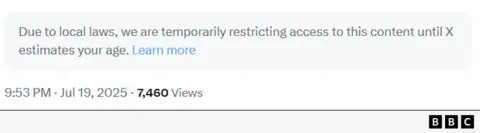
When users who had not verified their age attempted to access the post they were met with a message reading: “Due to local laws, we are temporarily restricting access to this content until X estimates your age.”

X A graphic showing the message used by X to users who have not verified their age. It reads: "Due to local laws, we are temporarily restricting access to this content until X estimates your age."X

The same warning was experienced by users who attempted to view a video of a Shahed drone destroyed mid-flight in Ukraine. The Iranian-made drones, which are widely used by Russia in the full-scale invasion, are unmanned and nobody was injured or killed in the clip.

Reddit has introduced similar restrictions. The platform, which hosts countless communities which discuss major news events, now requires age checks for some groups when users try to access them via search engines.

Among the Reddit communities which have been restricted is one called R/UkraineConflict, a message board with 48,000 members that frequently posts footage of the war. Similar restrictions, which urge users to “log in to confirm your age”, have been imposed on several pages which discuss the Israel-Gaza war and communities which focus on healthcare.

Meanwhile, clips of parliamentary debates have also been swept up in the restrictions. A speech by Conservative MP Katie Lam, containing a graphic description of the rape of a minor by a grooming gang, is available to view without restriction on Parliament’s official streaming website, ParliamentLive, but is restricted on X.

Lam, who was elected in 2024, wrote on social media: “The British state won’t protect children from mass gang rape. But it will ‘protect’ adults from hearing about it.”

Getty Images Katie Lam MP walks alongside Robert Jenrick. They are walking down a long corridor. Jenrick is wearing a dark suit, while Lam is wearing a brown suit. Getty Images

Another post restricted on X shared an image of Francisco de Goya’s 19th-century painting entitled Saturn Devouring His Son. The striking work depicts the Greek myth of the Titan Cronus – known as Saturn by the Romans – eating one of his children in fear of a prophesy that one would overthrow him and has been described as depicting “utter male fury”.

The examples gathered by BBC Verify are largely focussed on X and Reddit, as they clearly flag age-restricted content. Meta has a different system whereby ‘teen’ profiles are a different type of account with parental control – making it harder for us to identify which content is age-restricted.

It is unclear exactly how many posts commenting on debates of public interest are being restricted. X and Reddit did not respond to a request for comment.

But Prof Livingstone noted that it was “possible that the companies are over-blocking to undermine the Act”.

X owner Elon Musk has been highly critical of the Online Safety Act. The billionaire has launched a stream of attacks against the legislation online and X suggested that it could dissuade companies from launching products in the UK.

“[The law’s] purpose is suppression of the people,” Musk wrote on X on Monday, before sharing several posts by the far-right activist Tommy Robinson which also opposed the law.

Data suggests that the legislation could heavily impact adults in the UK. Large proportions of users – up to 37% on X and 59% on Reddit – access these platforms whilst logged out, according to data from the platforms. This means those users won’t be age-verified and will experience the internet in the same way as children.

The Department of Science, Innovation and Technology (DSIT) emphasised to BBC Verify that it was up to social media platforms themselves to decide how to implement the requirements of the act, but insisted that the risk-based approach must not “censor political debate”.

Ofcom, the UK media regulator tasked with enforcing the act, has warned that firms could face fines not only for failing to protect children, but also for breaching freedom of speech under the act.

BBC Verify’s analysis also suggested that the legislation had succeeded in blocking some harmful material online. Since Musk bought X, previously called Twitter, the platform has earned a reputation for being flooded with pornographic material, as well violent, antisemitic and racist posts.

However, we found that violent and pornographic content was significantly restricted when using an account without age verification.

The new obligations effectively puts firms in a position where they must comply with the law. Prof Livingstone suggested that they could still be in a period of “working out how best” to make judgements over the sort of content on their sites, which could be refined over time.

But Prof Wachter said that the level of self-regulation afforded to tech companies in choosing how to comply with the Online Safety Act called for well-staffed moderation teams equipped with “time, resources, expertise and nuance” to effectively make decisions.

She also noted that many major social media companies, such as X and Meta, have slimmed down their moderation teams in recent years or dissolved them completely.

“This trend is very worrying when opaque rules are now applied to make these take down decisions, especially in the current political climate,” Prof Wachter said.

The BBC Verify banner
A green promotional banner with black squares and rectangles forming pixels, moving in from the right. The text says: “Tech Decoded: The world’s biggest tech news in your inbox every Monday.”