Posted on

Children at risk of identity theft and fraud from ‘sharenting’

Shiona McCallumSenior tech reporter

Getty Images A young boy with an orange backpack on holding his mother's hand and looking into the distance. Getty Images

Children are at increased risk of being harassed, cyber-bullied and having their identities stolen in later life by having their photos posted online by parents, according to new research.

So-called “sharenting” – documenting a child’s special moments on social media – has become commonplace, but academics now warn this could come with unexpected risks.

University of Southampton researchers said their findings indicated it increased the risk of children becoming the victims of cyber-crime.

“These findings highlight the serious risks which children can face when photos and videos of them are shared widely on social media,” the NSPCC child safety online policy manager Rani Govender told the BBC.

“Sharing photos or videos of children at scale across the online world can put their safety, privacy and wellbeing at risk,” she said.

The researchers surveyed more than 1,000 parents in the UK, and then conducted follow-up interviews.

They found 45% of parents they spoke to actively put photos of their kids online – while one-in-six reported their child had experienced harms.

One concern is that the media being shared online could reveal details like birthdays, addresses, pet names, and so on – which later in life could increase the risk of identity fraud.

“Sharenting poses a real and present danger to our children,” lead researcher Pamela Ugwudike said.

“By proudly sharing photos and information about children on social media, parents are unwittingly putting them at risk of harm, both online such as cyberbullying, and in the real world – not just now, but also years down the line.”

She warned that, when pictures are shared, strangers could use that information to contact children not only online, but offline too.

‘Years down the line’

Sharenting has proven to be a controversial topic in the past, with some arguing it is an invasion of privacy.

It became a hot topic in 2019 when Gwyneth Paltrow posted a picture with her daughter Apple on Instagram – who then said she didn’t give her mother permission for the image to be shared.

At the time, one of the concerns was parents not being aware of privacy settings – which the researchers reported remains an issue now.

They found parents, carers and relatives – as well as schools – were largely unaware of the way privacy features on social media can be overridden by certain actions.

“This research shows parents overestimate the protection offered by privacy settings,” Ms Govender said.

“Features like tagging and resharing can bypass these protections, allowing content to spread beyond the intended audience even from ‘private’ accounts.”

Meanwhile, the Internet Watch Foundation (IWF) warned there were other risks linked to sharenting.

“We have seen criminals in the darkest parts of the internet boasting that they can use AI image generators to create life-like nude and sexual imagery of any child they like with only a handful of normal, non-sexual images,” said IWF head Kerry Smith.

She warned AI now poses a whole new range of harms including “the risk of sexual extortion” if the pictures were used to threaten or blackmail a child.

“AI imagery of children can now be so realistic, it is indistinguishable from real imagery,” she said.

A green promotional banner with black squares and rectangles forming pixels, moving in from the right. The text says: “Tech Decoded: The world’s biggest tech news in your inbox every Monday.”
Posted on

The first game to feel truly cinematic is back – years after its creator left

Tom GerkenTechnology reporter

Konami A video game character rendered in modern, high-quality graphics. She has long dirty blonde hair and blue eyes. She is wearing a jacket and has goggles hanging around her neck.Konami

Metal Gear is one of the best-selling video game series in history, shifting more than 60 million copies.

The series pioneered cinematics in gaming by blending cutting-edge cutscenes, voice acting and dynamic camera angles to create something that would have looked more at home on the big screen at the time.

Metal Gear tackled themes not commonly seen in games, such as nuclear disarmament and child soldiers, and posed philosophical questions while also leveraging offbeat humour.

The games would often break the fourth wall and ask players to find solutions to puzzles in unusual ways – such as looking on the back cover of the game’s physical box.

The series’ significant place in gaming history meant fans were stunned when its creator Hideo Kojima quit game publisher Konami in an acrimonious split in 2015.

One of gaming’s biggest titles was left directionless – and there’s been no game in the best-selling series since.

But now, a decade later, Konami has released a remake of Metal Gear Solid 3.

So what happened between Konami and Kojima, and how does the new game hold up without its original creator?

Why did Kojima leave Konami?

“The impact Metal Gear has had on game-making makes it one of the most heralded entertainment franchises in the world, and made Hideo Kojima one of the industry’s most famous creators,” industry expert Christopher Dring told the BBC.

With such success, you might think it was a match made in heaven, but there were issues bubbling under the surface.

While nothing has been said publicly, one generally accepted theory behind the split relates to the spiralling cost of 2015’s Metal Gear Solid V, estimated by some at more than $80m (£59m) – a very significant development cost at the time.

It is not known exactly what happened between Konami and Kojima, but the studio was clearly fed up with the amount of money he was spending to make a single game – with Kojima’s internal studio actually removed from promotional materials for Metal Gear Solid V at the time.

Konami got the game out the door, but it seemed to be scaled back from its original vision despite the high cost, with repeated levels and a third chapter that never emerged.

Even so, the game still received excellent reviews and won several awards, but the rift between company and creator seemed unfixable.

And in an act that proved highly controversial – and perhaps shows how heated things had become behind the scenes – when Metal Gear Solid V won an award, Konami informed the developer he was not allowed to collect it.

Getty Images Hideo Kojima. He has black hair in a short cut and wears large black glasses. He is smiling while he talks at a conference. He is wearing a trim black jacket and black t-shirt.Getty Images

A few months later, Kojima was gone, and in the years that followed, his former studio pivoted.

“Konami shifted its strategy for a while, away from console games, and focused its efforts on the amusements markets, things like pachinko machines,” Mr Dring said.

“They also focused increasingly on mobile.”

It meant Konami’s other classic franchises like Castlevania and Silent Hill also went without new games for a decade.

Meanwhile, Kojima’s new studio signed a blockbuster deal with Sony to develop the monster hit Death Stranding for PlayStation, followed by a sequel this year.

Why a remake now?

Gaming has pivoted towards remakes in recent years.

High-profile games like Resident Evil 4, Final Fantasy VII and Demon’s Souls, all classics in their day, have been remade with the benefits of modern graphics and game design to big fanfare – and strong sales figures.

“It’s a hugely lucrative and growing sector,” said Mr Dring.

“The industry is getting older, gamers are entering middle age and are nostalgic for classic titles.

Mr Dring points out that one of the best-selling games of the year so far is Elder Scrolls IV: Oblivion Remastered, a remake of a classic Role-Playing Game (RPG) from 2007, selling millions of copies since its release in April.

Konami has begun a return to publishing games by focusing in this area, with a Silent Hill remake coming last year and a new Survival Kids game released earlier in 2025.

So it is a potentially lucrative move – but is Metal Gear Solid 3: Snake Eater the right game to remake?

Konami A jungle scene from a video game. It is instantly recognisable as an older video game, with blocky rocks and pixel-y trees.Konami

Fans of the series told the BBC Metal Gear Solid 3 was chosen for good reason.

YouTuber Zak Ras said there was “immense significance” behind the game.

“Most people will say their favourite entry to the series is either Metal Gear Solid 1 or 3,” he said.

“Story-wise, given that it’s the first prequel set at the very beginning of the series timeline, it’s one of the few entries you can go into completely blind with absolutely no required knowledge of the series, other than very first Metal Gear from 1987.”

Ras said Metal Gear Solid 3 struck a good balance between gameplay and cinematic storytelling, making it a good choice for people who have never played a game in the series before.

For example, the game opens with an introduction heavily influenced by James Bond films, meaning new fans are eased into the series’ weirder elements.

And the brothers behind PythonSelkan Studios – known as Python & Selkan to their 122,000 YouTube subscribers – agreed.

“Completing the game was an incredible experience in itself,” they said. “Snake Eater’s gut-wrenching ending is what stood out most, leaving an impact on us that no other game had ever left before.”

“This game holds a special place in our hearts,” they added.

Metal Gear without Kojima

The brothers said, as lifelong fans of the series, they were “incredibly excited” by the announcement.

The pair are currently playing the remake, and have been “very impressed” by its improved graphics and audio.

They described the game as a “truly a faithful recreation”, adding that it improved “the essence of the original without changing its fundamental structure”.

Konami A jungle scene rendered in a video game. In the foreground, photo-realistic plants grow in front of a large tree. Several trees in the background are broken up by a beam of light.Konami

So far so good for Metal Gear Solid without Hideo Kojima – which Ras put down to the game being true to the original.

One example he highlights is that the voice performances have been kept the same, and players can choose whether to use the original control scheme or a more modern take.

“There’s no doubt it is Kojima’s directorial ‘genes’ that are being dominantly expressed here,” he said.

“Kojima expressed a desire to move on from Metal Gear since as early as MGS2 and leave the series in the hands of others to continue.

“It may have taken him another 14 years and five director credits for that to happen, but it is now reality.”

And however the remake fares with fans, one household won’t be picking up a new copy – Kojima himself has laughed off the suggestion that he would play the new game.

A green promotional banner with black squares and rectangles forming pixels, moving in from the right. The text says: “Tech Decoded: The world’s biggest tech news in your inbox every Monday.”
Posted on

Court documents shed new light on UK-Apple row over user data

Graham FraserTechnology Reporter

Getty Images The Apple logo on a window, with a city scene including skyscrapers reflected on the windowGetty Images

The UK government may have wanted to force Apple to provide it with access to more customer data than previously thought, a court document has indicated.

A row erupted between the two after it emerged the Home Office asked the tech giant for the right access to highly encrypted user data stored via a service called Advanced Data Protection (ADP).

Now a court document suggests the request – made under legislation called the Investigatory Powers Act – could have also enabled the government to seek access to a wider range of Apple customer data.

It also suggests the government may still be seeking to access data of non-UK users, despite US officials saying last week it had dropped the demand.

The UK government and Apple have been approached for comment.

It is believed the UK government would only want to access this data if there was a risk to national security.

In February, it emerged the government had demanded to be able to access encrypted data stored by Apple users worldwide in its cloud service. It applied to all content stored using ADP service.

The tech uses end-to-end encryption, where only the account holder can access the data stored – even Apple itself cannot see it.

It was an opt-in service, and not all users choose to activate it.

While it makes your data more secure, it comes with a downside – it encrypts your data so heavily that it cannot be recovered if you lose access to your account.

It is unknown how many people choose to use ADP.

‘Back door’

After US politicians and privacy campaigners outlined their anger at the move, Apple decided to pull ADP from customers in the UK.

Now, a new court document has emerged from the Investigatory Powers Tribunal (IPT), an independent judicial body.

The IPT hears complaints from anyone who feels they have been the victim of unlawful action by a public body using covert investigative techniques.

It could also relate to the conduct of UK intelligence services including MI5 and MI6.

In this latest court filing, first reported by the Financial Times, it states Apple was given a technical capability notice (TCN) by the UK government at some point between late 2024 and early 2025.

It states the notice “applies to (although is not limited to) data covered by” ADP – it was previously understood the government’s demand was exclusively focused on data stored using the encryption technology.

The TCN to Apple also included “obligations to provide and maintain a capability to disclose categories of data stored within a cloud based backup service and to remove electronic protection which is applied to the data where that is reasonably practicable”.

The filing adds: “The obligations included in the TCN are not limited to the UK or users of the service in the UK; they apply globally in respect of the relevant data categories of all iCloud users.”

The new court document from the IPT is dated Wednesday, 27 August – eight days after Tulsi Gabbard, the US director of national intelligence, said the UK had withdrawn its controversial demand to access global Apple users’ data if required.

Gabbard said at the time in a post on X the UK had agreed to drop its instruction for the tech giant to provide a “back door” which would have “enabled access to the protected encrypted data of American citizens and encroached on our civil liberties”.

The BBC understood at the time Apple had not yet received any formal communication from either the US or UK governments.

It is not clear if this new court document simply refers to the UK government’s initial intention, or if indicates that the UK government has not yet dropped its wish to be able to access the data of Apple users from around the world, including those from the US.

Apple declined to comment, but says on its website that it views privacy as a “fundamental human right”.

Apple has previously said it would “never build a back door” in its products.

Cyber security experts agree that once such an entry point is in place, it is only a matter of time before bad actors also discover it.

No Western government has yet been successful in attempts to force big tech firms like Apple to break their encryption.

The US government has previously asked for this, but Apple has refused.

In 2016, Apple resisted a court order to write software which would allow US officials to access the iPhone of a gunman – though this was resolved after the FBI was able to successfully access the device.

Similar cases have followed, including in 2020, when Apple refused to unlock iPhones of a man who carried out a mass shooting at a US air base.

A green promotional banner with black squares and rectangles forming pixels, moving in from the right. The text says: “Tech Decoded: The world’s biggest tech news in your inbox every Monday.”
Posted on

Kick accuses French authorities of politicising streamer’s death

Graham FraserTechnology Reporter

@jeanpormanove Raphaël Graven stands outside at night in the street. He is wearing a white shirt and grey suspenders, with a white flat cap. He has glasses and sharp facial hair trimmed in a type of goatee. There are cars and houses behind him lit yellow in the streetlights under the dark sky.@jeanpormanove

The streaming platform Kick has accused French authorities of politicising the death of a content creator who passed away during a livestream.

Raphaël Graven, also known as Jean Pormanove, was found dead in a residence near the city of Nice last week.

Prosecutors have opened an investigation into the Australian video platform, and French government minister Clara Chappaz said the state would take Kick to court to “stop the damage caused by the content involved in this tragedy”.

“This is not about creator safety, customer safety, or the well-being of the industry, but rather a politicised narrative that takes advantage of a tragic personal loss,” Kick told BBC News.

And the streaming platform said it was “disappointed” the media were told about the minister’s actions before it was.

The BBC has reached out to the French government for a response.

Mr Graven was known for videos in which he appeared to endure apparent violence and humiliation.

The Paris prosecutor said this week its investigation would look into whether Kick knowingly broadcast “videos of deliberate attacks on personal integrity”.

Kick has now given more information, from its perspective, about the death of Mr Graven.

It said the creator died during a “typical” livestream and, according to prior statements made by Mr Graven and the other participants, their content was “pre-planned and scripted”.

Kick said Mr Graven passed away in bed during the stream, and it said it has removed content showing his death.

Kick also states it suspended all related accounts pending investigation, and said it cooperated fully with all authorities, including law enforcement, the regulatory body Arcom and the office of Chappaz.

‘Correct the false narratives’

“We are surprised by the messages conveyed by politicians,” Kick said.

“We never tried and will not try to escape or deny our regulatory obligations.

“We hope that it will be possible to work serenely with French authorities and correct the false narratives that are circulated.”

Mr Graven was found dead on 18 August.

Local media reported the 46-year-old had been subject to bouts of violence and sleep deprivation during streams.

In a post on X, Chappaz described his death as an “absolute horror” and said he had been humiliated and mistreated on the platform for months.

A post-mortem examination revealed Mr Graven’s death was not the result of trauma or the actions of a third party.

Local police have seized videos and interviewed a number of people they say were present when he died.

They also disclosed Mr Graven had previously been spoken to by detectives and had “firmly denied” being a victim of violence, saying the acts he was involved in were staged to “create a buzz” and make money.

Kick is a platform similar to Twitch, and users can broadcast content and interact with other users in real time.

“We are deeply saddened by the loss of Jean Pormanove and extend our condolences to his family, friends and community,” said Kick in a previous statement.

A green promotional banner with black squares and rectangles forming pixels, moving in from the right. The text says: “Tech Decoded: The world’s biggest tech news in your inbox every Monday.”
Posted on

Apple warns UK against introducing tougher tech regulation

Apple has warned that “EU-style rules” proposed by the UK competition watchdog “are bad for users and bad for developers”.

It says EU laws – which have sought to make it easier for smaller firms to compete with big tech – have resulted in some Apple features and enhancements being delayed for European users.

It argues the UK risks similar hold-ups if the Competition and Markets Authority (CMA) pushes ahead with plans designed to open up markets the regulator says is too dominated by Apple and Google.

The CMA told the BBC it rejected Apple’s characterisation of UK competition rules, arguing they were different from those in the EU and helped businesses innovate and grow.

Apple’s intervention comes as international tech regulation was sharply criticised by President Donald Trump.

He did not specify which countries he was unhappy with, but attacked rules he claimed were “designed to harm, or discriminate against, American Technology” in an online post on Monday.

He demanded nations “show respect to America and our amazing Tech Companies or, consider the consequences!”

The US President wrote that all countries with digital taxes, legislation, rules, or regulations were “on notice” that unless such “discriminatory actions” were removed tariffs and restrictions on their access to US technology would follow.

The CMA, however, argues that its interventions will be good for users and UK app developers.

In July it found that “around 90-100% of UK mobile devices” ran on Apple or Google’s mobile platforms, adding this meant the firms had “an effective duopoly”.

As a result it said it would require Apple and Google to make changes to their services – for example permitting app makers to “steer” users to payment systems outside of Apple’s own App Store.

It has now given the companies a chance to respond and will make a final decision in October.

In its new statement, Apple argues that the CMA’s approach “undermines the privacy and security protections our users have come to expect, hampers our ability to innovate, and forces us to give away our technology for free to foreign competitors.”

According to Apple, the watchdog’s proposed changes repeat mistakes made by the EU in its enforcement of its tech competition law the Digital Markets Act (DMA).

Apple has had big fines imposed on it for breaching the DMA.

The CMA wants UK app makers to be able to use and exchange data with Apple’s mobile technology – something called “interoperability”

Without it, app makers cannot create the full range of innovative products and services, it argues.

Apple claims under EU interoperability rules it has received over100 requests — some from big tech rivals — demanding access to sensitive user data, including sensitive information Apple itself cannot access.

It argues the rules are effectively allowing other firms to demand its data and intellectual property for free.

However, the CMA argues that, unlike the EU, it is focused on ensuring the interoperability of particular aspects of Apple’s tech such as digital wallets and watches, so that UK developers can use them to create innovative new apps.

Apple also argues that proposals enabling App developers to steer users to rival payment systems would open the door to scams and threaten the security of users.

In response to Apple’s criticisms, the CMA wrote that UK competition rules work in a fundamentally different way to the EU:

“They are designed to help UK businesses, including our thriving app developer economy, innovate and grow while ensuring UK consumers don’t miss out on innovation being introduced in other countries,” it said in a statement.

“Driving greater competition on mobile platforms need not undermine privacy, security or intellectual property, and as we carefully consider UK-specific steps, we will ensure it does not,” it added.

Posted on

Video platform Kick investigated over streamer’s death

French prosecutors have opened an investigation into the Australian video platform Kick over the death of a content creator during a live stream.

Raphaël Graven – also known as Jean Pormanove – was found dead in a residence near the city of Nice last week.

He was known for videos in which he endured apparent violence and humiliation.

The Paris prosecutor said the investigation would look into whether Kick knowingly broadcast “videos of deliberate attacks on personal integrity”.

A spokesperson from Kick said the firm was aware of the investigation and was taking legal advice.

“We remain fully committed to cooperating with the relevant authorities with any ongoing investigation,” they added.

The prosecutor’s investigation will also seek to determine whether Kick complied with the European Union’s Digital Services Act, and the obligation on platforms to notify the authorities if the life or safety of individuals is in question.

In a separate announcement, France’s minister for digital affairs, Clara Chappaz, said the government would sue the platform for “negligence” over its failure to block “dangerous content”, according to the AFP news agency.

Mr Graven was found dead on 18 August.

Local media reported the 46-year-old had been subject to bouts of violence and sleep deprivation during streams, and died in his sleep during a live broadcast.

In a post on X the next day Chappaz, described his death as an “absolute horror”, and said he had been humiliated and mistreated on the platform for months.

A postmortem carried out later that week revealed Mr Graven’s death was not the result of trauma or the actions of a third party.

Local police have seized videos and interviewed a number of people they say were present when he died.

They also disclosed Mr Graven had previously been spoken to by detectives and had “firmly denied” being a victim of violence, saying the acts he was involved in were staged to “create a buzz” and make money.

Kick is a platform similar to Twitch, and users can broadcast content and interact with other users in real time.

“We are deeply saddened by the loss of Jean Pormanove and extend our condolences to his family, friends and community,” said Kick in a previous statement.

The platform’s community guidelines were “designed to protect creators” and Kick was “committed to upholding these standards across our platform”, its spokesperson added.

Posted on

Child sex abuse victim begs Elon Musk to remove links to her images

Angus Crawford and Tony Smith

BBC News Investigations

BBC Woman with long hair, show the back of her head. She is surrounded by empty online message boxes, in the background is the X logo.BBC

A victim of child sexual abuse has begged Elon Musk to stop links offering images of her abuse being posted on his social media platform X.

“Hearing that my abuse – and the abuse of so many others – is still being circulated and commodified here is infuriating,” says “Zora” (not her real name) who lives in the United States and was first abused more than 20 years ago.

“Every time someone sells or shares child abuse material, they directly fuel the original, horrific abuse.”

X says it has “zero tolerance for child sexual abuse material” and tackling those who exploit children remains “a top priority”.

The BBC found images of Zora while investigating the global trade of child sex abuse material, estimated to be worth billions of dollars by Childlight, the Global Child Safety Institute.

The material was among a cache of thousands of similar photos and videos being offered for sale on an X account. We got in contact with the trader through the messaging app Telegram, and this led us to a bank account linked to a person in Jakarta, Indonesia.

Zora was first abused by a family member. A collection of images of her abuse have become infamous among paedophiles who collect and trade such content. Many other victims face the same situation, as images of abuse continue to circulate today.

Zora is angered the trade continues to this day.

“My body is not a commodity. It never has been, and it never will be,” she says.

“Those who distribute this material are not passive bystanders, they are complicit perpetrators.”

Tracking the X account

Images of Zora’s abuse were originally only available on the so-called dark web, but she now has to live with the reality that links are being openly promoted on X.

Social media platforms are trying to rid their platforms of illegal material, but the scale of the problem is enormous.

Last year the US National Center for Missing and Exploited Children (NCMEC), received more than 20 million mandatory reports from tech companies about incidents of child sexual abuse material (CSAM) – illegal images and videos on their platforms.

NCMEC attempts to identify victims and perpetrators, the organisation then contacts law enforcement.

We approached “hacktivist” group Anonymous, whose members are trying to combat the trade in child abuse images on X. One of them told us the situation was as bad as ever.

They tipped us off about a single account on X. It used a photo of the head and shoulders of a real child as its avatar. There was nothing obscene about it.

But the words and emojis in the account’s bio made it clear the owner was selling child sexual abuse material and there was a link to an account on the messaging app Telegram.

Getty Images Anonymous logo: a man in a suit with a question mark instead of a head.Getty Images

The trader appeared to be based in Indonesia and was offering “VIP packages”, collections of images and video files of abuse for sale to paedophiles around the world.

The Anonymous activist had been working to report this trader’s multiple accounts on X, so they could be removed by the platform’s moderation systems. But each time one account was removed, he told us, another new one would replace it.

The trader appeared to have been overseeing more than 100 almost-identical accounts. The activist told us that when he had contacted the trader directly using Telegram, the trader had replied saying he had thousands of videos and images for sale.

“I have baby. Kids young 7-12”, he wrote in messages to the activist seen by the BBC. He also explained that some of the content showed child rape.

We got in touch with the trader ourselves.

He provided links to samples of material, which we did not open or view. Instead, we contacted experts from the Canadian Centre for Child Protection (CCCP) in Winnipeg – who work alongside law enforcement and are legally permitted to view such content.

Young woman wearing glasses looks at. computer monitor screen.

“The Telegram account was, for lack of a better term, a taster pack – essentially a collage of the material he had available of all the different victims,” explained Lloyd Richardson, the CCCP’s director of technology. “When we looked at all the different images in the collages, I would say there were thousands.”

Among the files were images of Zora.

Her abuser in the US was prosecuted and imprisoned many years ago, but not before footage of the abuse had already been shared and sold across the world.

Zora told us: “I have tried over the years to overcome my past and not let it determine my future, but perpetrators and stalkers still find a way to view this filth.”

As she grew older, stalkers uncovered Zora’s identity, contacting and threatening her online. She says she feels “bullied over a crime that robbed me of my childhood”.

Finding the trader

To identify the trader selling photos of Zora, we posed as a buyer.

The trader sent us his bank information and an online payment account, both had the same name listed as the account holder.

The Anonymous activist had discovered this name was also linked to two money transfers and another bank account.

We tracked down a man with the same name as that listed on the accounts, to an address on the outskirts of the Indonesian capital, Jakarta.

A producer working in the city for the BBC World Service went to visit the address and confronted a man on the premises who, when presented with the evidence, said he was shocked.

“I don’t know anything about this,” he said.

The man confirmed one of the bank accounts was his and stated it was created for a single mortgage-related transaction. He said he had not used the account since and that he would contact his bank to find out what had happened. He denied knowledge of the other bank account or the money transfers.

We cannot know for certain if, and to what extent, he may be involved and as a result we are not naming him.

Jakarta cityscape, four roads of traffic, in the background are many skyscrapers.

The way Zora’s images were being marketed is a method used by hundreds of traders across the world, our investigation found.

Posts on X use different hashtags familiar to paedophiles. Images that appear on the platform are often taken from known child abuse images but can be cropped so they are not obscene.

Elon Musk said removing child sexual abuse material was his “top priority” when he took over X, then known as Twitter, in 2022.

AFP via Getty Images Elon Musk carries a sink into the reception of the headquarters of X, then known as Twitter, on the wall is the old Twitter logo.AFP via Getty Images

Social media platforms in general, not just X, could do much more to prevent criminals posting repeatedly in this way, says Lloyd Richardson from the CCCP.

“It’s great that we can send a takedown notice [to social media platforms], and they remove the account, but that’s the bare minimum.”

The problem is that users can come back onto the platforms in a few days with a new account, he says.

X told us it has “zero tolerance” for child sexual exploitation. “We continually invest in advanced detection to enable us to take swift action against content and accounts that violate our rules,” said a spokesperson.

The platform told us it works “closely with the National Center for Missing and Exploited Children (NCMEC) and supports law enforcement efforts to prosecute these heinous crimes”.

Telegram said: “All channels are moderated, and more than 565,000 groups and channels related to the spread of CSAM have been banned so far in 2025.”

The platform said it has more than a thousand moderators working on the issue.

“Telegram proactively monitors public content across the platform and removes objectionable material before it can reach users or be reported,” a spokesperson said.

When we told Zora her photos were being traded using X, she had this message for the platform’s owner, Elon Musk: “Our abuse is being shared, traded, and sold on the app you own. If you would act without hesitation to protect your own children, I beg you to do the same for the rest of us. The time to act is now.”

If you are affected by any of the issues raised in this report, help and support is available via the BBC Action Line

Posted on

Women aren’t just ‘cosy gamers’ – I play horror games and 600,000 watch

Alex Taylor

Reporting fromLondon

Alyce Rocha Alyce Rocha kneeling next to her PC at home. She has brown eyes and brunette hair, with blonde highlightsAlyce Rocha

Alyce Rocha makes her living working from home – but she doesn’t have a normal nine to five.

Forget endless Teams meetings, she’s spent recent weeks living the (virtual) life of an ambitious Mafia upstart in 1900s Sicily.

Such is life as a video game streamer.

Known online as Alyska, she has made gaming her full-time career, by broadcasting herself playing games live, to her combined 585,000 followers.

The appeal, she says, is “sharing an experience together”.

“If you’ve played the game yourself then you want to see someone else’s reaction,” she tells the BBC’s Woman’s Hour.

Once thought of as a male-dominated pastime, today women make up around half of the game-playing public, according to the UK Games Industry Census.

Alyce says part of her role is challenging perceptions over the types of games women enjoy.

Statistics suggest women mostly play puzzle and strategy-style games. These non-violent titles, including life simulators The Sims and Animal Crossing, are often grouped under the label of “cosy gaming”.

But Alyce says she, like many women, also enjoys role-playing action and fantasy-adventure games.

“I used to hate horror games,” Alyce explains. “However, my audience loved to see me suffer, so I would play more and more, to the point I actually love them now”.

The make-up of her audience reflects this. While still predominantly male, she’s seen female viewership jump to around 10% in recent years – a small but significant increase.

Alyce earns what she describes as a “respectable” wage – even as one of the smaller names in the scene.

Not that it’s easy work. Gaming may be fun, but the challenge to not only grow, but maintain, an audience is relentless.

“I’m always grinding,” says Alyce, only recently cutting down from 12-hour days to six-hour streams, alongside morning admin, seven days a week.

She needs to juggle multiple accounts streaming on popular platforms like Twitch and YouTube, to make enough income from things like paying subscribers, revenue and partnerships.

It’s a task complicated by many platforms requiring a cut of broadcast earnings. Twitch, for example, takes half as standard.

This competitiveness reflects an industry that is now worth more than music, TV and film combined, with revenue this year projected to reach £13.7bn in the UK alone.

Getty Images A games console controller backlit by a screen showing a Twitch profileGetty Images

Women ‘less quiet’ about gaming

Although figures show young women now play games just as much as men, the streaming sector audience is still predominantly male according to YouGov. Blockbuster titles like Fifa and Call of Duty mirror this.

Frankie Ward, an eSports gamer and presenter, says this is a lot about who games are being marketed to.

“In the past gaming has kind of been this protected identity that men have held on to very strongly.

“Women are being a lot more vocal about the fact that they’re gamers, and they’re becoming a lot prouder to say so.”

Sony Ellie in The Last of Us II, playing a guitar while sitting against a treeSony

In the industry, there’s also been a noticeable departure from the over-sexualised, female characters of yesteryear, toward more rounded portrayals.

Games like The Last of Us, partly moulded by writers like Halley Gross, boast layered female characters at their core. Elsewhere, Life is Strange and Rage and Bloom have woven the realities of teenage life and womanhood – from periods to sexuality and body image – into their wider narratives.

Reflecting on the shift, Alyce says there have always been women gamers, but they’ve just been “quieter about it” – until now.

“I’ve been gaming since I was a child.” she says. “I didn’t know anyone in my school who was a girl who played games, whereas now it’s so easy to find communities and streamers who are women who you can talk to and game with.”

An ‘escape’ from daily struggles

Black Girl Gamers are one group that are bringing women together through gaming. What started out as a small Facebook group in 2015 has grown into a community of over 10,000 black female players worldwide.

Speaking to BBC Women’s Hour, community member Iesha says that gaming with the group has helped her meet like-minded people who share her background – some of whom have become her closest friends.

“When I was younger… I didn’t know there were other black female gamers like me.

“I thought I was a bit of an anomaly. I like the fact that I’m not.

Fellow member Deanne has become a close friend. She playfully compares meeting lesha online to a “try before you buy” situation. Hours spent chatting while gaming meant they got to know each other so well that their first in-person meeting felt entirely natural.

Deanne says that gaming with the group offers her “an escape” from daily struggles, including those unique to black women. “It’s a whole universe of people who just get it; everybody understands – it gives you a calmer mindset,” she says.

Adaobi, Deanne, Woman's Hour presenter Nuala McGovern and Iesha

This can help when dealing with the toxic elements of the wider online gaming community that persist more than a decade on from GamerGate.

Adaobi, another Black Girl Gamer, says the camaraderie buffers the times when she joins public online game sessions outside the group and faces misogynistic or racist abuse.

“I know if I turn on my mic and I open my mouth [to talk during an online game], somebody’s not going be happy with it,” she says. In response, she’s begun telling men who abuse her to simply “do better”.

Others, like Deanne, opt to mute interactions. “I just turn it off. I don’t listen to them. The scoreboard will tell everything,” she quips.

To help combat these shared negative experiences, the community has launched a ‘venting’ channel on its Discord social media platform. A safe, member-only space for discussion and support.

Gaming then, is no longer a solitary experience, but an online world that can be a positive gateway to real-world understanding and connection.

For Iesha, be it playing online with others or watching a stream, gaming has also become an emotional refuge to navigate feelings.

“Gaming has helped me through some tough times, including family loss and grief,” she says. “Some of these games allow you to experience these emotions in gentle ways.”

And, as she emphasises, the shared journey makes all the difference. “I’m going through stuff…they’re going through stuff – but we can get through it,” she says. “That’s gaming”.

More on this story
Posted on Leave a comment

Top Smart TV Brands: Who Offers the Fastest and Best Processors?

Top Smart TV Brands: Who Offers the Fastest and Best Processors?

Understanding Smart TV Processors

Smart TV processors are critical components that significantly influence a television’s performance, affecting everything from speed to image quality and user interface responsiveness. Essentially, the processor acts as the brain of the smart TV, executing tasks and managing various multimedia functions. In the context of smart TVs, processors handle the processing of images, decoding video streams, and running the operating system and applications. The efficiency and power of the processor can determine how smoothly a user can navigate through menus, stream content, or multitask between different applications.

Various types of processors are utilized in smart TVs, typically categorized into single-core, dual-core, quad-core, and even more advanced multi-core configurations. Generally, a higher number of cores allows for better multitasking capabilities, enabling users to run multiple applications simultaneously without experiencing lag. For instance, a quad-core processor can efficiently manage tasks such as streaming a movie while also updating its operating system in the background. Additionally, some brands employ specialized processors designed specifically for enhancing video quality through upscaling and color adjustments, further enriching the viewing experience.

Key specifications to consider when evaluating smart TV processors include clock speed measured in gigahertz (GHz), number of cores, and the architecture of the processor itself. A higher clock speed indicates faster processing capabilities, while an efficient architecture can lead to better power consumption. Other metrics like RAM size play a role as well, as adequate memory is crucial for ensuring applications run smoothly. Thus, understanding these aspects of smart TV processors is vital for consumers aiming to select a television brand that offers optimal speed while enhancing overall user satisfaction.

Leading Brands and Their Processor Technologies

In the competitive landscape of smart TVs, several leading brands distinguish themselves with advanced processor technologies designed to optimize performance and enhance user experience. Samsung, LG, Sony, and TCL are among the most prominent players, each offering unique innovations that drive their flagship models.

Samsung, known for its high-quality displays and cutting-edge technology, utilizes the Quantum Processor series in its premium models. This family of processors leverages machine learning algorithms to upscale lower resolution content, improve picture quality, and manage HDR content dynamically. By employing AI capabilities, Samsung’s Quantum Processor ensures seamless multitasking and a responsive user interface, catering to the demands of modern streaming services and gaming.

LG, on the other hand, showcases its Alpha processor line, particularly in its OLED TVs. The Alpha 9 Gen 4 AI processor stands out with its deep learning technology, which analyzes and fine-tunes audio and video content in real-time. This leads to enhanced contrast, rich colors, and optimized sound performance. LG’s commitment to providing a cinematic experience is evident in its use of innovative technologies that make viewing more immersive and enjoyable.

Sony utilizes its proprietary Cognitive Processor XR in flagship models, aimed at replicating human perception for an enhanced viewing experience. This technology works by analyzing and optimizing multiple elements simultaneously, ensuring that colors appear more vibrant and images maintain clarity. Furthermore, Sony’s implementation of XR Motion and XR Surround contributes to smooth motion rendering and immersive audio experiences, positioning Sony as a leader in smart TV performance.

TCL, often recognized for its affordability, has rapidly gained traction due to their integration of the AiPQ Engine. This proprietary technology intelligently optimizes picture quality and performance across various content types, allowing TCL to deliver a competitive option with impressive processing capabilities without commanding premium pricing.

Each brand brings innovative processor technologies that reflect their unique philosophies and emphasize their commitment to enhancing the smart TV experience. By understanding these advancements, consumers can make informed decisions regarding their next purchase.

Performance Comparison: Speed and Efficiency

The performance of smart TVs largely hinges on the efficiency and speed of their processors, which play a pivotal role in determining overall user experience. In recent evaluations, several leading smart TV brands have been scrutinized for their processing capabilities, particularly focusing on benchmark results that highlight the strengths of their respective systems. Brands such as Samsung, LG, Sony, and TCL have demonstrated varying levels of processing efficiency in terms of load times for applications and overall responsiveness to user commands.

Benchmark tests reveal that Samsung’s Quantum Processor ranks among the fastest, offering rapid load times for popular streaming applications. Similarly, LG’s α9 processor is noted for its efficient performance that not only accelerates app response but also enhances picture quality through superior upscaling techniques. Sony’s Cognitive Processor XR also stands out, delivering remarkable real-time optimizations that further boost both speed and visual fidelity. These performance metrics are critical for consumers who desire seamless interaction without lag, especially when navigating through apps or streaming content in high resolution.

Another essential aspect contributing to operational efficiency is the integration of intelligent processing methods. For instance, upscaling capabilities allow these processors to enhance the quality of lower-resolution content, making it more visually appealing. This is particularly important in today’s media landscape, where the availability of 4K and 8K content is steadily increasing. Hence, not only do processors need to manage load efficiency, but they must also adeptly handle content enhancement. Overall, the comparative analysis shows that while there are top contenders in the smart TV market, the specific features and technologies each brand employs differentiate their performance and operational capabilities. Understanding these nuances helps consumers make informed decisions when choosing a smart TV based on processing speed and efficiency.

Making the Right Choice: Which Brand to Choose?

When it comes to selecting the right smart TV, understanding processor performance is essential. With a variety of brands available, consumers must assess their individual needs, whether it be for gaming, streaming, or general usage. Certain brands, such as Samsung and LG, are often praised for their advanced processors, which enhance overall performance, providing seamless multimedia experiences. For gamers, low latency and high frame rates are critical, making it worthwhile to research models with dedicated gaming modes that utilize their processing power for smoother gameplay.

For streaming purposes, consider smart TVs with robust application support and fast processor response times. Brands like Sony and Vizio offer models equipped with processors that provide quick access to popular streaming platforms, ensuring buffer-free content consumption. Additionally, it’s important to evaluate the smart TV’s operating system and interface—some brands provide more user-friendly platforms that can enhance the overall experience.

Price points are also a significant factor when choosing a brand. While premium brands may offer top-tier processors, more budget-friendly options from manufacturers like Hisense and TCL can still provide respectable performance without breaking the bank. It is advisable to balance cost with performance—ensuring that the chosen model meets your specific needs at a fair price.

Warranty options and processor longevity should not be overlooked either. Many brands offer extended warranties that reflect their confidence in processor durability and performance over time. Researching customer reviews and satisfaction ratings can also provide further insight into how well these processors hold up under various usage conditions. By taking these factors into account, consumers can make informed decisions for their next smart TV purchase, ultimately leading to greater satisfaction with their investment.


Posted on

My ex stalked me, so I joined a ‘dating safety’ app. Then my address was leaked

Jacqui Wakefield

Global Disinformation Unit, BBC World Service

Getty Images/ Carlos Barquero Woman holding phoneGetty Images/ Carlos Barquero

Sally was stalked by her ex-boyfriend.

After ending their relationship, he would turn up at work – and even her friends’ houses. She eventually had to move.

When she finally got back on to the dating scene, she was wary. She decided to sign up for a new app where women could do background checks and share experiences of men they were dating.

Users of the US-based Tea Dating Advice app, which is only available in America, could flag if potential partners were married or registered sex offenders.

They could run reverse image searches to check against people using fake identities. It was also possible to mark men as red or green flags, and share unproven gossip.

The app was founded in 2023 but climbed the charts in the US to the number one spot in July this year. It reportedly attracted more than a million users.

Sally, whose name has been changed to protect her identity, thought it was interesting to read what was being said about men in her area. But she found it “gossip-y” and that some of the information on it was unreliable.

In late July, the app was hacked. Over 70,000 images were leaked and posted on the online message board 4chan – including IDs and selfies of users which were meant to have been for verification purposes only and “deleted immediately”.

The leak was seized on by misogynist groups online, and within hours, several websites had been created to humiliate the women who’d signed up.

Two maps were published on social media, showing 33,000 pins spread across the United States. Fearing the worst, Sally zoomed in, looking for her home.

She found it – although it wasn’t linked to her name, her exact address was highlighted for anyone to see.

She was worried her stalker ex-partner could now track her down. “He didn’t know before where I lived or worked and I’ve gone to great lengths to keep it that way,” she says. “I’m very freaked out.”

The BBC alerted Google of the two maps hosted on Google Maps purporting to represent the locations of women who had signed up for Tea.

The company said the maps violated their harassment policies and deleted them. Since the breach, more than 10 women have filed class actions against the company which owns Tea.

A spokesperson for Tea app said they were “working to identify and notify users whose personal information was involved and notify them under applicable law” and that affected users would be “offered identity theft and credit monitoring services”.

They also said that they “bolstered resources” to enhance security for current membership, that they’re “proud of what [they’ve] built”, and that their “mission is more vital than ever”.

Misogynists ‘rank’ leaked selfies

Since the breach, the BBC has found websites, apps and even a “game” featuring the leaked data which encourages harassment towards women who had joined the app.

The “game” puts the selfies submitted by women head-to-head, instructing users to click on the one they prefer, with leaderboards of the “top 50” and “bottom 50”. The BBC could not identify the creator of the website.

Users outside of the misogynistic groups were also reposting content deriding the appearance of women on X and TikTok.

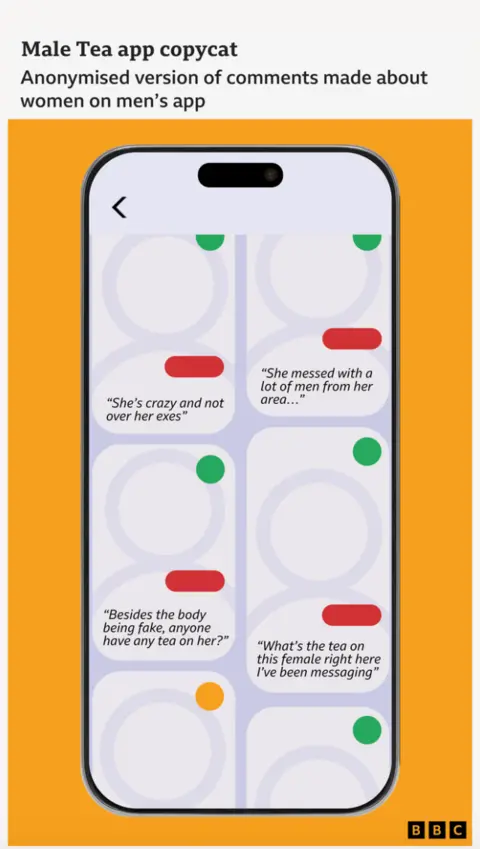
Copycat Tea apps for men have also proliferated – but there’s no suggestion the men are doing this for their safety. Instead, users post harsh derogatory reviews of women.

Image of phone shape with anonymised reviews from the male tea apps.

In screen recordings seen by the BBC, users comment on women’s sexuality and post intimate images of women without their consent in the apps.

The BBC also identified more than 10 “Tea” groups on the messaging app Telegram where men share sexual and apparently AI-generated images of women for others to rate or gossip. They post the women’s social media handles, revealing their identities.

A spokesperson for Telegram said that “illegal pornography is explicitly forbidden” and “removed when discovered”.

John Yanchunis, a lawyer representing one of the women against the company that owns the app, said she had been subject to immense online abuse.

“It caused a tremendous amount of emotional distress,” he told the BBC. “She became the subject of ridicule.”

It is unsurprising that the leak was exploited.

The app had drawn criticism ever since it had grown in popularity. Defamation, with the spread of unproven allegations, and doxxing, when someone’s identifying information is published without their consent, were real possibilities.

Men’s groups had wanted to take the app down – and when they found the data breach, they saw it as a chance for retribution.

“This leak was picked up by misogynist communities as a great cause and one that they obviously take a lot of pride in,” says Callum Hood, head of research at the Centre for Countering Digital Hate.

More than 12,000 posts on 4Chan referenced Tea Dating app from 23 July, three days before the leak, to 12 August, he adds.

A rift between men and women?

Online, the Tea app leak is being referred to as part of a “gender war” and the final straw in heterosexual dating.

There is growing evidence that suggests that heterosexual young people are turning away from traditional dating and long-term romantic relationships.

Negative experiences in online dating are adding to these tensions.

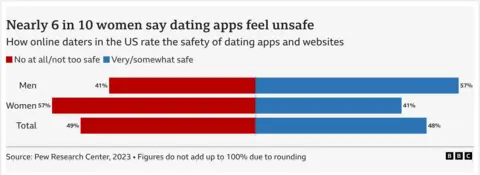
A 2023 Pew research found that in the US, over half of women’s experiences on dating apps have been negative, with women being more likely to report unwanted behaviours from men and feeling unsafe on dating apps.

Bar chart with Pew Research data showing 57% of women report feeling unsafe using dating apps, and 41% of men reporting feeling unsafe.

Dr Jenny Van Hooff, a sociologist at Manchester Metropolitan University, says the perceived lack of safety impacts how many young women may want to take part in online dating.

Unlike meeting partners through friends or work, there are fewer repercussions for poor online dating behaviour.

“Women’s experiences of the opposite sex on dating apps is a feeling of fear and lack of trust,” she says. “Misogyny is just getting more entrenched in dating.”

Previous incarnations to the Tea app, such as ‘Are We Dating the Same Guy’ social media groups with thousands of followers, have existed for years globally.

At first, they were hailed as a new way to hold men accountable. But, like Tea, controversy followed, and many men felt misrepresented by what was posted.

With reportedly more than a million users, the Tea App took this concept to a new scale.

But experts have also questioned possible profit motivations behind the app, alongside the trustworthiness of the information posted.

For women wishing to use the app for safety, verifying the information can be challenging. Meanwhile, men, who are unable to access the app, have no way of knowing if false information is posted about them.

Dr Van Hooff said the leak was “proving women’s point to why this app was felt to be necessary”.

“It’s definitely not disabusing these women of any thoughts they have about men and male behaviour.”

She believes women’s safety has been compromised, and men have felt their actions were taken out of context and exploited for gossip.

For Sally, the leak has impacted her sense of protection.

“I’m moving in with loved ones just to feel safe,” she says.

More weekend stories