Posted on

Ofcom asks X about reports its Grok AI makes sexualised images of children

Ofcom has made “urgent contact” with Elon Musk’s company xAI following reports its AI tool Grok can be used to make “sexualised images of children” and undress women.

A spokesperson for the regulator said it was also investigating concerns Grok has been producing “undressed images” of people.

The BBC has seen several examples on the social media platform X of people asking the chatbot to alter real images to make women appear in bikinis without their consent, as well as putting them in sexual situations.

X has not responded to a request for comment. On Sunday, it issued a warning to users not to use Grok to generate illegal content including child sexual abuse material.

Elon Musk also posted to say anyone who asks the AI to generate illegal content would “suffer the same consequences” as if they uploaded it themselves.

XAI’s own acceptable use policy prohibits “depicting likenesses of persons in a pornographic manner”, but people have been using Grok to digitally undress people without their consent.

Images of Catherine, Princess of Wales, were among many to have been digitally de-clothed by Grok users on X.

The BBC has approached Kensington Palace for comment.

The European Commission – the EU’s enforcement arm – said on Monday it was “seriously looking into this matter” and authorities in France, Malaysia and India were reportedly assessing the situation.

Meanwhile, the UK’s Internet Watch Foundation told the BBC it had received reports from the public relating to images generated by Grok on X.

But it said it had so far not seen images which would cross the UK’s legal threshold to be considered child sexual abuse imagery.

Grok is a free virtual assistant – with some paid for premium features – which responds to X users’ prompts when they tag it in a post.

Samantha Smith, a journalist who discovered users had used the AI to create pictures of her in a bikini, told the BBC’s PM programme on Friday it had left her feeling “dehumanised and reduced into a sexual stereotype”.

“While it wasn’t me that was in states of undress, it looked like me and it felt like me and it felt as violating as if someone had actually posted a nude or a bikini picture of me,” she said.

Under the Online Safety Act (OSA), Ofcom says it is illegal to create or share intimate or sexually explicit images – including “deepfakes” created with AI – of a person without their consent.

Tech firms are also expected to take “appropriate steps” to reduce the risks of UK users encountering such content, and take it down “quickly” when made aware of it.

Dame Chi Onwurah, chair of the Science, Innovation and Technology Committee, said the reports were “deeply disturbing”.

She said the Committee found the OSA to be “woefully inadequate” and called it “a shocking example of how UK citizens are left unprotected whilst social media companies act with impunity”.

And she called for the government to take up recommendations by the Committee to compel social media platforms “to take greater responsibility for their content”.

Meanwhile, European Commission spokesperson Thomas Regnier said on Monday it was aware of posts made by Grok “showing explicit sexual content,” as well as “some output generated with childlike images”.

“This is illegal,” he said, also calling it “appalling” and “disgusting”.

“This is how we see it, and this has no place in Europe,” he said.

Regnier said X was “well aware” the EU was “very serious” about enforcing its rules for digital platforms – having handed X a €120m (£104m) fine in December for breaching its Digital Services Act.

A Home Office spokesperson said it was legislating to ban nudification tools, and under a new criminal offence, anyone who supplied such tech would “face a prison sentence and substantial fines”.

Posted on

Watch: BBC reporter tests AI anti-shoplifting tech

Some major retailers and independent stores have introduced AI body scans, CCTV or facial recognition equipment to identify crimes, such as shoplifting on their premises.

But civil liberty campaigners are warning the public are being put on “secret watchlists and electronically blacklisted” from their high streets.

The government says while commercial facial recognition is legal, its use must comply with strict data protection laws and be used transparently.

Watch as BBC’s Jim Connolly puts the technology to the test at an independent post office.

Posted on

AI teachers and cybernetics – what could the world look like in 2050?

Laura CressTechnology reporter

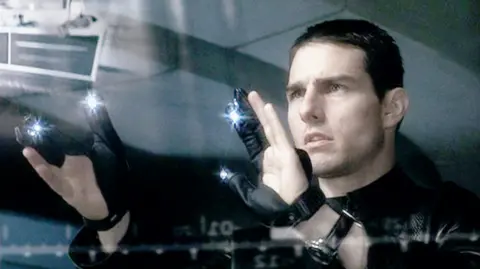
CBS Photo Archive Scene from the film Minority Report. A man (the actor Tom Cruise in the film Minority Report) stares at a transparent screen, wearing black gloves with bright lights on them. CBS Photo Archive

The last 25 years has seen some mind-bending technological changes.

At the start of the century, most computers connected to the internet with noisy dial-up connections, Netflix was an online DVD rental company, and the vast majority of people hadn’t even heard of a smartphone.

Fast forward two and a half decades, and innovations in AI, robotics and much else besides are emerging at an incredible rate.

So we decided to ask experts what the next 25 years could bring.

Here are their predictions for the technology we’ll be using by 2050 – and how it could reshape our lives.

Merging humans and machines

Science fiction set in the 2050s is full of examples of humans using technological enhancements to feel fitter, happier and more productive.

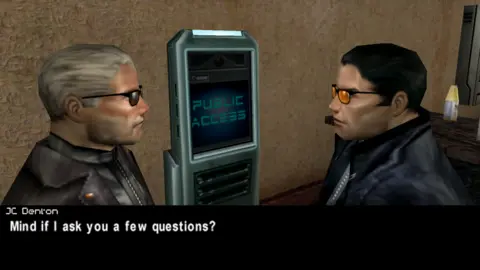
In the 2000 hit game Deus Ex – set in 2052 – the player can inject themselves with tiny robots called “nanites”.

These microscopic robots manipulate matter on atomic levels, giving superhuman abilities such as enhanced speed and the ability to see in the dark.

Eidos A screenshot from the video game Deus Ex. Two men in the game are staring at each other, in front of a machine with the words "Public Access" written on it. The dislogue at the bottom reads "JC Denton: Mind if I ask you a few questions?".Eidos

It sounds like something from the distant future, but nanotechnology – engineering at a scale of millionths of a millimetre – is already used in lots of everyday real-life tech.

In fact, it is powering the way you are reading these very words right now – every smartphone or computer is run by a central chip made up of billions of tiny transistors – electrical components built on a nanoscale to speed up data processing.

Professor Steven Bramwell at the London Centre for Nanotechnology told the BBC by 2050 we should expect the lines between machines, electronics and biology to be “significantly blurred”.

That means we could see nanotechnology implants by then – but more to “monitor your health or aid communication” rather than to appear invisible, as in Deus Ex.

Medicine could also make common use of machines at a nanometre scale to “deliver drugs to exactly where they need to go”, said Professor Bramwell.

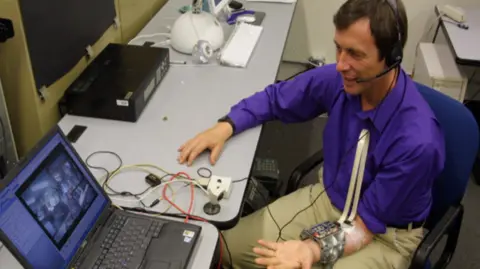
Cybernetics professor Kevin Warwick is equally interested in studying augmentations, going one step further than most.

In 1998 he became the first human to have a microchip implanted into his nervous system, earning him the title “Captain Cyborg”.

Professor Warwick believes by 2050, advancements in cybernetics – the science studying the links between natural and mechanical systems – could lead to trailblazing treatments for diseases.

Kevin Warwick A man sitting down with a headset and wearing a purple shirt has his hand helf out in front of him, around his arm is a metal chip bracelet. He is looking at an open laptop screen.Kevin Warwick

He predicts the use of “deep brain electronic stimulation” as a partial treatment for some conditions such as schizophrenia, rather than medicine.

He adds it is likely we’ll see more cybernetic enhancements of the kind he has already trialled himself, so that “your brain and body can be in different places”.

And what if we wanted to test out how the latest enhancement, or even new diet worked on our bodies, without any risks of experiencing the side effects?

Professor Roger Highfield, director of the Science Museum Group believes “digital twins” – virtual versions of a physical object, updated using real time data – could become a regular feature in our lives.

He imagines a world where each of us could have “thousands of simplified twins”, using them to explore how “different medications or lifestyle changes affect your unique biology”.

In other words, we could preview our futures before we live them.

The next generation of AI

Many technology firms, including Google and IBM, are currently locked in a multi-billion dollar race to revolutionise how we push fields like AI even further – in the form of quantum computing.

Quantum computers are machines which can do very complex calculations at incredibly fast speeds – for example, simulating molecular interactions to design new drugs faster.

In January 2025, Jensen Huang – boss of the leading chip firm Nvidia – said he believed “very useful” quantum computing would come in 20 years.

AI itself will undoubtedly continue to loom large in our society as we journey towards the half century mark.

Futurist and author Tracey Follows, who helped write a government White Paper on UK education in 2050, believes learning will take place across “virtual and physical realities” using AI teachers which “adjust in real time”.

Rather than textbooks, she predicts children will use “immersive simulations”.

Meanwhile, education will be less standardised, with each child’s individual DNA or biometric data studied to understand how they learn best.

Traffic-free roads and lunar bases

Bloomberg A white Waymo autonomous taxi driving down the road.Bloomberg

The writer Bill Douglass is well-versed in making compelling forecasts – in 2000 he won a $20,000 (£14,800) global futurist writing contest entitled “The World in 2050”.

While he still agrees one of his original predictions – pilotless planes – will come true by 2050, he believes we will first see more advances in driverless cars, making traffic congestion “largely a thing of the past”.

“Cars will drive so much closer to each other than they can now,” he told the BBC. “And if one has to break, they all break.

“On private toll roads for autonomous vehicles, there’s no reason traffic can’t go up to 100 miles an hour or so – you’ll see mortality from traffic accidents plummet.”

Away from Earth, the space race will equally continue at speed, journalist and co-host of the Space Boffins podcast Sue Nelson told the BBC.

She says in 25 years, it is likely there will be a liveable base on the Moon; and some industries could be almost entirely based in space.

For example, she believes we may see pharmaceutical companies making the next generation of medicines in microgravity, i.e. on board an orbiting spacecraft.

This is because, she says, crystals grown this way rather than on Earth, are “often larger and better quality”.

Sci-fi meets science

The film Minority Report, based on a novella by science fiction author Philip K Dick, was released in 2002 and set in the year 2054.

Three years before production began, director Steven Spielberg invited fifteen experts, including the founder of virtual reality Jaron Lanier, to a three-day summit to reflect on which technologies could possibly exist in the 2050s.

The discussions shaped many of the innovations featured in the film.

If the events of the Tom Cruise-starring science fiction thriller are to be believed, by the mid-2050s we will all be using gesture recognition (and fancy gloves) to swirl through videos on our transparent monitors, while policemen on jetpacks fight impending crime with the help of vomit-inducing batons.

Like much science fiction in the arts, the film paints a dystopian view of our future years.

It’s a feeling which some experts have begun to echo in our current timeline – with some going even as far as to suggest that artificial intelligence could lead to the extinction of humanity.

Perhaps before getting too despondent about what may await us in 2050, it’s worth returning to the words of Philip K Dick himself.

“I, for one, bet on science as helping us,” he wrote in his 1968 personal autobiographical essay Self Portrait.

“Science has given us more lives than it has taken,” he said.

“We must remember that.”

A green promotional banner with black squares and rectangles forming pixels, moving in from the right. The text says: “Tech Decoded: The world’s biggest tech news in your inbox every Monday.”
Posted on

Why everything from your phone to your PC may get pricier in 2026

Tom GerkenTechnology reporter

Getty Images Ram chips sacked on top of one another. They are green rectangles with black boxes, and golden marks at the bottom where they would plug in to a computer.Getty Images

The cost of lots of the devices we all use could be forced up in 2026 because the price of Ram – once one of the cheapest computer components – has more than doubled since October 2025.

The tech powers everything from smartphones to smart TVs, as well as things like medical devices.

Its price has shot up because of the explosive growth in the data centres which power AI, which need Ram too.

That’s caused an imbalance between supply and demand which means everyone has to pay more.

Manufacturers often choose to swallow small cost increases, but big ones tend to get passed on to consumers.

And these increases are anything but small.

“We are being quoted costs around 500% higher than they were only a couple of months ago,” said Steve Mason, general manager of CyberPowerPC, which builds computers.

He said there “will come a point” where these increased component costs will “force” manufacturers to “make decisions about pricing”.

“If it uses memory, or storage, there is the potential for price increases,” he said.

“The manufacturers will have choices to make, as will consumers.”

Ram – or random access memory – is used to store code while you use a device. It is a critical component of almost every kind of computer.

Without it would be impossible for you to read this article, for example.

And with the component being so ubiquitous, Danny Williams from rival computer building site PCSpecialist said he expected price increases to continue “well into 2026”.

“The market has been very buoyant in 2025 and if memory prices do not fall back a little I would expect a reduction in consumer demand in 2026,” he said.

He said he’d seen “a varied impact” across different Ram producers.

“Some vendors have larger inventories and therefore their price increases are more subtle at perhaps 1.5x to 2x,” he said.

But he said other firms did not have a large amount of stock – and they had increased prices by “up to 5x” more.

AI making prices rise

Chris Miller, author of Chip War, called AI “the main factor” driving demand for computer memory.

“There’s been a surge of demand for memory chips, driven above all by the high-end High Bandwidth Memory that AI requires,” he said.

“This has led to higher prices across different types of memory chips.”

He said prices “often fluctuate dramatically” based on “demand and supply” – and demand is significantly up right now.

And Mike Howard from Tech Insights told the BBC it came down to cloud service providers finalising their memory requirements for 2026 and 2027.

He said that gave the people who make Ram a clear picture of demand – and it was “unmistakeable” that supply “will not meet the levels that Amazon, Google, and other hyperscalers are planning for”.

“With both demand clarity and supply constraints converging, suppliers have steadily pushed prices upward, in some cases aggressively,” he said.

“Some suppliers have even paused issuing price quotes, a rare move that signals confidence that future prices will rise further.”

He said some manufacturers will have seen this coming and built up their inventory ahead of time to help mitigate the price rises – but called those firms “outliers”.

“In PCs, memory typically accounts for 15 to 20 percent of total cost, but current pricing has pushed that toward 30 to 40 percent,” he said.

“Margins in most consumer categories are not deep enough to absorb these increases.”

The bottom line for 2026

With prices trending upwards, customers will likely be left deciding whether to pay more or accept a less powerful device.

“Most of the market intelligence we have received would suggest pricing and supply will be a challenge worldwide throughout 2026 into 2027,” Mr Mason said.

And some big firms have turned their nose up at the consumer market altogether.

Micron, previously one of the biggest sellers of Ram, announced in December it would stop selling its Crucial brand to focus on AI demand.

“It removes one of the biggest players from the market,” Mr Mason said.

“On the one hand, that’s less choice for consumers – on the other hand, if their entire production ploughs into AI, it should free up capacity for the others to make more for consumers, so it may balance out.”

Mr Howard said a typical laptop, with 16GB of Ram, could see its manufacturing cost increase by $40 to $50 (£30 to £37) in 2026 – and this “will likely be passed on to consumers”.

“Smartphones will also see upwards pressure on their prices,” he said.

“A typical smartphone could see it’s cost to build increase $30 which, again, will likely get passed on directly to consumer.”

And Mr Williams said there might be another outcome of increased prices too.

“Computers are a commodity – an everyday item that people need in a modern day world,” he said.

“With the increase in memory prices, consumers will need to decide to either pay a higher price for the performance they need, or accept a compromise in a lower performing device.”

There is, of course, another option, says Mr Williams – consumers might have to “make do with old tech for a little longer.”

A green promotional banner with black squares and rectangles forming pixels, moving in from the right. The text says: “Tech Decoded: The world’s biggest tech news in your inbox every Monday.”
Posted on

Meta buys Chinese-founded AI start-up Manus

Meta says it is acquiring the Chinese-founded AI firm Manus as it looks to boost the capabilities of its tech.

Bloomberg analysts and The Wall Street Journal suggested the purchase could be worth more than $2bn (£1.48bn).

Meta said the deal would help improve its own AI by giving people access to “agents” – tools which can do complex things with minimal user interaction such as planning trips or making presentations.

“Manus’s exceptional talent will join Meta’s team to deliver general-purpose agents across our consumer and business products, including Meta AI,” it said in a blog post.

Barton Crockett, analyst at Rosenblatt Securities, told Reuters it was a “natural fit” for Meta, which extended into boss Mark Zuckerberg’s “vision of personal AI” using agents.

Based in Singapore after relocating from China, Manus has sought to set itself apart from rival AI developers with what it claims can be a “truly autonomous” agent.

Unlike many chatbots which need to be repeatedly asked for things before a user can get their desired response, Manus says its service can plan, execute and complete tasks independently in accordance with instructions.

It forms part of the company’s mission to “extend human reach” with general-purpose agents that can aid, rather than replace, human work.

The company said its acquisition by Meta was “validation” of its efforts.

“Joining Meta allows us to build on a stronger, more sustainable foundation without changing how Manus works or how decisions are made,” said Xiao Hong, its chief executive and one of its Chinese founders, in a blog post.

“We’re excited about what the future holds with Meta and Manus working together and we will continue to iterate the product and serve users that have defined Manus from the beginning.”

Meta said as part of its deal it would continue to operate and sell Manus’ AI service.

It marks yet another high-profile move by the Silicon Valley tech giant to cement its presence in the sector through deals with rising start-ups.

In June the company spent $14bn to buy 49% of Scale AI and secured its boss to take a lead role in Meta’s development of the tech.

This came amid a wider increase in spending by Zuckerberg on the company’s AI strategy, as well as reportedly luring talent from rivals like OpenAI.

Posted on

China plans AI rules to protect children and tackle suicide risks

Osmond ChiaBusiness reporter

Getty Images A young girl with a pony tail is watching social media videos on a three fold mobile phone at Huawei's world's largest flagship store in Shanghai, ChinaGetty Images

China has proposed strict new rules for artificial intelligence (AI) to provide safeguards for children and prevent chatbots from offering advice that could lead to self-harm or violence.

Under the planned regulations, developers will also need to ensure their AI models do not generate content that promotes gambling.

The announcement comes after a surge in the number of chatbots being launched in China and around the world.

Once finalised, the rules will apply to AI products and services in China, marking a major move to regulate the fast-growing technology, which has come under intense scrutiny over safety concerns this year.

The draft rules, which were published at the weekend by the Cyberspace Administration of China (CAC), include measures to protect children. They include requiring AI firms to offer personalised settings, have time limits on usage and getting consent from guardians before providing emotional companionship services.

Chatbot operators must have a human take over any conversation related to suicide or self-harm and immediately notify the user’s guardian or an emergency contact, the administration said.

AI providers must ensure that their services do not generate or share “content that endangers national security, damages national honour and interests [or] undermines national unity”, the statement said.

The CAC said it encourages the adoption of AI, such as to promote local culture and create tools for companionship for the elderly, provided that the technology is safe and reliable. It also called for feedback from the public.

Chinese AI firm DeepSeek made headlines worldwide this year after it topped app download charts.

This month, two Chinese startups Z.ai and Minimax, which together have tens of millions of users, announced plans to list on the stock market.

The technology has quickly gained huge numbers of subscribers with some using it for companionship or therapy.

The impact of AI on human behaviour has come under increased scrutiny in recent months.

Sam Altman, the head of ChatGPT-maker OpenAI, said this year that the way chatbots respond to conversations related to self-harm is among the company’s most difficult problems.

In August, a family in California sued OpenAI over the death of their 16-year-old son, alleging that ChatGPT encouraged him to take his own life. The lawsuit marked the first legal action accusing OpenAI of wrongful death.

This month, the company advertised for a “head of preparedness” who will be responsible for defending against risks from AI models to human mental health and cybersecurity.

The successful candidate will be responsible for tracking AI risks that could pose a harm to people. Mr Altman said: “This will be a stressful job, and you’ll jump into the deep end pretty much immediately.”

If you are suffering distress or despair and need support, you could speak to a health professional, or an organisation that offers support. Details of help available in many countries can be found at Befrienders Worldwide: www.befrienders.org.

In the UK, a list of organisations that can help is available at bbc.co.uk/actionline. Readers in the US and Canada can call the 988 suicide helpline or visit its website.

Posted on

US denies visas to ex-EU commissioner and others over social media rules

The US State Department said it would deny visas to five people, including a former EU commissioner, for seeking to “coerce” American social media platforms into suppressing viewpoints they oppose.

“These radical activists and weaponized NGOs have advanced censorship crackdowns by foreign states – in each case targeting American speakers and American companies,” Secretary of State Marco Rubio said in a statement.

Thierry Breton, the former top tech regulator at the European Commission, suggested that a “witch hunt” was taking place.

Breton was described by the State Department as the “mastermind” of the EU’s Digital Services Act (DSA), which imposes content moderation on social media firms.

However, it has angered some US conservatives who see it as seeking to censor right-wing opinions. Brussels denies this.

Breton has clashed with Elon Musk, the world’s richest man and owner of X, over obligations to follow EU rules.

The European Commission recently fined X €120m (£105m) over its blue tick badges – the first fine under the DSA. It said the platform’s blue tick system was “deceptive” because the firm was not “meaningfully verifying users”.

In response, Musk’s site blocked the Commission from making adverts on its platform.

Reacting to the visa ban, Breton posted on X: “To our American friends: Censorship isn’t where you think it is.”

Clare Melford, who leads the UK-based Global Disinformation Index (GDI), was also listed.

US Undersecretary of State Sarah B Rogers accused the GDI of using US taxpayer money “to exhort censorship and blacklisting of American speech and press”.

A GDI spokesperson told the BBC that “the visa sanctions announced today are an authoritarian attack on free speech and an egregious act of government censorship”.

“The Trump Administration is, once again, using the full weight of the federal government to intimidate, censor, and silence voices they disagree with. Their actions today are immoral, unlawful, and un-American.”

Imran Ahmed of the Center for Countering Digital Hate (CCDH), a nonprofit that fights online hate and misinformation, was also handed a ban.

Rogers called Mr Ahmed a “key collaborator with the Biden Administration’s effort to weaponize the government against US citizens”.

The BBC has reached out to the CCDH for comment.

Also subject to bans were Anna-Lena von Hodenberg and Josephine Ballon of HateAid, a German organisation that the State Department said helped enforce the DSA.

In a statement to the BBC, the two CEOs called it an “act of repression by a government that is increasingly disregarding the rule of law and trying to silence its critics by any means necessary”.

“We will not be intimidated by a government that uses accusations of censorship to silence those who stand up for human rights and freedom of expression,” they added.

Rubio said that steps had been taken to impose visa restrictions on “agents of the global censorship-industrial complex who, as a result, will be generally barred from entering the United States”.

“President Trump has been clear that his America First foreign policy rejects violations of American sovereignty. Extraterritorial overreach by foreign censors targeting American speech is no exception,” he added.

Posted on

Call of Duty co-creator Vince Zampella dies in California car crash

Vince Zampella, who co-created the widely-popular video game series Call of Duty, has died in a car crash in California, aged 55.

Zampella’s death was confirmed by Electronic Arts, which owns Respawn Entertainment, a game studio he co-founded.

The influential video game developer was travelling in a Ferrari with another person, when it crashed and caught fire on a highway in Los Angeles on Sunday.

“This is an unimaginable loss, and our hearts are with Vince’s family, his loved ones, and all those touched by his work,” a spokesperson for Electronic Arts told the BBC.

Officials said the person on the vehicle’s passenger seat was ejected while the driver remained trapped. It is unclear if Zampella was driving the car and who the other person inside was.

Both people inside the vehicle died.

“For unknown reasons, the vehicle veered off the roadway, struck a concrete barrier, and became fully engulfed,” the California Highway Patrol said in a statement to the BBC.

Zampella created Call of Duty with his long time collaborators Jason West and Grant Collier in 2003.

Partly inspired by events in World War II, the game has sold more than 500 million copies making owners Microsoft’s Activision one of the most profitable gaming companies. It has also spawned an upcoming live-action film.

The Call of Duty franchise was not his only success. He was also behind other widely popular games including the Medal of Honor, Titanfall and Apex Legend.

“He really cared about the player experience, he cared about making games, he cared about how people felt when they played and that really came across whenever you spoke to him,” Keza MacDonald, the Guardian’s video games editor told BBC Newshour.

In 2010, Zampella and West were fired from Activision, which publishes the Call of Duty games, and the pair were subsequently locked in a long dispute with the company which they settled out of court in 2012.

At Electronic Arts, Zampella worked on Battlefield 6, which is seen as a direct competitor to Call of Duty.

Infinity Ward, the American company that developed Call of Duty, said Zampella “will always have a special place in our history”.

“Your legacy of creating iconic, lasting entertainment is immeasurable,” the company said in a statement on X.

Posted on

Will the US TikTok deal make it safer but less relevant?

Laura Cress,Technology reporterand

Lily Jamali,North America technology correspondent, San Francisco

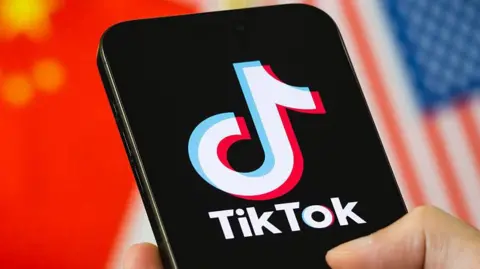
Getty Images Smartphone displays the logo of TikTok with the national flags of China and the United States in the background.Getty Images

TikTok’s Chinese owner ByteDance has signed a deal with investors to run its business in the US.

But what does this mean for the over 170 million Americans (or so the social media platform claims) who use the app?

The key may lie in how TikTok’s recommendation algorithm – the powerful system that curates the platform’s For You Page to predict content you might watch – is managed when it changes hands.

Social media industry expert Matt Navarra told the BBC the question will not be whether TikTok survives, but “what version of TikTok survives”.

‘Smoothing out the edges’

Currently, TikTok’s system depends on huge amounts of global data and feedback loops, which can change recommendations in an instant.

Under the terms of the deal TikTok’s algorithm, which will be licensed by investor Oracle, is set to be retrained on American user data.

Mr Navarra said this could leave the app feeling “safer and sturdier” but also leaving it at a risk of “becoming less culturally essential” as a result.

“TikTok’s power has always come from feeling slightly out of control – weird, niche, uncomfortable, sometimes politically sharp content for anyone else or before it goes anywhere else,” he said.

“If you start smoothing those edges, you don’t just change moderation. I think you change its relevance.”

Matching ByteDance’s algorithm

Whether the US version will differ from the TikTok so many know and use already may also depend on if it gets “all the new features, security updates and platform improvements” as soon as the international version does, tech journalist Will Guyatt told the BBC.

And computing expert Kokil Jaidka from the National University of Singapore said she expected the things that make the platform popular – such as its short videos and shopping – are likely to “stay intact” as these features are not dependent on the algorithm.

She said the changes might be more subtle and gradual, depending on if the narrower data inputs of the “siloed” US version can match the app’s global reach.

“If TikTok is operating with a licensed or partially diluted version of its recommendation algorithm, some of the system’s blind spots may start to matter more,” she said.

For users, she said this means in practice the US algorithm may “lag in personalisation” and take longer to adapt to viral content.

To experiment or behave?

Oracle is TikTok’s longtime cloud computing partner in the United States, and is chaired by Larry Ellison, an ally of President Trump.

Another foreign entity, MGX – an Abu-Dhabi government investment fund – will join it along with private equity firm Silver Lake as the main incoming investors.

Pressure from these investors may also add to the US app feeling “blander” said Mr Navarra.

“I think the real test won’t be whether the users leave,” he said.

“It will be whether TikTok still feels the place the internet goes to experiment – or if it becomes the place it goes to behave.”

Additional reporting by Peter Hoskins.

A green promotional banner with black squares and rectangles forming pixels, moving in from the right. The text says: “Tech Decoded: The world’s biggest tech news in your inbox every Monday.”
Posted on

TikTok owner signs agreements to avoid US ban

TikTok’s Chinese owner ByteDance has signed binding agreements with US and global investors for the majority of its business in America, TikTok’s boss told employees on Thursday.

Half of the joint venture will be owned by a group of investors, including Oracle, Silver Lake and the Emirati investment firm MGX, according to a memo sent by chief executive Shou Zi Chew.

The deal, which is set to close on 22 January, would end years of efforts by Washington to force ByteDance to sell its US operations over national security concerns.

It is in ​line with a deal unveiled in September, when US President Donald Trump delayed the enforcement of a law that would ban the app unless it was sold.

In the memo, TikTok said the deal will enable “over 170 million Americans to continue discovering a world of endless possibilities as part of a vital global community”.

Under the agreement, ByteDance will retain 19.9% of the business, while Oracle, Silver Lake and Abu Dhabi-based MGX will hold 15% each.

Another 30.1% will be held by affiliates of existing ByteDance investors, according to the memo.

The White House previously said that Oracle, which was co-founded by Trump supporter Larry Ellison, will license TikTok’s recommendation algorithm as part of the deal.

The deal comes after a series of delays.

In April 2024, during President Joe Biden’s administration, the US Congress passed a law to ban the app over national security concerns, unless it was sold.

The law was set to go into effect on 20 January 2025 but was pushed back multiple times by Trump, while his administration worked out a deal to transfer ownership.

Trump said in September that he had spoken on the phone to China’s President Xi Jinping, who he said had given the deal the go ahead.

The platform’s future remained unclear after the leaders met face to face in October.

The White House referred the BBC to TikTok when contacted for comment.

Oracle and Silver Lake declined to comment. The BBC has contacted MGX for comment.

The deal drew critiques from Senate Democrat Ron Wyden of Oregon, who said it wouldn’t do “a thing to protect the privacy of American user”.

Under the terms, TikTok’s recommendation algorithm is set to be retrained on American user data to ensure feeds are free from outside manipulation.

“It’s unclear that it will even put TikTok’s algorithm in safer hands,” said Sen Wyden.

He opposed the 2024 law, and was among the US lawmakers who lobbied to extend the TikTok deadline in January in a bid to give Congress more time to mitigate threats from China.

Some users also expressed caution at the prospect of new investors.

Small business owner Tiffany Cianci, who has more than 300,000 followers and nearly four million likes on the platform, said she hopes the incoming investors will maintain the same user experience for entrepreneurs like her.

“I hope small business owners are protected,” Ms Cianci said.

TikTok has said that more than seven million small businesses market their products and services on TikTok in the US.

“I reserve judgement on whether or not we have saved the app for those small business,” she added.

Ms Cianci said she chose TikTok for promotion because the platform offers profit-sharing on terms that are more favourable than what competitors like Meta offer.

Over the last year, Ms Cianci has been active in organising protests in Washington and on TikTok aimed at saving the app.