Posted on

Fifa video game to return after four years in Netflix exclusive

Fifa will finally release its much-anticipated return to video games in 2026, several years after its acrimonious split with developer EA.

But it is Netflix, rather than a major game studio, which has secured the rights to the upcoming football game.

Once one of the most profitable brands in gaming history, issues including a costly licence prompted Fifa’s previous publisher Electronic Arts to stop using the name in 2023 – instead naming its best-selling game EA Sports FC.

Netflix said the new Fifa would be developed and published by Delphi Interactive – which has yet to release a video game – and released ahead of the 2026 World Cup.

It said subscribers will be able to play online via the Netflix app on iOS and Android devices – or on select TVs by using their phone as the controller.

EA Sports released the first Fifa game in 1993, and ran the franchise for 30 years until moving away from the branding to create its own.

The series was estimated to have around 150 million players.

But the renamed game still connected with fans – with EA FC 24 being the best-selling game in the UK in 2023.

Fifa president Gianni Infantino said the football governing body was “very excited” to team up with Netflix Games ahead of the World Cup in 2026.

“Our reimagined game truly marks the beginning of a new era of digital football,” he said.

“It will be available for free to Netflix members and is a great historic step for Fifa.”

California-based Delphi Interactive, the studio behind the game, is also working in partnership with IO Interactive on a new James Bond title, 007: First Light.

The firm’s boss Casper Daugaard said as “lifelong Fifa fans” it wanted to make the game “the most fun, approachable, and global football game ever created”.

Reaction to the announcement has so far been mixed, with some fans questioning whether the mobile-first focus from Netflix was the way forward for the franchise.

“FIFA should never have left EA,” said one person on social media site X.

“Let’s see what the new game’s got.”

Posted on

Downing Street insists negotiations over US-UK tech deal still live

Downing Street says the UK remains in “active conversations with US counterparts at all levels of government” about a wide-ranging tech deal.

The BBC understands talks over the Technology Prosperity Deal have stalled because of US concerns about what it considers to be wider UK trade barriers.

Billed as “historic” when it was unveiled during US President Donald Trump’s state visit in September, the partnership saw both countries pledge to co-operate further in areas such as AI and quantum computing.

“We’re confident of securing a deal that will shape the future of millions on both sides of the Atlantic,” the Prime Minister’s official spokesman said.

He said he would not comment directly on what were “live” discussions but added “negotiations of this kind are never straightforward”.

The New York Times – which first reported the story – said there were “broader disagreements” between the two sides, including over digital regulations and food safety rules.

The UK government did not comment on these specific claims. The White House has not responded to the BBC’s request for a comment.

However, Trump’s science adviser Michael Kratsios on Tuesday evening said the administration hoped to restart talks over the deal.

“In line with Section III of the US-UK Technology Prosperity Deal, we hope to resume work with the United Kingdom once the UK has made substantial progress in implementing its commitments under the Economic Prosperity Deal,” Kratsios wrote on X.

“We look forward to continuing our productive collaboration across AI, quantum, nuclear, and other critical technology areas under the Deal.”

When the deal was announced the government was keen to highlight the benefits it said it would bring.

“This Tech Prosperity Deal marks a generational step change in our relationship with the US,” Prime Minister Sir Keir Starmer said in a statement.

Technology secretary Liz Kendall said the partnership would “transform lives across Britain” and was a “vote of confidence in Britain’s booming AI sector.”

At the same time the deal was revealed, a series of US tech firms announced a flurry of investment in the UK.

A total of £31bn in planned spending was set out by tech giants including Microsoft, Nvidia and Google.

It is believed those investment plans are unaffected.

Google, Microsoft and Nvidia have also been approached for comment, but the firms have not yet responded to the BBC.

Nvidia boss Jensen Huang said in September his company’s UK investment reflected his belief it could become an “AI superpower” – an ambition championed by Sir Keir’s government.

It said investment announced by tech firms alongside the Tech Prosperity Deal would be used to scale-up AI infrastructure such as data centres, across the UK.

The tech pact was documented in a Memorandum of Understanding (MOU) which said both countries would seek to collaborate across AI, quantum computing and nuclear power.

It said this could include working together to build “powerful quantum machines,” support innovation in AI hardware and explore potential new ways to use advanced nuclear energy.

But the MOU also states any proposals are not binding and that it only “becomes operative alongside substantive progress being made to formalise and implement” the wider US-UK Economic Prosperity Deal, signed in May.

The Trump administration has sought to rewrite the global rules on trade, imposing tariffs on many countries – including traditional allies like the UK – and seeking new deals which it argues are fairer to the US.

For the UK that has meant haggling over various sectors of the economy, a process which has yielded agreements on cars and more recently, pharmaceuticals.

However, a proposed deal to eliminate tariffs on UK steel exports to the US has been put on hold indefinitely, the BBC understands.

Allie Renison, director of communications firm SEC Newgate UK and a former government trade adviser, said the current impasse over tech reflected the US and UK’s “slightly piecemeal approach” to inking trade deals.

“Instead of having everything done at once, different areas are being linked to different parts,” she told the BBC – noting how concerns about separate trade areas may now be affecting tech agreements.

While questions hung over what the potential roadblocks could mean for US tech firms’ pledged investments in the UK, Ms Renison added, it was unlikely to be little more than “a bit of posturing in the wider negotiations”.

Additional reporting by Michael Race and Philippa Wain

Posted on

UK launches taskforce to ‘break down barriers’ for women in technology

The government has launched a new taskforce it says will help women “enter, stay and lead” in the UK tech sector.

Led by technology secretary Liz Kendall, it will see female leaders from tech companies and organisations advise the government on how to boost diversity and economic growth in the industry.

BCS, the Chartered Institute for IT, recently suggested women accounted for only 22% of those working in IT specialist roles in the UK.

Ms Kendall said the Women in Tech group would “break down the barriers that still hold too many people back”.

“When women are inspired to take on a role in tech and have a seat at the table, the sector can make more representative decisions, build products that serve everyone,” she said.

BCS, the Chartered Institute for IT, warned in December the amount of women working in the UK tech sector still lagged far behind men.

It said the government should look to help close the gender gap in order to meet its ambitious AI goals.

“We cannot create high-trust, high-integrity AI systems if the profession behind them is missing out on the talents and perspective of half the population,” said chief executive Sharron Gunn.

Ms Kendall will lead the taskforce alongside Anne-Marie Imafidon, founder of Stemettes, who has been appointed as the Women in Tech Envoy.

Dr Imafidon, who passed A-level computing aged 11 and received a Master’s Degree in Maths and Computer Science from the University of Oxford aged 20, has sought to encourage more young women into careers in Stem – science, technology, engineering and maths.

She told the BBC her role would build on more than a decade of work to establish greater equality for – and representation of – women.

But now, amid what she called “a fourth industrial revolution”, was a key moment to “be part of shifting who is making those decisions for what comes next”.

“This isn’t just about having women being the driving force and building the technology, but this is about building technology that benefits everybody,” she said.

The government said the taskforce will advise on ways to make the tech sector more representative and “ensure the UK accesses the full talent pool, market opportunities, and innovation capacity needed for economic growth”.

BT Group boss Allison Kirkby, Revolut chief executive Francesca Carlesi and Dr Hayaatun Sillem, chief executive of the Royal Academy of Engineering, are among its 15 founding members.

It also includes TUC assistant general secretary Kate Bell, director of public policy at Uber Emma O’Dwyer, and Sue Daley, director of technology and innovation at industry group techUK.

“Entry routes, career progression to leadership, and access to capital are just some of the barriers women in tech still face today,” Ms Daley said.

“Achieving gender equality is long overdue, and I am honoured to join the Women in Tech taskforce alongside Liz Kendall and several inspiring women from across the industry, working together to chart a path forward for true gender equality.”

Posted on

US TikTok investors in limbo as deal set to be delayed again

A billionaire investor keen on buying TikTok’s US operations has told the BBC he has been left in limbo as the latest deadline for the app’s sale looms.

The US has repeatedly delayed the date by which the platform’s Chinese owner, Bytedance, must sell or be blocked for American users.

US President Donald Trump appears poised to extend the deadline for a fifth time on Tuesday.

“We’re just standing by and waiting to see what happens,” investor Frank McCourt told BBC News.

“But if the moment arrives, we’re prepared to move forward… we’ve raised the capital to buy it – we’ll see.”

The popular short-form video app was due to be banned or sold in the US in January in accordance with a law passed by Congress in 2024.

Lawmakers said at the time ByteDance’s links to the Chinese government threatened national security, and expressed fears Beijing could force the company to hand over data on US users.

It’s a concern TikTok and its owners have always said is unfounded.

The law was signed by President Joe Biden while he was still in office and was upheld by the Supreme Court in early 2025.

Trump and members of his administration have previously claimed a TikTok deal was done, and had the blessing of Chinese President Xi Jinping.

The president has also said “sophisticated” US investors would acquire the app, including two of his allies: Oracle chairman Larry Ellison and Dell Technologies’ Michael Dell.

Members of the Trump administration had indicated the deal would be formalised in a meeting between Trump and Xi in October – however it concluded without an agreement being reached.

Neither TikTok’s Chinese owner ByteDance nor Beijing have since announced approval of a sale, despite Trump’s claims.

This time there are no such claims a deal is imminent, leading most analysts to conclude another extension is inevitable.

Without naming Trump’s hand-selected investors, Mr McCourt told the BBC he was concerned “about a concentration of power and influence because platforms like TikTok are very influencing”.

He is part of a group of investors including Reddit co-founder Alexis Ohanian and Canadian investor Kevin O’Leary.

“My hope would be that whatever happens, that it is shut down or sold, and lands in the hands of people that comply with the law,” he said.

He said he wants to operate TikTok without any of its Chinese technology, including its powerful recommendation algorithm, and that his Project Liberty has developed other technology that could be used instead.

Posted on

Crypto fraudster sentenced for ‘epic’ $40bn stablecoin crash

A former crypto entrepreneur who was behind two digital currencies that collapsed and lost an estimated $40bn ($29.9bn) has been sentenced by a New York judge to 15 years in prison for an “epic” fraud.

Do Kwon, a South Korean national, was co-founder of Singapore-based Terraform Labs, which developed the TerraUSD and Luna digital coins.

Kwon had admitted misleading investors about TerraUSD, a so-called stablecoin that was supposed to maintain its value against the US dollar.

He was one of a number of crypto bosses to face charges in the US after digital tokens slumped in 2022, triggering the failure of several companies.

US District Judge Paul A Engelmayer, who handed down the sentence, said the Stanford graduate had repeatedly lied to investors who trusted him with their money.

“This was a fraud on an epic, generational scale,” he said during Thursday’s court hearing in Manhattan.

“In the history of federal prosecutions, there are few frauds that have caused as much harm as you have.”

Kwon – who pleaded guilty in August to conspiracy to defraud and wire fraud – expressed remorse to the judge.

“I have spent almost every waking moment of the last few years thinking of what I could have done different and what I can do now to make things right,” he said.

Prosecutors alleged that when TerraUSD fell below its $1 peg in May 2021, Kwon told investors that a computer algorithm had restored its value.

Instead, Kwon had arranged for a trading firm to secretly buy millions of dollars of the coin to artificially boost its value, according to court documents.

Posted on

Oracle shares slide as earnings fail to ease AI bubble fears

Shares of cloud computing giant Oracle plunged more than 10% in after-hours trading on Wednesday after the company’s revenues fell short of Wall Street expectations.

The company reported revenue of $16.06bn (£11.99bn) for the three months that ended in November, compared with the $16.21bn projected by analysts.

Revenue growth was up 14%, with a 68% surge in sales at its AI business, Oracle Cloud Infrastructure (OCI), the company said.

OCI services major AI technology developers whose demand for Oracle’s AI infrastructure helped the company’s shares reach new highs this fall but Wednesday’s results failed to quell fears about a potential AI bubble.

In September, Oracle agreed a highly sought-after contract with ChatGPT-maker OpenAI, which agreed to purchase $300bn in computing power from Oracle over five years.

Oracle chairman and chief technology officer Larry Ellison briefly became the world’s richest man in after the announcement.

But the firm’s shares have lost 40% of their value since peaking three months ago. Still, they are up by more than a third since the start of the year.

In a statement issued on Wednesday, Mr Ellison struck a cautious tone.

“There are going to be a lot of changes in AI technology over the next few years and we must remain agile in response to those changes,” he wrote.

Mr Ellison also appeared to snub Nvidia, the designer of highly-sophisticated AI chips, saying Oracle would buy chips from any maker in order to serve clients.

“We will continue to buy the latest GPUs from Nvidia, but we need to be prepared and able to deploy whatever chips our customers want to buy,” Mr Ellison declared in a policy he called “chip neutrality”.

Oracle is involved in multiple AI infrastructure arrangements that have raised the prospect that major players in the sector are participating in ‘circular financing’ deals whereby companies finance purchases of their own products and services.

“Oracle’s earnings arrive as investors weigh whether its massive OpenAI partnership might mean overexposure with a customer currently in the spotlight over profitability concerns,” said Emarketer analyst Jacob Bourne following the release of the company’s quarterly report.

Mr Bourne said Oracle faced mounting scrutiny over the increased debt the company has amassed to fund building data centres.

Oracle raised a record $18bn in a massive bond sale in September, one of the largest debt issuances ever in the tech sector.

“Although Oracle’s shares are buoyed by its September surge, this revenue miss will likely exacerbate concerns among already cautious investors about its OpenAI deal and its aggressive AI spending,” Mr Bourne said.

The Ellison family, supporters of US President Donald Trump, also recently purchased Paramount and have spearheaded a bid to take over another major Hollywood studio, Warner Brothers Discovery.

Posted on

UK spending half an hour longer online than in pandemic, says Ofcom

Laura CressTechnology reporter

Getty Images Smiling woman using smartphone in bed at nightGetty Images

UK adults spent over half an hour longer online every day in 2025 than they did during the pandemic, according to an annual survey of internet habits by the regulator Ofcom.

The Online Nation report found on average, people in the UK spent four hours and 30 minutes online every day in 2025 – 31 minutes longer than in 2021.

Psychologist Dr Aric Sigman told the BBC this was not a problem in itself, but what mattered was “what this time is displacing and how this may harm mental health”.

He added the “good news” was society was “beginning to question online time more critically”.

In a year where the major UK Netflix drama Adolescence won praise and politicial attention for shining a light on misogynistic online content, the survey found adults were feeling less positive about the impact of the internet overall.

Only a third (33%) said they felt it was “good for society” – down from 40% in 2024.

However, nearly two thirds of people still believed the benefits of being online outweighed the risks.

And many adults said they found the internet to be a source of creativity, with roughly three quarters agreeing being online helped them to broaden their understanding of the world.

Children wary of ‘brain rot’

The report also explored children’s experiences of being online.

While more than eight in ten aged 8-17 said they were happy with the amount of time they spent on the internet, they also recognised there were negative impacts of endlessly scrolling on smartphones.

The term “brain rot” was used by some children surveyed to describe the feeling they were left with after spending too long on their devices.

It has become a popular phrase to describe overconsuming online posts and videos considered to be the opposite of mentally challenging.

And Ofcom found across four of the main services used by children – YouTube, Snapchat, TikTok and WhatsApp – up to a quarter of the time 8 to 14-year-olds spent online was between 2100 and 0500.

VPN use more than doubles

From 25 July, Ofcom required websites operating in the UK with pornographic content to “robustly” age-check users, under the Online Safety Act.

Some people began using a virtual private network (VPN) at this time – tools which can disguise your location online to allow you to use the internet as though you are in another country.

The increase indicates people are likely using them to bypass requirements of the Act.

After the age checks became mandatory, the survey said VPN use more than doubled, rising from roughly 650,000 daily users before July and peaking at over 1.4 million in mid-August

But it also found the number had since declined to around 900,000 in November.

ASMR ‘relaxing’

The report also found 69% of children aged 13 to 17 said they used online services to help with their wellbeing, either to relax or improve their mood.

More than half named ASMR as a tool they had used in particular to help them relax.

These videos became an online phenomenon more than a decade ago – which some people claim causes them to feel a tingling sensation.

It has led to an entire industry of online creators making special content viewed on platforms such as YouTube.

But children were not solely positive about their online experiences.

Seventy percent said they had issues with self-improvement media – involving toxic messaging or body shaming.

A green promotional banner with black squares and rectangles forming pixels, moving in from the right. The text says: “Tech Decoded: The world’s biggest tech news in your inbox every Monday.”
Posted on

Trump gives Nvidia green light to sell advanced AI chips to China

US President Donald Trump has announced that he will allow AI chip giant Nvidia to sell its advanced H200 chips to “approved customers” in China.

“We will protect National Security, create American Jobs, and keep America’s lead in AI,” Trump said on social media on Monday.

The decision will apply to other US chip companies like AMD and comes after extensive lobbying by Nvidia boss Jensen Huang, who visited Washington last week to drum up support.

Nvidia – both the world’s leading chip firm and most valuable company – has found itself at the centre of a geopolitical tug-of-war between the US and China in recent months, and had been banned from selling its most advanced chips to Beijing.

Trump reversed the chip-selling ban in July, but demanded that Nvidia pay 15% of its Chinese revenues to the US government.

Beijing then reportedly ordered its tech companies to stop buying Nvidia chips manufactured for use in the Chinese market.

“We applaud President Trump’s decision to allow America’s chip industry to compete to support high paying jobs and manufacturing in America,” Nvidia said in a statement provided to BBC News.

Mr Huang told the BBC in September that the US needed “to make sure that people can access this technology from all over the world, including China.”

He has also repeatedly warned that China, which has cultivated a chip production ecosystem of its own, was close behind the US in chip development.

Nvidia hailed Trump’s announcement on Monday.

“Offering H200 to approved commercial customers, vetted by the Department of Commerce, strikes a thoughtful balance that is great for America,” Nvidia said in its statement.

The companies shares rose slightly on the news.

Trump said “$25% [sic] will be paid to the United States of America” in his post.

The BBC has reached out to the White House for clarification on the arrangement, which will likely face opposition from national security hawks in Congress.

Researchers at Georgetown University’s Center for Security and Emerging Technology (CSET) said China’s People’s Liberation Army is using advanced chips designed by US companies to develop AI-enabled military capabilities.

“By making it easier for the Chinese to access these high-quality AI chips, you enable China to more easily use and deploy AI system for military applications,” said Cole McFaul, senior research analyst at CSET. “They want to harness advanced chips for battlefield advantage.”

Posted on

Trump says $72bn Netflix-Warner Bros deal ‘could be a problem’

US President Donald Trump has flagged potential concerns over Netflix’s planned $72bn (£54bn) deal to buy Warner Brothers Discovery’s movie studio and popular HBO streaming networks.

At an event in Washington DC on Sunday, he said Netflix has a “big market share” and the firms’ combined size “could be a problem”.

On Friday, the two companies said they had reached an agreement that could bring Warner Brothers’ franchises like Harry Potter and Game of Thrones to Netflix, creating a new media giant.

The planned deal, which has raised concerns among some in the industry, is yet to be approved by competition authorities. The BBC has contacted Warner Brothers, Netflix and the White House for comment.

Launched in 1997 as a postal DVD rental business, Netflix has grown to become the world’s largest subscription streaming service. The deal – the biggest the film industry has seen in a long time – would cement its number one position.

Under the agreement several global entertainment franchises, such as Looney Tunes, The Matrix and Lord of the Rings, would move to Netflix.

The US Justice Department’s competition division, which oversees major mergers, could contend that the deal violates the law if the combined businesses account for too much of the streaming market.

At an event at the John F. Kennedy Center in the US capital, Trump said that Netflix has a “very big market share” which would “go up by a lot” if the deal goes ahead.

Trump added that he would be personally involved in the decision on whether or not to approve the deal and repeatedly highlighted the size of Netflix’s market share.

He also said that Netflix’s co-CEO Ted Sarandos recently visited the Oval Office and praised him for his work at the company.

“I have a lot of respect for him. He’s a great person,” said Trump. “He’s done one of the greatest jobs in the history of movies.”

Mr Sarandos earlier acknowledged that the agreement may have surprised investors but said it was a chance to position Netflix for success in the “decades to come”.

Some in the entertainment industry have criticised the agreement.

The Writers Guild of America’s East and West branches called for the merger to be blocked, saying the “world’s largest streaming company swallowing one of its biggest competitors is what antitrust laws were designed to prevent.”

“The outcome would eliminate jobs, push down wages, worsen conditions for all entertainment workers, raise prices for consumers and reduce the volume and diversity of content for all viewers,” it said on Friday.

Posted on

Twitch star QTCinderella says she wishes she never started streaming

Laura CressTechnology reporter

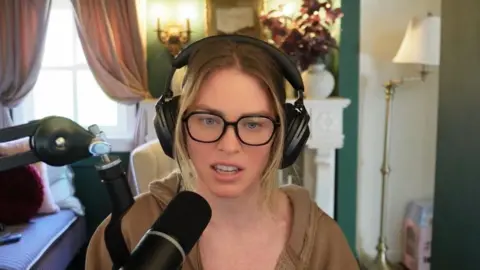
BBC A woman, QTCinderella, is sitting wearing black over-ear headphones and black glasses, with a brown, open hoodie. She is speaking into a black microphone. In the background is a lamp and a vase of flowers and a window with pink curtains. BBC

The popular Twitch streamer QTCinderella says she would be a “happier person” if she could go back and tell her younger self to choose a different career.

The 31-year-old, real name Blaire (she does not make her second name public), became famous for playing video games and cooking meals in live videos for her 1.2 million followers online.

In 2021 she created the annual Streamer Awards, which will be streamed online on Saturday.

But she told the BBC while she felt “incredibly lucky” to be in her position, the negatives of the role – ranging from being under constant scrutiny to at times being concerned for her safety – makes it difficult to enjoy.

“If I could go back and never experience some of the things I’ve experienced because of this job, I do think I would be a happier person overall,” she said.

“The biggest thing I wish I could do, if I went back and was able to whisper in my ear, I would say, don’t do it.”

Getty Images A close-up of a woman's face, QTCinderella, in make up in front of a black background with white names of gaming logos on it such as Fortnite and OC Game Pass.Getty Images

Throughout 2025, several female content creators have spoken out about concerns of their safety, particularly when attending public events.

In March, three US Twitch streamers, Cinna, Valkyrae and Emiru, were taking part in a week-long marathon stream when a man threatened to kill them.

Then, at the annual streamer event TwitchCon in October, a man from the crowd grabbed Emiru and tried to kiss her without her consent.

While her personal security were able to intervene, she accused the on-site security team of not detaining him until hours after the event – something Twitch refuted in a statement.

Harassment – or the threat of it – is an issue which Blaire says she has also had to face since her rise in popularity online.

“I could open my Instagram DMs right now and read you 100 horrible things about why or how I could be harmed by people,” she said.

In 2021, Blaire said she spent over $2,000 (£1,500) every month to have heavily edited photos of her removed from the internet.

Then in January 2023, she discovered a deepfake website was using a likeness of her in pornographic material, alongside other popular female streamers.

Now, she said despite opening a craft shop in Los Angeles earlier this year, it’s rare she ever visits – because of men turning up to the shop and asking for her.

“I thought it’d be fun,” she said.

“Unfortunately, it’s gotten to the point where I can’t go there because we’ve had men show up looking for me.

“I don’t want it to be unsafe for my employees.”

From drama to positivity

Blaire said she thought security at the Streamer Awards would be “aggressive” in comparison to other events, as she hopes to help the attendees from the streaming world feel as safe as possible.

The ceremony recognises top creators across various categories like Gamer of the Year and Best Community, while this year’s Streamer of the Year nominees includes the most-followed Twitch streamer with 20 million followers, Kai Cenat.

A mix of 70% fan votes and 30% industry panellists decide the winners.

In November, Blaire faced accusations from viewers claiming certain popular streamers were blocked from particular categories for being too “problematic” – which she denied.

Clips of the streamer tearfully replying to criticisms of the event soon spread online.

“I think I need to respond less”, she said.

“But as a human, you just want to be understood”.

The constant ebb and flow of streamer “drama” which many content creators like Blaire experience is one of the reasons she finds the job tough – but she said it was also why she started the awards.

“For me, it’s really important to bring people together, because I do think there’s lots of toxicity on the internet,” she said.

“And if people were just able to have a dinner together or reach across the board, it makes a big difference.

“For one night of the year, the negativity is silent”.

A green promotional banner with black squares and rectangles forming pixels, moving in from the right. The text says: “Tech Decoded: The world’s biggest tech news in your inbox every Monday.”