Posted on

UK to consult on social media ban for under 16s

Laura CressTechnology reporter

Getty Images Teenage girl using mobile phoneGetty Images

The government will consult on whether social media should be banned for under-16s in the UK.

It said “immediate action” would give Ofsted the power to check policies on phone use when it inspects schools, and it expected schools to be “phone-free by default” as a result of the announcement.

A similar ban took effect in Australia in December 2025, the first of its kind in the world. Other countries are said to be considering such a law.

It comes after more than 60 Labour MPs wrote to the prime minister about the issue, with the mother of murdered teenager Brianna Ghey also calling on the government to act.

“Some argue that vulnerable children need access to social media to find their community,” Brianna’s mother Esther Ghey wrote in a letter seen by the BBC.

“As the parent of an extremely vulnerable and trans child, I strongly disagree.

“In Brianna’s case, social media limited her ability to engage in real-world social interactions. She had real friends, but she chose to live online instead.”

According to The Department of Science, Innovation and Technology, the consultation will “seek views from parents, young people and civil society” to determine the effectiveness of a ban.

It would also look at whether more robust age checks could be implemented by social media firms, which could be forced to remove or limit features “which drive compulsive use of social media”.

And Ofsted will give tougher guidance to schools to reduce phone use – including telling staff not to use their devices for personal reasons in front of pupils.

The government will respond to the consultation in the summer.

Technology Secretary Liz Kendall said the laws in the Online Safety Act were “never meant to be the end point” and said she understood “parents still have serious concerns”.

“We are determined to ensure technology enriches children’s lives, not harms them – and to give every child the childhood they deserve,” she said.

Conservative leader Kemi Badenoch has already said her party would introduce a social media ban for under-16s if it was in power.

She said the consultation was “more dither and delay” from Labour.

“The prime minister is trying to copy an announcement that the Conservatives made a week ago, and still not getting it right,” she said.

Liberal Democrat education spokeswoman Munira Wilson said there was “no time to waste in protecting our children from social media giants” and “this consultation risks kicking the can down the road yet again”.

National Education Union (NEU) general secretary Daniel Kebede called the move a “welcome shift”.

“Every day, parents and teachers see how social media shapes children’s identities and attention long before they sit their GCSEs, pulling them into isolating, endless loops of content,” he said.
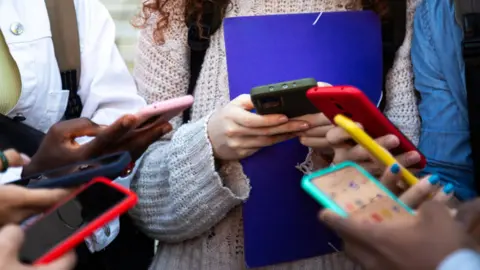
Getty Images Hands of teenage girls on mobile phonesGetty Images

The Association of School and College Leaders also welcomed the consultation on social media, but said the government had been “sluggish” in responding to the online risks posed to children.

The union’s general secretary Pepe Di’Iasio said there was “clearly a much wider problem of children and young people spending far too much time on screens and being exposed to inappropriate content”.

And Paul Whiteman, general secretary of the National Association of Head Teachers, also welcomed the plans to consult on a potential social media ban.

But he said the suggestion that Ofsted should “police” phones in schools was “deeply unhelpful and misguided”.

“School leaders need support from government, not the threat of heavy-handed inspection,” he added.

‘Not strong evidence’

It comes as the government faces additional pressure from the House of Lords, which is expected to vote on a proposed ban on Wednesday.

The amendment to the Children’s Wellbeing and Schools Bill has backing from several prominent figures such as former children’s TV presenter Baroness Benjamin and former education minister Lord Nash.

There is also a separate amendment calling for the introduction of film-style age ratings which could limit the social media apps children can access.

Professor Amy Orben, who leads the Digital Mental Health programme at the University of Cambridge’s MRC Cognition and Brain Sciences Unit, told the BBC there was “broad agreement” more needed to be done to keep children safe online.

However, she said there was still “not strong evidence” that age-based social media bans were effective.

Dr Holly Bear from Oxford University, whose work focuses on developing, evaluating, and implementing mental health interventions for young people, agreed the evidence for the effects of a social media ban was “still unfolding”.

“A balanced approach might be trying to reduce algorithm-driven exposure to harmful content, improving safeguards, supporting digital literacy and carefully evaluating any major policy interventions,” she said.

The NSPCC, Childnet, and suicide prevention charity the Molly Rose Foundation were among 42 individuals and bodies to argue a ban would be the “wrong solution” on Saturday.

“It would create a false sense of safety that would see children – but also the threats to them – migrate to other areas online,” the organisations wrote.

“Though well-intentioned, blanket bans on social media would fail to deliver the improvement in children’s safety and wellbeing that they so urgently need.”


A green promotional banner with black squares and rectangles forming pixels, moving in from the right. The text says: “Tech Decoded: The world’s biggest tech news in your inbox every Monday.”
Posted on

ChatGPT to carry adverts for some users

Zoe KleinmanTechnology editor

Getty Images A laptop keyboard with a mobile phone on it. On the phone screen is a blue and white ChatGPT logo.Getty Images

Adverts will soon appear at the top of the AI tool ChatGPT for some users, the company OpenAI has announced.

The trial will initially take place in the US, and will affect some ChatGPT users on the free service and a new subscription tier, called ChatGPT Go.

This cheaper option will be available for all users worldwide, and will cost $8 a month, or the equivalent pricing in other currencies.

OpenAI says during the trial, relevant ads will appear after a prompt – for example, asking ChatGPT for places to visit in Mexico could result in holiday ads appearing.

In example screenshots shared by the firm, the ads look like banners.

OpenAI says they will not influence ChatGPT’s responses and the firm will not share data about conversations with advertisers.

It said it had decided to explore ads “so more people can benefit from our tools with fewer usage limits”.

However there is also growing speculation that the AI sector has been over-valued by keen investors and hype, and has yet to actually demonstrate much in the way of profit.

Some analysts predict this “bubble” is unsustainable and could soon burst.

Henry Ajder, an expert in AI, Deepfakes and synthetic media, said OpenAI’s decision to explore ad revenue was not a surprise.

“OpenAI is a company that’s seen a huge amount of growth in terms of users in the last few years but it continues to burn investor money – it is not a profit making entity,” he said.

“And so, for this company to start actually turning a profit, it has to find more revenue sources from somewhere other than just standard paying subscribers. And for many software businesses, advertising is a revenue source which is reliable.”

OpenAI Screenshot of ChatGPT, showing a query about Santa Fe, New Mexico. Below shows an advert for desert cottages, with a "sponsored" message.OpenAI

The Financial Times reported that in 2025 OpenAI operated at a loss of around $8bn (£5.98bn) in the first six months of the year, and that only 5% of ChatGPT’s 800 million users are paid subscribers.

In addition to the new Go subscription tier, it already has Plus and Pro tiers, which cost $20 and $200 respectively per month in the US.

ChatGPT Go was first introduced in India in 2025 before being expanded out to other countries.

OpenAI was originally set up as a non-profit organisation but has increasingly turned towards a more commercial operation.

The internet economy has been largely funded by advertising for more than two decades.

OpenAI isn’t the only AI firm considering this business model, despite boss Sam Altman once saying he hated ads and describing them as “a last resort”.

In 2025, AI firm Perplexity appointed Taz Patel in the role of “head of advertising and shopping”, but he left the company nine months later.

Google denies reports that it had approached advertisers about bringing ads to its Gemini AI tool in 2026.

A green promotional banner with black squares and rectangles forming pixels, moving in from the right. The text says: “Tech Decoded: The world’s biggest tech news in your inbox every Monday.”
Posted on

X to stop Grok AI from undressing images of real people after backlash

Christal Hayesand

Osmond Chia

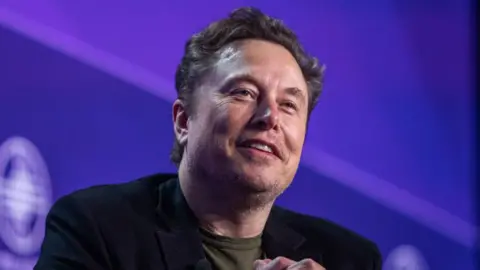
Getty Images Elon Musk stares towards the camera with a smile while sitting against a purple background on a stageGetty Images

Elon Musk’s AI model Grok will no longer be able to edit photos of real people to show them in revealing clothing, after widespread concern over sexualised AI deepfakes in countries including the UK and US.

“We have implemented technological measures to prevent the Grok account from allowing the editing of images of real people in revealing clothing such as bikinis.

“This restriction applies to all users, including paid subscribers,” reads an announcement on X, which operates the Grok AI tool.

The change was announced hours after California’s top prosecutor said the state was probing the spread of sexualised AI deepfakes, including of children, generated by the AI model.

X, formerly known as Twitter, also reiterated in a statement on Wednesday that only paid users will be able to edit images using Grok on its platform.

This will add an extra layer of protection by helping to ensure that those who try and abuse Grok to violate the law or X’s policies are held accountable, it said.

Users who try to generate images of real people in bikinis, underwear and similar clothing using Grok will be stopped from doing so according to the laws of their jurisdiction, X’s statement said.

With NSFW (not safe for work) settings enabled, Grok is supposed to allow “upper body nudity of imaginary adult humans (not real ones)” consistent with what can be seen in R-rated films, Musk wrote online on Wednesday.

“That is the de facto standard in America. This will vary in other regions according to the laws on a country by country basis,” said the tech multi-billionaire.

Musk had earlier defended X, posting that critics “just want to suppress free speech” along with two AI-generated images of UK Prime Minister Sir Keir Starmer in a bikini.

In recent days, leaders around the world have criticised Grok’s image editing feature.

Over the weekend, Malaysia and Indonesia became the first countries to ban the Grok AI tool after users said photos had been altered to create explicit images without consent.

Britain’s media regulator, Ofcom, said on Monday that it would investigate whether X had failed to comply with UK law over the sexual images.

Sir Keir warned X could lose the “right to self regulate” amid a backlash over the AI images, but later in the week said he welcomed reports that X was taking action to address the issue.

Some UK MPs also left the X social media platform in the wake of the outcry.

California Attorney General Rob Bonta said on Wednesday: “This material, which depicts women and children in nude and sexually explicit situations, has been used to harass people across the internet.”

Policy researcher Riana Pfefferkorn said she is surprised X took so long to deploy the new Grok safeguards and that the editing features should have been removed as soon as the abuse began.

Questions remain on how X will enforce its new policies, such as how the AI model will know if an image is of a real person and what actions it will take when users break the rules, said Pfefferkorn.

Musk has not presented the company in a serious light either, she said, adding that it would help if he stopped “doing things like re-posting an AI image of Keir Starmer in a bikini.”

Additional reporting by Katy Bailes

Posted on

Monzo bank says issue affecting its mobile app resolved

Monzo says it has resolved an issue affecting its mobile banking app on Tuesday afternoon after thousands of customers reported difficulties accessing it.

Platform outage monitor Downdetector saw more than 4,000 reports from users complaining of problems shortly after 15:00 GMT.

The company earlier acknowledged an issue affecting its app – telling customers who tried to use it that it would “not be fully functional” while it investigated.

A Monzo spokesperson said “customers can now use the app as normal.”

“For a short period today, we activated Monzo Stand-in – our fully independent backup bank – while we investigated an issue,” they told the BBC.

“Customers were always able to make payments with their card, withdraw cash, freeze their card and send and receive bank transfers.”

Many attempting to open the app after 15:00 GMT on Tuesday were met with a notice telling them “we’re experiencing issues”.

This said the app would not function as normal but other services, such as viewing account details and moving money between accounts, would be available.

However, some users attempting to access the app took to social media to complain to Monzo that they could not view funds, recent payments or make bank transfers.

In posts seen by the BBC, some X users also told Monzo they had been unable to use their card or withdraw money.

The BBC has asked Monzo for comment about these complaints.

The company has more than 14 million personal and business customers across the UK.

It has previously highlighted its back-up banking infrastructure as a way it avoids large-scale outages and issues for customers – many of which were seen across other UK banks during a spate of online outages last year.

About 1.2m people in the UK were affected by banking outages occurring on what was pay day for many in early 2025.

Posted on

What a new law and an investigation could mean for Grok AI deepfakes

Zoe KleinmanTechnology editor

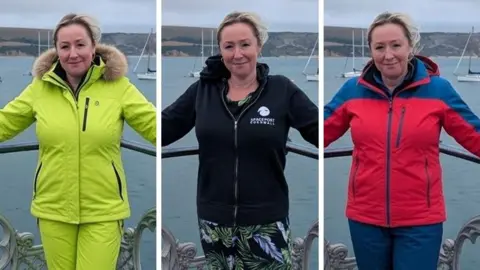
BBC Three shots of Zoe Kleinman side-by-side. They are identical but for her clothing, with a seaside background. On the left, she is wearing a bright yellow ski suit. In the middle, a black hoodie. On the right, a red and blue jacket. It is incredibly difficult to tell which is the original.BBC

Here’s me, at the end of a pier in Dorset in the summer.

Two of these images were generated using the artificial intelligence tool Grok, which is free to use and belongs to Elon Musk.

It’s pretty convincing. I’ve never worn the rather fetching yellow ski suit, or the red and blue jacket – the middle photo is the original – but I don’t know how I could prove that if I needed to, because of those pictures.

Of course, Grok is under fire for undressing rather than redressing women. And doing so without their consent.

It made pictures of people in bikinis, or worse, when prompted by others. And shared the results in public on the social network X.

There is also evidence it has generated sexualised images of children.

Following days of outrage and condemnation, the UK’s online regulator Ofcom has said it is urgently investigating whether Grok has broken British online safety laws.

The government wants Ofcom to get on with it – and fast.

But Ofcom will have to be thorough and follow its own processes if it wants to avoid criticism of attacking free speech, which has dogged the Online Safety Act from its earliest stages.

Elon Musk has been uncharacteristically quiet on the subject in recent days, which suggests even he realises how serious this all is.

But he did fire off a post accusing the British government of seeking “any excuse” for censorship.

Not everyone agrees that on this occasion, the defence is acceptable.

“AI undressing people in photos isn’t free speech – it’s abuse,” says campaigner Ed Newton Rex.

“When every photo a woman posts of themselves on X immediately attracts public replies in which they’ve been stripped down to a bikini, something has gone very, very wrong.”

With all this in mind, Ofcom’s investigation could take time, and a lot of back-and-forth – testing the patience of both politicians and the public.

It’s a major moment not only for Britain’s Online Safety Act, but the regulator itself.

It can’t afford to get this wrong.

Ofcom has previously been accused of lacking teeth. The Act, which was years in the making, only came fully into force last year.

It has so far issued three relatively small fines for non-compliance, none of which have been paid.

The Online Safety Act doesn’t specifically mention AI products either.

And while it is currently illegal to share intimate, non-consensual images, including deepfakes, it is not currently illegal to ask an AI tool to create them.

That’s about to change. The government will this week bring into force a law which will make it illegal to create these images.

And the UK says it will amend another law – currently going through Parliament – which would make it illegal for companies to supply the tools designed to make them, too.

These rules have been around for a while, they’re not actually part of the Online Safety Act but a completely different piece of legislation called the Data (Use and Access) Act.

They’ve not been brought into enforcement despite repeated announcements from the government over many months that they were incoming.

Today’s announcement shows a government determined to quell criticisms that regulation moves too slowly, by showing it can act quickly when it wants to.

It’s not just Grok that will be affected.

A political bombshell?

The new law that will be enforced this week could prove to be a headache for other owners of AI tools which are technically mostly capable of generating these images as well.

And there are already questions around how on earth it will be enforced – Grok only came under the spotlight because it was publishing its output on X.

If a tool is used privately by an individual user, they find a way around the guardrails and the resulting content is only shared with those who want to see it, how will it come to light?

If X is found to have broken the law, Ofcom could issue it with a fine of up to 10% of its worldwide revenue or £18m, whichever is greater.

It could even seek to block Grok or X in the UK. But this could also be a political bombshell.

I sat at the AI Summit in Paris last year and watched Vice President JD Vance thunder that the US administration was “getting tired” of foreign countries attempting to regulate its tech companies.

His audience, which included a huge number of world leaders, sat in stony silence.

But the tech firms have a lot of firepower inside the White House – and several of them have also invested billions of dollars in AI infrastructure in the UK.

Can the country afford to fall out with them?

A green promotional banner with black squares and rectangles forming pixels, moving in from the right. The text says: “Tech Decoded: The world’s biggest tech news in your inbox every Monday.”
Posted on

Malaysia and Indonesia block Musk’s Grok over sexually explicit deepfakes

Malaysia and Indonesia have blocked access to Elon Musk’s artificial intelligence (AI) chatbot Grok over its ability to produce sexually explicit deepfakes.

Grok, a tool on Musk’s X platform, allows users to generate images. In recent weeks however, it has been used to edit images of real people to show them in revealing outfits.

The South East Asian countries said Grok could be used to produce pornographic and non-consensual images involving women and children. They are the first in the world to ban the AI tool.

The BBC has contacted the Grok platform for comment. Musk had said earlier that critics of his platform are looking for “any excuse for censorship“.

Grok, and its parent company X, also face pressure in Britain, after Technology Secretary Liz Kendall backed calls to block access to the social media platform for failing to follow online safety laws.

Malaysia and Indonesia’s communications ministries announced their move against Grok in separate statements over the weekend.

The Malaysian Communications and Multimedia Commission said on Sunday that it issued notices to X earlier in the year to seek tighter measures after it found “repeated misuse” of Grok to generate harmful content.

But in its response, X failed to address the inherent risks of its platform’s design and focused mainly on the reporting process for users, the regulator said.

It added that Grok will be blocked until effective safeguards are implemented and urged the public to report harmful online content.

Using Grok to produce sexually explicit content is a violation of human rights, dignity and online safety, Meutya Hafid, Indonesia’s communications and digital affairs minister, said in a post on Instagram.

The ministry has also asked Musk’s X to provide a clarification on the use of Grok.

Indonesian authorities have cracked down on other online sources of pornographic material in recent years, with platforms such as OnlyFans and Pornhub already banned in the country.

British media regulator Ofcom is expected to soon decide on what to do about Grok.

The use of Grok to generate sexualised images has been condemned by leaders worldwide, including UK Prime Ministry Keir Starmer, who called it “disgraceful” and “disgusting”.

Posted on

X could face UK ban over deepfakes, minister says

Liv McMahonand

Laura Cress,Technology reporters

Technology Secretary Liz Kendall says she would back regulator Ofcom if it blocks UK access to Elon Musk’s social media site X for failing to comply with online safety laws.

Ofcom says it is urgently deciding what to do about X’s artificial intelligence (AI) chatbot Grok, which digitally undressed people without their consent when tagged beneath images posted on the platform. X has now limited the use of this image function to those who pay a monthly fee.

But Downing Street said the change was “insulting” to victims of sexual violence.

Musk said on X the UK government “want any excuse for censorship” as he replied to a post questioning why other AI platforms were not being looked at.

Kendall said: “Sexually manipulating images of women and children is despicable and abhorrent.

She added: “I, and more importantly the public, would expect to see Ofcom update on next steps in days not weeks.”

She said the Online Safety Act “includes the power to block services from being accessed in the UK, if they refuse to comply with UK law” and “if Ofcom decide to use those powers they will have our full support”.

The BBC has approached X for comment.

An Ofcom spokesperson said: “We urgently made contact [with X] on Monday and set a firm deadline of today [Friday] to explain themselves, to which we have received a response.”

“We’re now undertaking an expedited assessment as a matter of urgency and will provide further updates shortly.”

Ofcom’s powers under the Online Safety Act include being able to seek a court order to prevent third parties from helping X raise money or be accessed in the UK – should the firm refuse to comply.

These so-called business disruption measures remain largely untested.

The use of Grok to generate non-consensual sexualised images has been condemned by politicians on all sides, with Prime Minister Sir Keir Starmer calling it “disgraceful” and “disgusting”.

Reform UK leader Nigel Farage said it was “horrible in every way” and that X “needs to go further” than the changes it had made to Grok earlier on Friday.

But he said the idea of banning X in the UK was “frankly appalling” and an attack on free speech.

The Liberal Democrats have called for access to X to be temporarily restricted in the UK while the social media site was investigated.

‘Humiliated and dehumanised’

Grok is a free tool which users can tag directly in posts or replies under other users’ posts to ask it for a particular response.

The tool can still edit images on X if accessed through other areas of the platform, such as via its in-built “edit image” function, or on its separate app and website.

Many requests have been made asking it to edit images of women to show them in bikinis or little clothing – something those subject to such requests have told the BBC left them feeling “humiliated” and “dehumanised“.

However as of Friday morning, Grok has told users asking it to alter images uploaded to X that “image generation and editing are currently limited to paying subscribers”, adding users “can subscribe to unlock these features”.

Some posts on the platform seen by BBC News suggest only those with a blue tick “verified” mark – exclusive to X’s paid subscriber tier – were able to successfully request image edits to Grok.

Dr Daisy Dixon, a lecturer in philosophy at Cardiff University and female X user who said she had seen an increase in people using Grok to undress her, welcomed the change but said it felt “like a sticking plaster”.

“Grok needs to be totally redesigned and have built-in ethical guardrails to prevent this from ever happening again,” she told the BBC.

“Elon Musk also needs to acknowledge this for what it is – yet another instance of gender-based violation.”

Hannah Swirsky, head of policy at the Internet Watch Foundation, said it “does not undo the harm which has been done”.

“We do not believe it is good enough to simply limit access to a tool which should never have had the capacity to create the kind of imagery we have seen in recent days,” she said.

The charity previously said its analysts had discovered “criminal imagery” of girls aged between 11 and 13 which “appeared to have been created” using Grok.

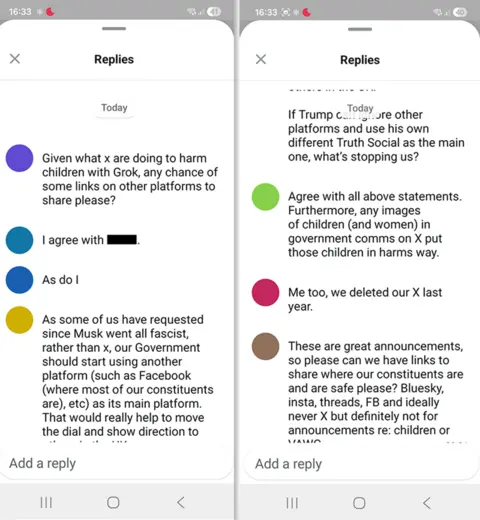
A mocked-up image of the leaked WhatsApp messages from Labour MPs, with identities redacted

Labour MPs are increasingly unhappy with the party’s use of X to get its political messages out.

Leaked messages from the Parliamentary Labour Party’s WhatsApp group, used to post announcements for backbench Labour MPs to share on social media, show at least 13 Labour MPs have called on the government to stop using the platform.

The messages, first reported by Politics Home and seen by BBC News, show Labour MPs calling on the government to “take a stand” and “put our messages out in other places”.

One MP said: “As some of us have requested since Musk went all fascist, rather than X, our government should start using another platform”.

Another said: “Any images of children (and women) in government comms on X put those children in harms way.”

Earlier on Friday, Downing Street suggested that the government would continue posting on X.

The prime minister’s official spokesperson told reporters changes to the way Grok complied with user requests to edit images on the platform showed X “can move swiftly when it wants to”.

They said it was “abundantly clear that X needs to act and needs to act now”.

“It is time for X to grip this issue, if another media company had billboards in town centres showing unlawful images, it would act immediately to take them down or face public backlash,” they added.

A green promotional banner with black squares and rectangles forming pixels, moving in from the right. The text says: “Tech Decoded: The world’s biggest tech news in your inbox every Monday.”
Posted on

OpenAI launches ChatGPT Health to review your medical records

Liv McMahonTechnology reporter

Getty Images A man wearing dark clothes typing on a smartphone.Getty Images

OpenAI has launched a new ChatGPT feature in the US which can analyse people’s medical records to give them better answers, but campaigners warn it raises privacy concerns.

The firm wants people to share their medical records along with data from apps like MyFitnessPal, which will be analysed to give personalised advice.

OpenAI said conversations in ChatGPT Health would be stored separately to other chats and would not be used to train its AI tools – as well as clarifying it was not intended to be used for “diagnosis or treatment”.

Andrew Crawford, of US non-profit the Center for Democracy and Technology, said it was “crucial” to maintain “airtight” safeguards around users’ health information.

It is unclear if or when the feature may be introduced in the UK.

“New AI health tools offer the promise of empowering patients and promoting better health outcomes, but health data is some of the most sensitive information people can share and it must be protected,” Crawford said.

He said AI firms were “leaning hard” into finding ways to bring more personalisation to their services to boost value.

“Especially as OpenAI moves to explore advertising as a business model, it’s crucial that separation between this sort of health data and memories that ChatGPT captures from other conversations is airtight,” he said.

According to OpenAI, more than 230 million people ask its chatbot questions about their health and wellbeing every week.

In a blog post, it said ChatGPT Health had “enhanced privacy to protect sensitive data”.

Users can share data from apps like Apple Health, Peloton and MyFitnessPal, as well as provide medical records, which can be used to give more relevant responses to their health queries.

OpenAI said its health feature was designed to “support, not replace, medical care”.

‘Watershed moment’

Generative AI chatbots and tools can be prone to generating false or misleading information, often stating this in a very matter-of-fact, convincing way.

But Max Sinclair, chief executive and founder of AI marketing platform Azoma, said OpenAI was positioning its chatbot as a “trusted medical adviser”.

He described the launch of ChatGPT Health as a “watershed moment” and one that could “reshape both patient care and retail” – influencing not just how people access medical information but also what they may buy to treat their problems.

Sinclair said the tech could amount to a “game-changer” for OpenAI amid increased competition from rival AI chatbots, particularly Google’s Gemini.

The company said it would initially make Health available to a “small group of early users” and has opened a waitlist for those seeking access.

As well as being unavailable in the UK, it has also not been launched in Switzerland and the European Economic Area, where tech firms must meet strict rules about processing and protecting user data.

But in the US, Crawford said the launch meant some firms not bound by privacy protections “will be collecting, sharing, and using peoples’ health data”.

“Since it’s up to each company to set the rules for how health data is collected, used, shared, and stored, inadequate data protections and policies can put sensitive health information in real danger,” he said.

A green promotional banner with black squares and rectangles forming pixels, moving in from the right. The text says: “Tech Decoded: The world’s biggest tech news in your inbox every Monday.”
Posted on

Inside the sub-zero lair of the world’s most powerful computer

Faisal IslamEconomics editor

It looks like a golden chandelier and contains the coldest place in the universe.

What I am looking at is not just the most powerful computer in the world, but technology pivotal to financial security, Bitcoin, government secrets, the world economy and more.

Quantum computing holds the key to which companies and countries win – and lose – the rest of the 21st Century.

In front of me suspended a metre in the air, in a Google facility in Santa Barbara California, is Willow. Frankly, it was not what I expected.

There are no screens or keyboards, let alone holographic head cams or brain-reading chips.

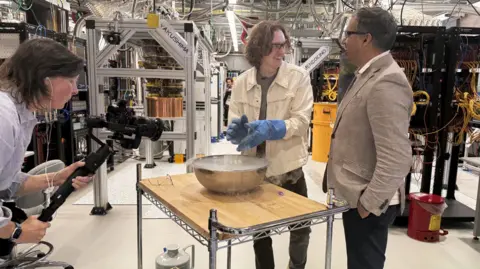
Willow is an oil barrel-sized series of round discs connected by hundreds of black control wires descending into a bronze liquid helium bath refrigerator keeping the Quantum microchip a thousandth of a degree above absolute zero.

It looks, and feels, very eighties, but if quantum’s potential is realised, the metal and wire jellyfish structure in front of me will transform the world, in many ways.

“Welcome to our Quantum AI lab,” says Hartmut Neven, Google’s Quantum chief, as we go through the high security door.

Neven is something of a legendary figure, part technological genius, part techno music enthusiast, who dresses like he has snowboarded here straight from the Burning Man music festival – for which he designs art. Perhaps he has, in a parallel universe – more on that later.

His mission is to turn theoretical physics into functional quantum computers “to solve otherwise unsolvable problems” and he admits he’s biased but says these chandeliers are the best performing in the world.

BBC economics editor Faisal Islam being shown around a Google facility in Santa Barbara

Secret temple of high science

Much of our conversation is about what we are not allowed to film in this restricted lab. This critical technology is subject to export controls, secrecy and is at the heart of a race for commercial and economic supremacy. Any small advantage, from the shape of new components to the companies in global supply chains, is a source of potential leverage.

There is a notable Californian vibe in this temple of high science, in its art and colour. Each quantum computer is given a name such as Yakushima or Mendocino, they are each wrapped in a piece of contemporary art, and various graffiti style murals adorn the walls illuminated by the bright winter sun.

Neven holds up Willow, Google’s latest Quantum chip, which has delivered two important milestones. He said it settled “once and for all” the discussion about whether quantum computers can do tasks that classical computers can’t.

Willow also solved a benchmark problem in minutes that would have taken the best computer in the world 10 septillion years, so more than a trillion trillion, or one with 25 zeros on the end, more than the age of the universe.

This theoretical result was recently applied to the Quantum Echoes algorithm, impossible for conventional computers, which helps learn the structure of molecules from the same technology used in MRI machines.

Google's Willow quantum computer is an oil barrel-sized series of round discs connected by hundreds of black control wires descending into a bronze drum suspended a metre from the ground in a lab

Neven reels off the ways he believes this Willow quantum chip will be used “to help with many problems that humankind has now”.

“It will enable us to discover medicines more efficiently,” he says. “It will help us make food production more efficient, it will help us produce energy, to transport energy, to store energy..solve climate change and human hunger…”

“It allows us to understand nature much better, and then unlock its secret to build technologies that make life more pleasant for all of us,” he tells me.

Some researchers believe that actual Artificial Intelligence will only be truly possible with Quantum.

Members of the team here have just received the Nobel prize for the original research into “superconducting qubits” used here.

The Willow chip has 105 qubits. Microsoft’s quantum effort has 8 qubits, but uses a different approach. The race around the world is to get to 1 million qubits for a “utility scale machine” that can do quantum chemistry, drug design, without error. The technology is fragile.

What is going on here is being watched carefully around the world. Professor Sir Peter Knight, Chair of the National Quantum Technology Programmes Strategy Advisory Board, says Willow broke new ground.

“All the machines are really still at the toy model stage, they make mistakes. They need error correction. Willow was the first to demonstrate that you could do error correction, through repeated rounds of repairs, which improve,” he says.

This puts the technology on a path to being scaled towards accurately doing a trillion operations, perhaps within seven or eight years, rather than the two decades previously assumed.

If the first quarter of this century was defined by the rise of the internet and then Artificial Intelligence, the next 25 years will surely be the start of the Quantum era.

How does it work?

Imagine trying to find a tennis ball in one of a thousand closed draws. A classical computer opens each one in order. A quantum computer opens all of them at the same time. Or similarly, instead of having to need a hundred keys to open a hundred doors in normal computing, quantum enables you to open all one hundred, with one key, instantly.

These machines will not be for everyone. They will not shrink down into phones or AI glasses or laptops. But the point is that the power of these computers grow exponentially, and everyone is getting in on the act.

I ask Nvidia chief Jensen Huang whether this poses a threat to his model of providing the specialised chips for AI. “No, a quantum processor will be added to a computer in the future,” he replies.

And one of the UK’s leaders in the field points out what is up for grabs in the quantum world – the eventual power to decrypt almost anything from state secrets to Bitcoin.

All of cryptocurrency will also have to be re-examined because of the quantum computing threat,” Sir Peter says.

A top partner to Nvidia last year said that while Bitcoin had a few years yet, the technology needed to fork to a stronger blockchain by the end of the decade.

Tech industry sources refer to the process of “Harvest Now, Decrypt Later” to describe how state agencies are believed to be saving all of the worlds encrypted data at home and abroad with the expectation of future generations being able to access it.

Global race

And then there is the race across the world. China’s approach is very different to the commercial race in the US and the West.

At around $15bn (£11bn), the total resource committed to quantum technology in China is possibly of the order of all the rest of the world’s government programmes put together, says Sir Peter.

Since 2022 China has published more scientific papers on quantum than other countries, the efforts have been led by a pioneering physicist called Pan Jianwei. It is a key part of Beijing’s 14th five-year plan.

China took a decision to stop its tech companies such as Baidu and Alibaba from developing their own quantum research – and concentrate the people and the infrastructure into a state-run enterprise. China is trying to get the edge on quantum communications and satellites.

Last year, Jianwei developed and tested the Zuchongzhi 3.0 quantum computer using similar technology though a different approach to that of Willow, claiming similar results. In the Autumn it was opened up for commercial use. It all feels a little like the World War II Manhattan Project to produce the first nuclear weapons, or the Space Race of the 21st Century.

The UK is one of the scientific heartlands for quantum research. It was a British scientist who did the original research on superconducting qubits. There are dozens of companies and cutting-edge research here. The government plans to make a significant investment around this in the coming weeks. It is vital for economics, for military use, and for geopolitics. There is a hope that the UK will be the third power in this area.

Parallel universes

Back at the Willow lab, there are perhaps even more existential questions being posed. Last year Neven suggested that Willow’s unprecedented speed supported some conceptions of the existence of a multiverse. Basically this speed could be explained by Willow having tapped into parallel universes for its compute power. Not all scientists bought this.

“There is still a spirited debate,” he tells me. “As you have learned in your lab visit, the reason quantum computers are so powerful is that within one clock cycle it can touch 2 to the 105 combinations simultaneously. It makes you question where are these different things?… There’s a version of quantum mechanics to think about – the many worlds formulation – parallel universes or parallel reality.”

Willow had not proved this, Neven was careful to say, but was “suggestive that we should take this idea seriously”.

This is the cutting edge of the frontier of the world, of technology, of growth, and the British Government will soon pour hundreds of millions into catching up with Willow and the Chinese. It sounds like science fiction…it is rapidly becoming economic fact.

Posted on

Government demands Musk’s X deals with ‘appalling’ Grok AI deepfakes

Laura CressTechnology reporter

Bloomberg via Getty Images Elon Musk looking off camera in front of a blue backgroundBloomberg via Getty Images

Technology Secretary Liz Kendall has called on Elon Musk’s X to urgently deal with its artificial intelligence chatbot Grok being used to create non-consensual sexualised images of women and girls.

The BBC has seen multiple examples on X of people asking the bot to digitally undress people to make them appear in bikinis without their consent, as well as putting them in sexual situations.

Kendall said the situation was “absolutely appalling”, adding “we cannot and will not allow the proliferation of these degrading images.”

In a statement, X said: “We take action against illegal content on X, including Child Sexual Abuse Material (CSAM), by removing it, permanently suspending accounts, and working with local governments and law enforcement as necessary.

“Anyone using or prompting Grok to make illegal content will suffer the same consequences as if they upload illegal content,” the statement continued.

On Monday, the regulator Ofcom said it had made “urgent contact” with Elon Musk’s company xAI and said it was investigating concerns Grok has been producing “undressed images” of people.

Kendall has endorsed the regulator’s actions.

“It is absolutely right that Ofcom is looking into this as a matter of urgency and it has my full backing to take any enforcement action it deems necessary,” she said.

‘Dehumanising’ images

Grok is a free AI assistant – with some paid-for premium features – which responds to X users’ prompts when they tag it in a post.

It is often used to give reaction or more context to other posters’ remarks.

But people on X are also able to use it to edit an uploaded image through its AI image editing feature without the consent of the person depicted.

Women who have stumbled across sexualised images of themselves made by Grok have described it as dehumanising.

Dr Daisy Dixon is one of the many female X users who recently started to see people take everyday pictures she had posted of herself on the platform and ask Grok to undress her or sexualise her.

She told the BBC the pictures left her feeling “shocked”, “humiliated” and frightened for her safety.

She added while she backed the call from the technology secretary for action and found it “heartening”, she still felt frustrated with X’s lack of accountability.

Dr Daisy Dixon A headshot of Dr Daisy Dixon Dr Daisy Dixon

“Myself and many other women on X continue to report the inappropriate AI images/videos we are being sent daily, but X continues to reply that there has been no violation of X rules,” she said.

“I just hope Kendall’s words turn into concrete enforcement soon – I don’t want to open my X app anymore as I’m frightened about what I might see.”

In her statement Kendall said: “Services and operators have a clear obligation to act appropriately. This is not about restricting freedom of speech but upholding the law.

“We have made intimate image abuse and cyberflashing priority offences under the Online Safety Act – including where images are AI-generated. This means platforms must prevent such content from appearing online and act swiftly to remove it if it does.”

The leader of the Liberal Democrats Sir Ed Davey urged the government to “act very quickly” to stop the generation of sexualised images by Grok, suggesting one course of action would be to “reduce access” to X.

“If the reports turn out to be true the National Crime Agency need to launch a criminal investigation,” Sir Ed said.

“People like Elon Musk have to be held to account.”

Speaking to BBC Newshour, Thomas Regnier, spokesman for tech sovereignty at the European Commission, said they were taking the issue “very seriously”.

“We don’t want this in the European Union… it’s appalling, it’s disgusting.

“The Wild West is over in Europe,” he said.

“All companies have the obligation to put their own house in order – and this starts by being responsible and removing illegal content that is being generated by your AI tool.”