
Concerns were raised by a subcommittee including potential price rises and the future of cinemas.
Author: DA Gadgets
SpaceX to take over Elon Musk’s AI firm
Musk’s space exploration company and his AI start-up are merging.
Musk’s SpaceX applies to launch 1m satellites into orbit
The firm wants to create a network of “orbital data centres” to power artificial intelligence.
Apple reports best-ever iPhone sales as Mac dips
The company’s revenue was boosted by iPhone sales, but sales of its wearable tech and Mac computers dipped.
Driverless taxis set to launch in UK as soon as September
Waymo has laid out plans for a robotaxi service in London with a pilot scheme due to begin in April.
Pornhub to restrict access for UK users from next week
Pornhub has announced it will restrict access to its website in the UK from next week, blaming the tougher age checks which have been introduced for explicit sites.
From 2 February, only people who have previously made a Pornhub account will be able to access its content.
Aylo, Pornhub’s parent company, said that updates to the UK’s Online Safety Act (OSA), requiring age verification, had “not achieved its goal of protecting minors” and had “diverted traffic to darker, unregulated corners of the internet”.
In October, Aylo said the law change had caused traffic to the website to fall by 77%.
Ofcom, the regulator, said at the time that tougher age checks were fulfilling their purpose of stopping children stumbling across inappropriate material.
An Ofcom spokesperson said on Tuesday “porn services have a choice between using age checks to protect users as required under the Act, or to block access to their sites in the UK”.
The regulator said it would continue its dialogue with Aylo “to understand this change to its position”.
Alex Kekesi, head of community and brand at Aylo, said the move to restrict UK access to Pornhub had been a “difficult decision”.
“Our sites, which host legal and regulated porn, will no longer be available in the UK to new users, but thousands of irresponsible porn sites will still be easy to access,” she said.
Kekesi said the platform initially complied with OSA obligations “because we wanted to believe that a determined and prepared regulator in Ofcom could take poor legislation and manage to enforce compliance in a meaningful way”.
But six months after age check requirements were introduced to stop children accessing adult content, Kekesi said the company’s experience “strongly suggests that the OSA has failed to achieve that objective”.
A spokesperson for the Department for Science, Innovation and Technology, said: “The Online Safety Act is clear: online pornographic services must stop children accessing this material by putting robust age assurance in place.
“It does not stop adults viewing legal content, and services do not need to leave the UK – they simply need to ensure under 18s cannot access it. There are a range of ways to do this.”
Those attempting to access Pornhub in the UK after 2 February will effectively be met with “a wall” instead of site content, said Kekesi.
The same restrictions will apply to other porn sites owned by Aylo, including YouPorn and Redtube.
Solomon Friedman of Ethical Capital Partners (ECP), which owns Aylo, said the company believed Ofcom was “working in good faith” to enforce age check requirements.
“The problem here, however, is not the regulator – it is the law,” he said.
“You have a dedicated regulator working in good faith, but unfortunately, the law they are operating under cannot possibly succeed.”
Friedman said six months after the requirement for sites allowing sexually explicit content took effect in the UK, people were still able to easily access porn – such as by searching for it online.
Emma Drake, partner of online safety and privacy at law firm Bird and Bird, said research cited by Aylo suggesting adults were seeking riskier porn sites also stated overall use of porn sites by adults had fallen
“The same must be true of children,” she told the BBC.
“The determined will find alternative routes, like the VPNs or the new entrants Aylo mentioned, but adding barriers to the most well-known sites can still protect a very large number of children who won’t make that effort.”
The company reiterated its position that device manufacturers such as Apple, Google and Microsoft were best placed to introduce technical measures to stop children accessing porn sites.
“When access is controlled at the device level, it is efficient, it’s effective, it’s privacy-preserving,” Friedman said.
Ofcom’s spokesperson said there was “nothing to stop” tech firms from coming up with age assurance methods at device level, adding “we would urge the industry to get on with that if they can evidence it is highly effective”.
But they said its job was “to enforce the rules as they stand”.
“We’ve put in place age assurance rules that are flexible and proportionate, and we have seen widespread adoption,” the spokesperson added.
Cyber security expert Chelsea Jarvie told the BBC controls implemented at device level, while likely to play a role in age assurance, “are not a silver bullet”.
“Virtual Private Networks continue to offer a workaround which is why protecting children online requires layered controls rather than reliance on any single measure,” she said.
VPNs allow people to effectively disguise their location online, and give the appearance of using the internet as though they are in a different country.
Downloads of VPN apps soared in the UK after age verification requirements took effect on 25 July.
Peers in the House of Lords recently voted to pass an amendment to the Children’s Wellbeing and Schools Bill to “prohibit the provision” of VPNs to children.
Additional reporting by Laura Cress and Chris Vallance
Tech giants face landmark trial over social media addiction claims
Lily JamaliNorth America Technology correspondent, San Francisco

 BRENDAN SMIALOWSKI/Getty Images
A landmark social media addiction trial in which top tech executives are expected to testify begins on Tuesday in California.
The plaintiff, a 19-year-old woman identified by the initials KGM, alleges the design of the platforms’ algorithms left her addicted to social media and negatively affected her mental health.
The defendants include Meta – which owns Instagram and Facebook – TikTok’s owner ByteDance and YouTube parent Google. Snapchat settled with the plaintiff last week.
The closely-watched case at Los Angeles Superior Court is the first in a wave of such lawsuits, which could challenge a legal theory used by tech firms to shield themselves from culpability in the US.
‘Dangerous and addictive algorithms’
The named social media companies have said the plaintiff’s evidence falls short of proving they are responsible for alleged harms such as depression and eating disorders.
The case going to trial marks a distinct shift in how the US legal system treats tech firms, which face mounting claims that their products lead to addictive behaviours.
The companies have long argued that Section 230 of the Communications Decency Act, passed by Congress in 1996, exempts platforms from liability for what third parties post.
But at issue in this case are design choices about algorithms, notifications and other features that affect how people use their apps.
KGM’s attorney, Matthew Bergman, told the BBC the case will be the first time a social media company has been held to account by a jury at trial.
“Unfortunately, there are all too many kids in the United States, the UK, and around the world who are suffering as KGM does because of the dangerous and addictive algorithms that the social media platforms foist on unsuspecting kids,” he said.
“These companies are going to have to explain to a jury why their profits were more important than the lives of our young people.”
Eric Goldman, a law professor at Santa Clara University, told the BBC that losing these cases in court could pose an existential threat to the social media companies.
But he said it may be difficult for plaintiffs to prove physical harms can be blamed on content publishers.
“The fact that the plaintiffs have been able to sell that idea has opened the door to a whole bunch of new legal questions that the law wasn’t really designed to answer,” he said.
‘The tech industry has been given deferential treatment’
At trial, jurors are expected to see an array of evidence, including excerpts from internal company documents.
“A lot of what these companies have been trying to shield from the public is likely going to be aired in court,” said Mary Graw Leary, a law professor at Catholic University of America.
Meta previously said it introduced dozens of tools to support a safe environment for teens online, but some researchers have disputed the effectiveness of the recent measures.
The companies are expected to argue any asserted harms are caused by third-party users.
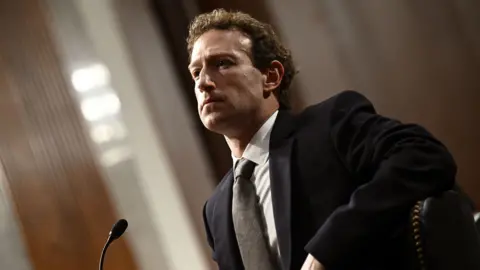
One highly-anticipated witness the jury will hear from is Meta boss Mark Zuckerberg, who is due to testify early in the trial.
In 2024, he told US senators “the existing body of scientific work has not shown any causal link between social media and young people having worse mental health outcomes”.
During that same hearing, at the prodding of one senator, Zuckerberg apologised to victims and their loved ones who had crowded into the chamber.
Tech executives “are often not good under pressure” said Mary Anne Franks, a law professor at George Washington University.
She said the firms were “very much much hoping” they could avoid having top bosses testify.
The trial comes as the companies face growing scrutiny from families, school districts, and prosecutors worldwide.
Last year, dozens of US states sued Meta, alleging the company misled the public over risks of social media use and had contributed to a youth mental health crisis.
Australia has enacted a social media ban on under-16s, and the UK signalled in January it may follow.
“There is a tipping point when it comes to the harms of social media,” Franks said.
“The tech industry has been given deferential treatment – I think we’re seeing that start to change.”

What does a new US TikTok deal mean for users?
Liv McMahonTechnology reporter
 Getty Images
TikTok has announced a deal allowing it to continue operating in the US.
But with the platform’s future in the country seemingly secured, its 200 million American users are expected to see some changes.
What is the US TikTok deal?
A majority-American board now owns and operates a separate entity controlling TikTok in the US.
Backed by mostly US investors, the newly established TikTok USDS Joint Venture LLC is governed by a board of seven directors.
TikTok chief executive Shou Zi Chew is among them, and its Chinese owner ByteDance will retain a 19.9% stake in the business.
The content recommendation algorithm at the heart of TikTok – determining which videos show up on the app’s For You feed – has been licensed to tech firm Oracle.
Headed by Trump ally Larry Ellison, Oracle already oversees TikTok US user data under a previous arrangement set up over security concerns called Project Texas.
But the company will now secure more of the app, including by retraining and updating its recommendation algorithm based on US user data.
TikTok says both the algorithm and US user data will be protected in “Oracle’s secure US cloud environment”.
The deal may be done, but it is likely to receive continued scrutiny. Some Democrats have already voiced concern that the ties between Trump and TikTok’s new investor group could end up limiting what gets shared on the platform.
“Americans won’t be any better off if a TikTok sale ends up with the company in the hands of Trump cronies backed by foreign funding,” Democrat Senator Ron Wyden said in December ahead of the deal being finalised.
Meanwhile Senator Ed Markey reportedly said on Friday Congress should investigate the agreement, citing a “lack of transparency” and detail.
Will I have to download a new app?
Something TikTok and those behind its new US joint venture will be keen to avoid is too much disruption – so making users download a new app seems unlikely.
The US is believed to be the platform’s largest global market, with 200 million users, according to TikTok.
It faces growing competition from Instagram and its short form video feature Reels – which parent firm Meta has boosted within its apps used by billions.
And experts and analysts have warned changing TikTok too much or requiring users to move to a new app could put users and advertisers off.
“Behind the scenes, TikTok is likely working hard to assure advertisers it will remain business as normal,” says Jasmine Enberg, co-CEO of Scalable, a media company and podcast focused on the creator economy.
“While the need for users to download a new app seems unlikely, brand partners will want to know that their TikTok strategies won’t be disrupted.”
Have TikTok US terms and conditions changed?
TikTok updated its terms of service for US users as the deal closed on Thursday.
It says the contract users agree to is now between themselves and the platform’s new US entity, TikTok USDS Joint Venture.
There are several changes. One new rule says children under the age of 13 cannot use TikTok outside of its specific “Under 13 Experience”.
Another point says the new US entity “does not endorse any content” on the platform, nor does it reflect its views.
US users who continue to use TikTok from 22 January also must agree to the limitations of generative AI – such as its potential to generate inaccurate, misleading, inappropriate or unlawful content.
“By using the platform, including its generative AI-enabled features, you recognise and assume this risk,” it says.
Will the algorithm get worse for US TikTok users?
Exactly what changes US users will see to their TikTok app and feeds, as a result of the deal, remains unclear.
The BBC has asked TikTok what will change in its American experience, and when.
But we know its recommendation algorithm will be retrained on US user data – sparking concern for some over whether highly personalised content it serves could change.
Enberg says algorithm tweaks could affect what people see or even create, potentially “leading to a different look and feel” for US users.
Dr Kokil Jaidka of the National University of Singapore previously said while the app is “unlikely to suddenly feel different” for most, “changes are plausible”.
Differences that do appear to US users are likely to be “subtle and gradual” – such as weaker personalisation.
But locally-controlled, user-facing features such as TikTok’s short videos, influencer culture and livestream shopping may not change, she said.
“There is a big incentive here to keep what works,” social media expert Matt Navarra told the BBC.
He said changes to an algorithm can bring “short-term tuning issues” such as less reach, repetitive content or random recommendations, and TikTok would want to maintain its algorithm as its “crown jewel”.
“What’s important here is you’re still using the same app, the same account and broadly the same recommendation engine,” he said
“I think the goal is continuity not reinvention.”
Will I see less global content on TikTok?
Using a licensed version of TikTok’s algorithm to power its US version could also present “constraints around data access, update frequency, and integration with TikTok’s global systems,” Jaika said.
But she said changes could impact the For You feed – which “learns from massive, cross-regional feedback loops” to surface relevant content – as well as how videos are ranked and moderated.
However she said many unknowns remain, with much depending “on how ByteDance tweaks the weaker links – such as data separation, update frequency, and oversight mechanisms – without degrading performance”.
TikTok meanwhile says the joint venture will be able to make the app compatible with other apps and regions to give US users “a global experience”.
Its press release claims US creators will still be discoverable and businesses will be able to maintain global reach.
“It’s not that the world disappears, more that domestic content could crowd out international content over time,” Navarra said.
“In other words, global content stays – but the balance may suddenly shift.”
What about CapCut and Lemon8?
CapCut and Lemon8 are two other popular apps owned by ByteDance accessed by US users.
Previously, it was slightly unclear what the law requiring TikTok’s sale or ban in the US could mean for its sister apps and their users.
But both “went dark” in the US alongside TikTok when the ban briefly took effect in January 2025.
Their future in the US now appears to be secured, with TikTok saying “safeguards provided by the Joint Venture will also cover CapCut, Lemon8, and a portfolio of other apps and websites in the US”.
Ubisoft cancels six games including Prince of Persia and closes studios
Ubisoft has cancelled six video games – including its long-awaited Prince of Persia: The Sands of Time remake – as part of a “major reset” of its operations.
The French developer and publisher, known for popular games such as Assassin’s Creed, Far Cry and Just Dance, has closed two studios and delayed seven titles as part of its changes.
Ubisoft boss Yves Guillemot said the move would “create the conditions for a return to sustainable growth”.
The firm’s shares plunged by 33% on Thursday morning following the announcement.
The move comes at a time when studios are increasingly turning to video game remakes and remasters, with new versions of Super Mario Galaxy, Oblivion and Metal Gear Solid 3 proving popular in 2025.
So the decision to bin the remake of Sands of Time – which sold millions of copies in 2003 – has left many fans scratching their heads.
Ubisoft has not specified which titles it has discontinued alongside the Prince of Persia remake.
But it says among them are four unannounced titles, including three based on new intellectual property, and a mobile game.
Ubisoft has closed its studios in Stockholm, Sweden and Halifax, Canada as part of the move, which will include restructuring three others.
The developers were working on a new intellectual property (IP) and mobile titles for Assassin’s Creed, respectively.
The closure of Ubisoft Halifax was previously announced in January – the same week the studio formed a union.
“While these decisions are difficult, they are necessary for us to build a more focused, efficient and sustainable organisation over the long term,” Guillemot said.
“Taken together, these measures mark a decisive turning point for Ubisoft and reflect our determination to confront challenges head-on to reshape the Group for the long term”.
Gaming industry analyst Piers Harding-Rolls told the BBC the move indicated the firm was trying to mitigate risk.
“It’s less risky to maintain scale by investing in existing big franchises such as Assassin’s Creed and Rainbow Six than launch entirely new IPs and that’s reflected in the cancellation of a number of games based on new IPs,” he said.
It is the second restructure from Ubisoft in subsequent years, after the firm cut 185 jobs across Europe in 2025.
In the UK, it closed its office in Leamington and restructured another in Newcastle-upon-Tyne.
Guillemot said the new move was in part due to a competitive market for triple-A games – blockbuster titles which cost millions to develop and dominate large studios’ offerings.
“On the one hand, the triple-A industry has become persistently more selective and competitive with rising development costs and greater challenges in creating brands,” he said in a statement on Wednesday.
Such big offerings are increasingly facing delays – with Grand Theft Auto VI pushed back for a second time to November 2026.
But Guillemot said despite these hurdles, successful blockbuster games could bring “more financial potential than ever”.
“In this context, today we are announcing a major reset built to create the conditions for a return to sustainable growth over time,” he said.
Ubisoft will now focus on developing open world adventure games – which let players freely navigate vast environments – and live service games which seek regular payments from players.
The firm said its subsidiary Vantage Studios, created after a €1.25bn ($1.25bn; £1bn) investment from Chinese tech giant Tencent, would aim to turn Assassin’s Creed, Far Cry and Rainbow Six “into annual billionaire brands”.
Snap settles social media addiction lawsuit ahead of trial
Snapchat’s parent Snap has settled a social media addiction lawsuit just days before the landmark case was due to go to trial in Los Angeles.
Terms of the deal were not announced as it was revealed by lawyers at a California Superior Court hearing, after which Snap told the BBC the parties were “pleased to have been able to resolve this matter in an amicable manner”.
Other defendants in the case include Instagram parent Meta, ByteDance’s TikTok and Alphabet’s YouTube, none of which have settled.
The plaintiff, a 19-year old woman identified by the initials K.G.M., alleged that the algorithmic design of the platforms left her addicted and affected her mental health.
In the absence of a settlement with the other parties, the trial is scheduled to go forward against the remaining three defendants, with jury selection due to begin on 27 January.
Meta boss Mark Zuckerberg is expected to testify, and until Tuesday’s settlement, Snap CEO Evan Spiegel was also set to take the stand.
Meta, TikTok and Alphabet did not respond to BBC inquiries seeking reaction to the settlement.
Snap is still a defendant in other social media addiction cases that have been consolidated in the court.
The closely watched cases could challenge a legal theory that social media companies have used to shield themselves.
They have long argued that Section 230 of the Communications Decency Act of 1996 protects them from liability for what third parties post on their platforms.
But plaintiffs argue that the platforms are designed in a way that leaves users addicted through choices that affect their algorithms and notifications.
The social media companies have said the plaintiffs’ evidence falls short of proving that they are responsible for alleged harms such as depression and eating disorders.