There is a big change coming for many people who use Windows computers.
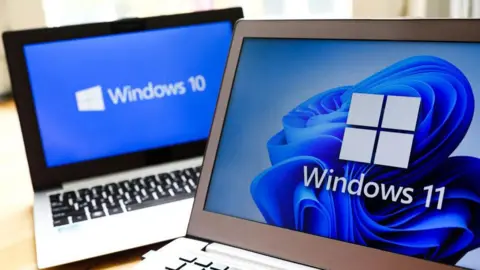
Microsoft is ending support for its Windows 10 operating system, which means that after Tuesday 14 October, these computers may be at risk.
This is because security updates will stop, making devices more vulnerable to attack.
Microsoft is encouraging people to upgrade for free to Windows 11 – but not all computers will be able to do that.
“The end of support for Windows 10 is shaping up to be a disaster for both consumers and the environment,” said Nathan Proctor, senior director at US consumer group PIRG.
So, what does it mean for you?
Who is affected?
Windows is the world’s most popular computer operating system, with Microsoft saying it is used on over 1.4 billion devices around the globe.
In the UK, consumer guide Which? estimates there could be 21 million people still using Windows 10.
In September, it ran a survey which found about a quarter of those users were planning to continue to use it even after Microsoft’s official support ends.
About one in seven said they planned to buy a new computer.
Other consumer groups have criticised the end of Windows 10 support, saying it will lead to unnecessary spending and environmental waste.
“People are tired of living in a world filled with short-lived devices we can’t fix, or lose software support or are otherwise forced into the waste stream,” said Mr Proctor, who campaigns for the right to repair in the US.
He added: “We deserve tech that lasts.”
What do I need to do?
Microsoft is essentially giving personal users two options: Update to Windows 11, or sign up to receive extended security updates for 12 months.
These can be done in the “Privacy and Security” section of your settings.
People who own PCs eligible for Windows 11 can upgrade for free.
However, many people “will have to purchase new devices – despite the fact that their current computers work just fine,” said Mr Proctor.
If you don’t want to upgrade straight away, or your device is too old for Windows 11, you can sign up to a scheme which will continue the most important security updates until October 2026.
This is called Extended Security Updates (ESU) – but it does not offer any technical support or other software updates.
People living in the European Economic Area will get it for free by registering. For other users to get it for free, they need to have updated to the latest version of Windows 10, have a Microsoft account and backed up their PC settings.
Otherwise, you have to pay a $30 (£22) fee or use 1,000 Microsoft Rewards points to access ESU.
For commercial organisations using Windows 10, it will cost $61 per device.
The exact amount you pay depends on where in the world you live.
Getty Images
What’s changing?
Since its release in 2015, Microsoft has kept Windows 10 going with frequent software updates.
These have been used to tweak or add new features, as well as patch security issues and bugs.
The company recommends users upgrade to Windows 11 for free – but some older devices won’t be able to run the new operating system.
It is also making it harder to use Windows 11 without a Microsoft account – and one way to extend the life of your Windows 10 machine also requires a Microsoft account.
Some users prefer not to log in with a Microsoft account for privacy reasons.
What’s the risk?
Microsoft will stop sending critical security updates and fixes to Windows 10 PCs.
That can make your device more vulnerable to threats such as viruses or malicious software – as you won’t get the latest defences against attacks.
We have seen a number of high-profile cyber-attacks in recent months, to businesses ranging from retailers to car manufacturers and even a nursery chain.
Companies may also “find it challenging to maintain regulatory compliance with unsupported software”, Microsoft Consumer Chief Marketing Officer Yusuf Mehdi wrote in a blog post.
You may also notice other software could lose some functionality as developers stop sending their latest features to older operating systems.
Suranjana TewariAsia business correspondent, Tokyo and
Peter HoskinsBusiness reporter
Reuters
Only four bottles of Asahi Super Dry beer are left on the shelves of Ben Thai, a cosy restaurant in the Tokyo suburb of Sengawacho.
Its owner, Sakaolath Sugizaki, expects to get a few more soon, but she says her supplier is keeping the bulk of its stock for bigger customers.
That’s because Asahi, the maker of Japan’s best-selling beer, was forced to halt production at most of its 30 factories in the country at the end of last month after being hit by a cyber-attack.
While all of its facilities in Japan – including six breweries – have now partially reopened, its computer systems are still down.
That means it has to process orders and shipments manually – using pen, paper and fax machines – resulting in much fewer shipments than before the attack.
Asahi accounts for about 40% of Japan’s beer market, so its problems are having a major impact on bars, restaurants and retailers.
The company has apologised “for any difficulties caused by the recent attack” but has not yet said when it expects its operations to be fully up and running again.
The BBC visited convenience stores and supermarkets in Tokyo and Hokkaido – where workers said they were selling their current stock and hadn’t been able to place new orders for Asahi products, which also include water and food items.
Hisako Arisawa, who runs a liquor store in Tokyo, says she is worried about her customers as she can only get a few bottles of Super Dry at a time and expects the disruption to go on for at least a month.
The problem isn’t just affecting beer, she adds, there are also shortages of Asahi’s soft drinks, such as ginger beer and soda water.
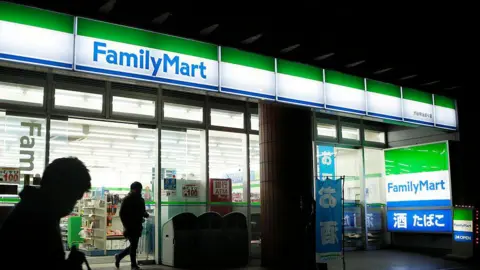
FamilyMart said its Famimaru range of bottled teas, which are made by Asahi, were expected to be in short supply or out of stock.
7-Eleven halted shipments in Japan of Asahi products, while Lawsons also said it expected shortages.
Mr Nakano, who didn’t want to share his first name, works for an alcohol wholesaler.
While some shipments from Asahi have resumed, he says he is only getting about 10-20% of the normal amount.
His orders are now handwritten and taken by fax. Asahi notifies him by fax when lorries are ready to leave its factory.
Asahi also owns big brands in Europe – such as Peroni, Grolsch, and the British brewer Fuller’s – but the firm has said those operations have not been affected by the cyber-attack.
Ransomware group Qilin – which has previously hacked other major organisations – has claimed responsibility for the attack on Asahi.
It operates a platform that allows users to carry out cyber-attacks in exchange for a percentage of extortion proceeds.
Asahi has not confirmed the nature of the attack on its operations but has said data suspected to have been leaked in the hack had been found on the internet.
Travellers were delayed at a number of European airports in September after a ransomware attack disrupted check-in and boarding software.
Back in Japan, a cyber-attack paralysed operations at a container terminal in the city of Nagoya for three days in 2024.
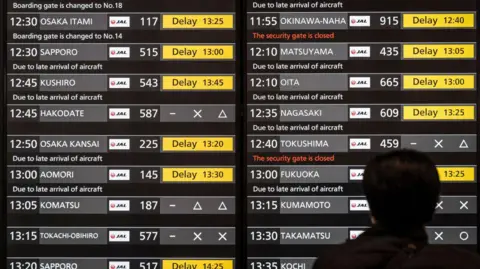
Japan Airlines was also hacked last Christmas, causing delays and cancellations to domestic flights.
AFP via Getty Images
While Japan’s image around the world may be of a technologically advanced nation, some experts have warned it does not have enough cybersecurity professionals and has low rates of digital literacy when it comes to business software.
Japan is vulnerable to cyber-attacks “given a reliance on legacy systems and a society with a high level of trust,” Cartan McLaughlin from Nihon Cyber Defence Group told the BBC.
Many organisations in the country are not prepared for attacks and are willing to pay ransoms, which makes them attractive to hackers, he added.
Speaking at a news conference this week, Japan’s Chief Cabinet Secretary Yoshimasa Hayashi said the Asahi cyber-attack was being investigated.
“We will continue to improve our cyber capabilities,” he added.
Earlier this year, the Japanese government passed a landmark law giving it more powers in the event of cyber-attacks.
Experts have praised the Active Cyber Defense Law (ACD), because it allows the government to share more information with companies, and also empowers the police and Japan’s Self-Defense Forces to mount their own attacks to neutralise attackers’ servers.
But that is little consolation to small businesses like Ben Thai restaurant and its customers.
Owner Sakaolath says she’s not sure what will happen the next time she puts in an order for Super Dry, and nor do many others across Japan.
OpenAI says the latest version of its text-to-video artificial intelligence (AI) tool Sora was downloaded over a million times in less than five days – hitting the milestone faster than ChatGPT did at launch.
The app, which has topped the Apple App Store charts in the US, generates ten second long realistic-looking videos from simple text prompts.
The figures were announced in an X post from Sora boss Bill Peebles, who said the “surging growth” came even though the app was only available to people in North America who had received an invite.
But its handling of copyright material – and the images of dead public figures – has attracted significant criticism online despite the growth.
The Sora app – which makes it easy for users to post videos they have created to social media – has resulted in a deluge of videos on social feeds.
Some have included depictions of deceased celebrities such as musicians Michael Jackson and Tupac Shakur.
Three days ago, Zelda Williams, the daughter of Robin Williams, asked people to stop sending her AI-generated videos of her father, the celebrated US actor and comic who died in 2014.
A plea that press reports have linked to the popularity of Sora.
An OpenAI spokesperson told US news site Axios in an email there were “strong free speech interests” in allowing the depiction of historical figures.
But the spokesperson said, for public figures who were “recently deceased”, authorized persons could request their likenesses aren’t used – though it did not specify what counted as “recent”.
Videos also frequently feature depictions of characters from films, TV and games.
In one Sora deepfake of Sam Altman, the OpenAI boss is shown with several Pokémon characters saying “I hope Nintendo doesn’t sue us”, CNBC reported.
In another viral deepfake video he grills and eats the game’s infamous Pikachu mascot.
Nintendo has not revealed any plans to take legal action, but several companies behind popular generative AI systems, including OpenAI, are currently locked in legal battles with the creators and rights holders of creative works.
The potential cost of these battles is high.
AI firm Anthropic agreed to pay $1.5bn (£1.11bn) to settle a class action lawsuit filed by authors who said the company stole their work to train its AI models.
OpenAI says it is adapting its approach to these issues.
On 4 October, Mr Altman blogged that the firm had been “learning quickly from how people are using Sora and taking feedback from users, rights holders, and other interested groups”.
He said the firm would “give rights holders more granular control over generation of characters”.
And he said there were plans for some form of revenue-sharing in the future.
But it remains to be seen if rights holders will agree Sora videos are a new kind of “interactive fan fiction” as Mr Altman suggested – or whether it will force the firm to face a grilling in the civil courts.
In the fiercely competitive world of video games, it’s common for new contenders to fade away as quickly as they burst on to the scene.
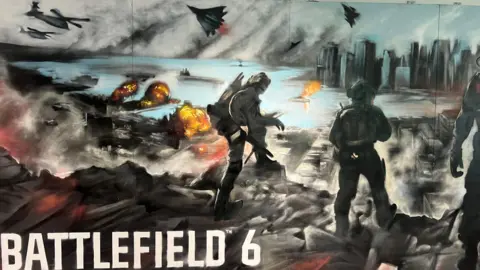
But Battlefield 6 is hoping to change that.
It’s the latest entry in a long-running military shooter series often framed as a grittier, more realistic answer to Call of Duty.
The title’s never quite managed to match its most famous rival in terms of sales or players, but there are signs the new installment could close the gap.
A preview weekend giving players a chance to try out the game earlier this year broke records, and the buzz heading into its launch has been huge.
But the project is still a big gamble for publisher Electronic Arts (EA), which has reportedly spent hundreds of millions of dollars making it.
BBC Newsbeat’s spoken to some of the makers to find out how they hope it will pay off.
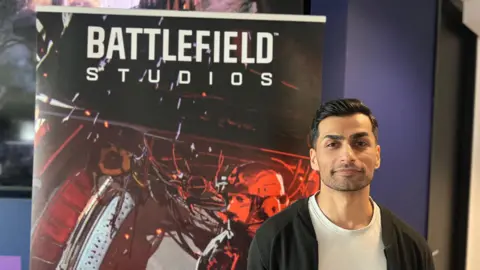
Four EA-owned studios have been working on the game under the Battlefield Studios banner.
They include original series developer Dice, based in Sweden, LA’s Motive Studios and Ripple Effect Studios in Canada.
The fourth, Criterion, is based in Guildford, UK.
Rebecka Coutaz is the general manager of the two European studios, and tells Newsbeat that, in terms of what it’s offering players, “Battlefield 6 is probably unbeatable”.
EA
The game comes off the back of the futuristic Battlefield 2042, released four years ago to a negative reception it struggled to recover from.
“We probably couldn’t make and develop Battlefield 6 without the learnings we had in Battlefield 2042,” Rebekah tells Newsbeat.
One of those lessons was to get fans involved early, and the team launched invite-only community playtests earlier this year.
The “feedback was explosively positive,” says Rebecka.
Another missing ingredient from Battlefield 2042 was a single-player campaign, which has been restored this time around.
Criterion design director Fasahat “Fas” Salim is the one in charge of “making sure those missions are as fun and interesting as possible for the players”.
Despite claims that the scale of the project had put a strain on the different studios collaborating across continents to build the game, Fas is positive about the process.
“Collaborating with different cultures, different backgrounds, it’s a really interesting environment to be involved in every day,” he says.
“This whole approach has been something new but something really exciting because we are working with people from all over the world.”
As for the expectation on the team, Fas says: “There is pressure but also it’s exciting.
“It’s a big project. It’s probably the biggest that most of us have ever worked on.”
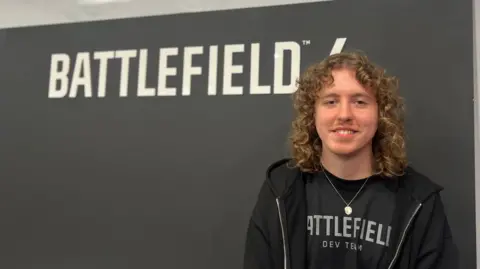
That’s definitely true of at least one team member, lighting artist Vlad Kokhan.
The 21-year-old makes the atmospheric effects that shape the mood, tone, and direction of the single-player campaign.
He completed an internship at Criterion before getting a job there, and currently works part-time while finishing his visual effects degree at Bournemouth University.
Vlad says he’s a long-time fan of the Battlefield series, and remembers playing the fourth instalment of the series at a friend’s house when he was younger.
To be working on it now, as his first industry job, “doesn’t feel real”.
“It’s really crazy seeing the marketing everywhere”, he says.
“To know that I’ve put my own thing into the game is really surreal.”
But its real success in a volatile and unpredictable industry won’t be clear for months, if not years.
To maintain the momentum, it will need to draw – and keep – players away from rivals including CoD, Fortnite and Roblox.
But while the signs are promising, Rebecka is cautious when asked if she is feeling confident.
“I would say yes and no, you never know,” she says.
“The only thing that matters to me now – and I’ve been saying it for four years – is that we don’t disappoint our community, our players.”
Concerns for Battlefield’s future were also sparked by recent news that EA had agreed to sell the company to a Saudi Arabia-led group for $55bn (£41bn).
EA has taken on $20bn (£14bn) of debt as part of the deal – known as a leveraged buyout – prompting fans to fear of cutbacks.
The company has told staff to expect “no immediate changes” to their jobs.
For Battlefield 6, Rebecka tells Newsbeat the team will continue as planned, and has already shared details for monthly updates and content additions.
“I am here to help our team members make their best work in their careers so the way hasn’t changed for me, the way is still the same,” she insists.
EA has been vocal about its plans to use generative AI in game development, and its prospective new owners are betting on the technology to boost profits, according to The Financial Times.
The tools are controversial, prompting concerns from developers and backlash from some fans.
Rebecka tells Newsbeat players won’t see anything made by GenAI within Battlefield 6, but it is used in preparatory stages to “to allow more time and more space to be creative.”
Rebecka says GenAI “is very seducing”, but there isn’t currently a way to incorporate it into developer’s daily work.
Yet she shares EA’s optimism for its potential.
“If we can break the magic with AI it will help us be more innovative and more creative,” she says.
In Fas’s opinion, GenAI is “not anything to be scared of in our industry”.
“Especially as we work in an environment at the bleeding edge of technology – we’re kind of used to things changing,” he says.
“It’s just a matter of how we can incorporate that productively into our workflows, how can we leverage that to take our games to the next level.”
For now, though, the team’s focus is on nailing Battlefield 6’s release.
“We spend a lot of time behind closed doors making these things,” says Fas.
“But when it goes into the players’ hands and you see them having a great time, people shouting, people excited, that’s something that we worked years for.
“This is what most of us game developers look forward to. We just want to see people play the thing and then get excited about it.”
Listen to Newsbeat live at 12:45 and 17:45 weekdays – or listen back here.
A 17-year-old boy and a 22-year-old man have been arrested by police investigating a cyber-attack on a chain of nurseries in London.
The Metropolitan Police say the pair were arrested at residential addresses in Bishop’s Stortford, Hertfordshire, on suspicion of computer misuse and blackmail.
Hackers were said to have stolen the photographs, names and addresses of about 8,000 children from the Kido chain.
The force said it received a referral from the Action Fraud cyber crime reporting service on 25 September detailing a ransomware attack.
Those arrested remain in custody for questioning.
Will Lyne, Met’s Head of Economic and Cybercrime, said: “We understand reports of this nature can cause considerable concern, especially to those parents and carers who may be worried about the impact of such an incident on them and their families.
“These arrests are a significant step forward in our investigation, but our work continues, alongside our partners, to ensure those responsible are brought to justice.”
The cyber attack on Kido’s nursery was first brought to the BBC’s attention on 22 September when hackers calling themselves Radiant attempted to get press attention for a data theft as part of their attempts to extort the nursery chain for around £600,000 in Bitcoin.
The BBC did not report on the breach until the hackers began posting images and profiles of some of the children on their darknet site on 25 September in what cyber experts described as a “new low” in cyber crime.
The stolen data included names, addresses and pictures of children along with contact details for parents and carers.
The hackers called parents directly about their hack to pressure Kido into paying the ransom to have the data deleted. More children’s profiles were added taking the total to 20.
In an unusual move they hackers then blurred the images as they were concerned about their reputation with other hacking groups.
Then on 2 October they removed all the stolen data and pictures from their darknet site and claimed to have deleted all 8,000 children’s’ files. “No more remains and this can comfort parents,” they said.
A spokesperson for Kido had confirmed the company had “identified and responded to a cyber incident” and worked with external specialists to investigate and determine what happened.
They added: “We swiftly informed both our families and the relevant authorities.”
The app’s parent company Snap announced in September it would start charging people if they have more than five gigabytes worth of previously shared images and videos saved as Memories.
For many, these retro posts act as a window to the past – leading some to accuse the firm of “corporate greed” in posts on social media and negative reviews on Google and Apple’s app stores.
Snap has compared its paid storage plans to those provided by Apple and Google for smartphones.
And as an alternative for those who don’t want to pay, users can download their Memories, which for some span tens of gigabytes of data, to their device.
The firm told the BBC only a small number of users would be affected by the changes.
It also acknowledged it was “never easy to transition from receiving a service for free to paying for it” – but suggested it would be “worth the cost” for users.
Many criticising the move online seem to disagree.
An online petition dubbed the fee a “memory tax”, with commenters calling it “dystopian” and “ridiculous” – while one person threatened never to use the app again.
Meanwhile, in a one-star review on the Google Play store, a person calling themselves Natacha Jonsson said it felt “very unethical”.
“If I know millennials right, most of us have years worth of memories on Snapchat,” they said.
“And most of us only kept the app mainly for that reason.
“5GB is absolutely nothing when you have years worth of memories… Bye Snap.”
And Guste Ven, a 20-year-old journalism student in London, shared on TikTok her plans to delete the app.
Allow TikTok content?
This article contains content provided by TikTok. We ask for your permission before anything is loaded, as they may be using cookies and other technologies. You may want to read and before accepting. To view this content choose ‘accept and continue’.
“I decided that I needed to download all my memories as soon as I could,” she told BBC News.
“Almost all of my teenage years have been documented through my Snapchat memories, all of the photos in there are really important to me.
“It just doesn’t make sense to start charging people for something that has been free for so many years.”
Snapchat has not yet said how much storage plans would cost in the UK – only that they are part of a “gradual global rollout”.
But 23-year-old Amber Daley, who also lives in London, said in a post on TikTok she would be “distraught” by such charges.
Allow TikTok content?
This article contains content provided by TikTok. We ask for your permission before anything is loaded, as they may be using cookies and other technologies. You may want to read and before accepting. To view this content choose ‘accept and continue’.
Amber told the BBC the app had become “a part of everyday life” since she started using it in 2014.
While she said she understood the platform needed to make money, Amber suggested the Memories feature means more to users than the company may have realised.
“I think it’s quite an unfair move to charge your customers who have been loyal and devoted,” she said.
“These aren’t just called Memories, these are our actual memories.”
‘Emotional artefacts’
Companies deciding to charge users for a service that was previously free is nothing new, and millions pay for services like iCloud and Google Drive to backup their photos and videos from their smartphone.
The reality of storing data in the cloud – which some in the tech industry like to refer to as simply “somebody else’s computer” – is it costs money.
“Hosting trillions of Memories on Snapchat isn’t a trivial amount,” social media consultant Matt Navarra told the BBC.
“Snapchat has to try to find a way to cover the cost of storage, bandwidth, back-ups, content delivery, encryption – all that stuff.”
Bloomberg via Getty Images
But Mr Navarra said introducing fees for a service that had previously been free, and users had been encouraged to use as such, may feel like a “bait and switch” for some.
“Moving the goalposts after people have built this huge digital archive doesn’t really sit right,” he said.
And for many, he added, “Memories aren’t just data dumps, they’re emotional artefacts”.
The feeling was shared by those leaving critical reviews, with one person calling their Snapchat photos and videos “the most precious thing to me”.
“[Memories] have every aspect of my life within them from celebrations of new family members’ births, mourning of passed loved ones, memories with friends/family, [and] my whole teenage years,” they wrote.
Dr Taylor Annabell, a postdoctoral researcher at Utrecht University in the Netherlands, said Snapchat’s move shows the implications of commercial platforms being used to store sentimental personal content.
“They benefit from this trust, interdependence, and presumption of never-ending access, which even incentivises some users to remain with the platform or continue to use it in order to scroll back through their archive,” she told the BBC.
“But these are not benevolent guardians of personal memory.”
The first day of September should have marked the beginning of one of the busiest periods of the year for Jaguar Land Rover.
It was a Monday, and the release of new 75 series number plates was expected to produce a surge in demand from eager car buyers. At factories in Solihull and Halewood, as well as at its engine plant in Wolverhampton, staff were expecting to be working flat out.
Instead, when the early shift arrived, they were sent home. The production lines have remained idle ever since.
Though they are expected to resume operations in the coming days, it will be in a slow and carefully controlled manner. It could be another month before output returns to normal. Such was the impact of a major cyber attack that hit JLR at the end of August.
It is working with various cyber security specialists and police to investigate, but the financial damage has already been done. Over a month’s worth of worldwide production was lost.
Analysts have estimated its losses at £50m per week.
Getty Images
For a company that made a £2.5bn profit in the last financial year, and which is owned by the Indian giant Tata Group, the losses should be painful but not fatal. But JLR is not an isolated incident.
So far this year there has been a wave of cyber attacks targeting big businesses, including retailers such as Marks & Spencer and the Co-op, as well as a key airport systems provider. Other high profile victims have included the children’s nursery chain Kido, while last year incidents involving Southern Water and a company that provided essential blood tests to the NHS raised serious concerns about the vulnerability of critical infrastructure and services.
In all, a government run survey on cyber security breaches estimates 612,000 businesses and 61,000 charities were targeted across the UK. So just how much are attacks like these costing businesses and the economy?
And could it be, as one expert analyst puts it, that this year’s major attacks are the result of a “cumulative effect of a kind of inaction” on cyber security from the government and businesses that is now starting to bite?
Pyramid of suppliers affected
What is significant about an attack on the scale of the one that hit JLR is just how far the consequences can stretch.
The company sits at the top of a pyramid of suppliers, thousands of them. They range from major multinationals, such as Bosch, down to small firms with a handful of employees, and they include companies which are heavily reliant on a single customer: JLR.
For many of those firms, the shutdown represented a very real threat to their business.
In a letter to the Chancellor on 25 September, the Business and Trade Committee warned that smaller firms “may have at best a week of cashflow left to support themselves”, while larger companies “may begin to seriously struggle within a fortnight”.
Industry analysts expressed concerns that if companies started to go bankrupt, a trickle could soon become a flood – potentially causing permanent damage to the country’s advanced engineering industry.
Resuming production does not automatically mean the crisis is over either.
“It has come too late,” explains David Roberts, who is the Chairman of Coventry-based Evtec, a direct supplier to JLR, with some 1,250 employees.
“All of our companies have had six weeks of zero sales, but all the costs. The sector still desperately needs cash.”
From Co-op to Marks & Spencer
A recent IBM report, which looked at data breaches experienced by about 600 organisations worldwide found that the average cost was $4.4m (or £3.3m).
But JLR is far from an outlier when it comes to high-profile cyber attacks on an even greater scale. Marks & Spencer and the Co-op supermarket chain this year are estimated to have cost £300 million and £120 million respectively.
Over the Easter weekend in April, attackers managed to gain entry to Marks & Spencer’s IT systems via a third-party contractor, forcing it to take some networks offline.
Initially, the disruption seemed relatively minor – with contactless payment systems out of action, and customers unable to use its ‘click and collect’ service. However, within days, it had halted all online shopping – which normally makes up around a third of its business.
It was described at the time as “almost like cutting off one of your limbs”, by Nayna McIntosh, former executive committee member of M&S and the founder of Hope Fashion.
Bloomberg via Getty Images
When the Co-op supermarket chain was hit, the same group of hackers claimed responsibility.
It was, they suggested, an attempt to extort a ransom from the company by infecting its networks with malicious software. However the IT networks were shut down quickly enough to avoid significant damage.
As the criminals angrily described it to the BBC, “they yanked their own plug – tanking sales, burning logistics, and torching shareholder value”.
According to Jamie MacColl, a cyber expert at the security research group, the Royal United Services Institute (RUSI), it is no surprise to see major businesses being targeted in this way.
He says it is the result of hackers being easily able to get hold of so-called ransomware (software which can lock up or encrypt a victim’s computer networks until a ransom is paid).
More from InDepth
“Historically, this kind of cyber crime… has mostly been carried out by Russian-speaking criminals, based in Russia or other parts of the former Soviet Union”, he explains.
“But there’s been a bit of a change in the last couple of years where English-speaking, mostly teenage hackers have been leasing or renting ransomware from those Russian-speaking cyber criminals, and then using it to disrupt and extort from the businesses they’ve gained access to.
“And those English-speaking criminals do tend to focus on quite high-profile victims, because they’re not just financially motivated: they want to demonstrate their skill and get kudos within this quite nasty sort of hacking ecosystem that we have.”
Weak spots of big business
What makes companies like Jaguar Land Rover and Marks & Spencer particularly vulnerable is the way in which their supply chains work.
Carmakers have a long tradition of using so-called “just-in-time delivery”, where parts are not held in stock but delivered from suppliers exactly where and when they are needed.
This cuts down on storage and waste costs. But it also requires intricate coordination of every aspect of the supply chain, and if the computers break down, the disruption can be dramatic.
Likewise, a retailer like Marks & Spencer relies on a carefully coordinated supply chain to guarantee customers the right quantities of fresh produce in the right places – which similarly proves vulnerable.
Reuters
“Other industries have this model too: electronics and high-tech, because it’s expensive and risky to hold inventory for a long time due to obsolescence. And then other industrial firms, such as in aerospace, for similar reasons to automotive,” explains Elizabeth Rust, lead economist at Oxford Economics.
“So they’re a bit more vulnerable to supply chain disruption from a cyber attack.”
But she points out this is not the case for industries such as pharmaceuticals, where regulators require firms to hold minimum levels of stock.
Rethinking lean production
Andy Palmer, a former chief executive of Aston Martin who has spent decades working in the manufacturing sector, thinks the lean production models in the car and food industries need a rethink.
It is a major risk, he says, when you have “these systems where everything is tied to everything else, where the waste is taken out of every stage… but you break one link in that chain and you have no safety.
“The manufacturing sector has to have another look at the way it tackles this latest black swan”, he says, referring to an event that is unforeseen but which has significant consequences.
But according to Ms Rust, businesses are unlikely to change the way their supply chains operate.
“Cyber attacks are really expensive… but shifting away from just-in-time management is potentially even more expensive. This is hundreds of millions, possibly, that a firm would have to incur annually”.
She believes the costs would also make it a steep challenge for regulators to demand such changes.
‘The cumulative effect of inaction’
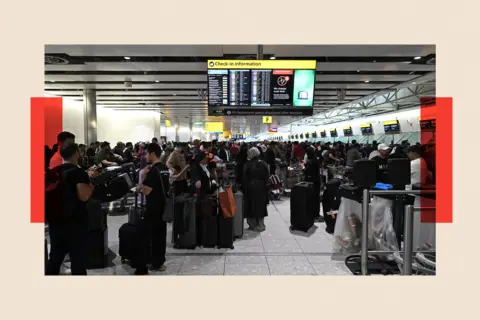
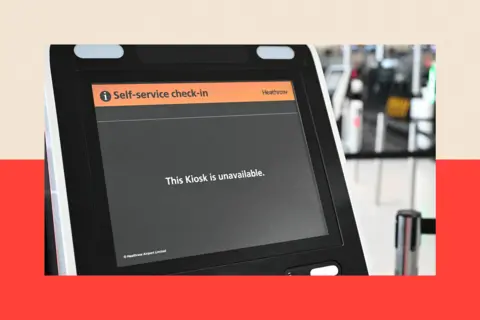
In late September a ransomware attack on American aviation technology firm Collins Aerospace caused serious problems at a number of European airports, including London Heathrow, after it disabled check-in and baggage handling systems.
The problem was resolved relatively quickly, but not before a large number of flights had been cancelled.
Industry sources warn that Europe’s airspace and key airports are so heavily congested that disruption in one area can quickly spread to others – and the costs can quickly add up.
In this instance, the knock-on effects were largely confined to widespread delays and flight cancellations. But it nods to a bigger question of what happens if a hack on critical infrastructure paralyses financial, transport or energy networks, potentially leading to huge economic costs – or worse?
AFP via Getty Images
“I think the worst-case scenario is probably something affecting financial services or energy provision, because of the potential cascading effects of either of those two”, says RUSI analyst Jamie MacColl.
“The good news is the financial sector is by far the most heavily-regulated sector in the UK for cyber security. And I think it’s quite telling, there’s rarely been a very impactful cyber attack on a Western bank.”
The outlook, were there an attack on the energy sector, is not clear.
A 2015 study by Lloyds Bank, entitled “Business Blackout”, modelled the impact of a hypothetical attack on the US power grid, concluding that economic losses could exceed $1 trillion (£742bn). However Mr MacColl believes that in the UK, there is probably enough spare capacity in the grid to deal with a cyber incident.
More concerningly, Mr MacColl thinks the UK has had “quite a laissez-faire approach to cyber security over the past 15 years”, with the issue given little priority by successive governments.
He believes that this year’s major attacks may be the “cumulative effect of a kind of inaction on cyber security, both from the government and from businesses, and it’s sort of really starting to bite now”.
That inaction, he says, needs to change, with both regulators and large businesses taking more responsibility.
Anadolu via Getty Images
In July last year the government did announce plans to introduce a Cyber Security and Resilience bill but its passage to becoming law has been repeatedly delayed.
In May, GCHQ’s National Cyber Security Centre published a report warning about the growing impact of cyber threats from hackers using artificial intelligence-based tools. It suggested that over the next two years, “a growing divide will emerge between organisations that can keep pace with AI-enabled threats, and those that fall behind – exposing them to greater risk, and intensifying the overall threat to the UK’s digital infrastructure.
However, what worries Jamie MacColl most are the sorts of attacks we haven’t yet thought to protect against.
“I would be more concerned about the sort of company that is the only business that provides a particular service, but that we don’t really know about, and that isn’t regulated as critical national infrastructure”, he says.
An attack on one of these less glamourous economic pivots, he argues, could have huge ramifications through the wider economy.
“That’s the sort of thing that would keep me up at night,” he says. “The single point of failure that we are not aware of yet.”
Top image credit: PA
BBC InDepth is the home on the website and app for the best analysis, with fresh perspectives that challenge assumptions and deep reporting on the biggest issues of the day. And we showcase thought-provoking content from across BBC Sounds and iPlayer too. You can send us your feedback on the InDepth section by clicking on the button below.
Apple has pulled apps that let users flag sightings of officers from US Immigration and Customs Enforcement (ICE).
The tech giant said it had removed ICEBlock from its App Store after law enforcement made it aware of “safety risks” associated with it and “similar apps”.
Another app called ICE Immigration Alerts has been removed from the App Store and Google Play. A third, Coqui, has also been taken down from Google Play.
In a statement US Attorney General Pam Bondi said she had “demanded” the removal of ICEBlock saying it was “designed to put ICE agents at risk”.
The app’s creator contacted BBC Verify after receiving an email informing him of the removal and accused Apple of “capitulating to an authoritarian regime.”
The decision means existing users of ICEBlock can continue to use the app but it cannot be newly downloaded.
A number of apps were released this year in response to President Trump’s crackdown on illegal immigration and an upsurge in ICE raids.
Critics – such as the creator of ICEBlock – accuse the government of abusing its powers and “bringing terror” to US streets.
The free app works by allowing users to report sightings of ICE officers. It has been downloaded more than a million times in the US.
However, Bondi argued it was being used to target ICE officers. The FBI says the man who targeted an ICE facility in Dallas in September – killing two detainees – had used similar apps to track the movements of agents and their vehicles.
In a statement Apple said: “We created the App Store to be a safe and trusted place to discover apps.
“Based on information we’ve received from law enforcement about the safety risks associated with ICEBlock, we have removed it and similar apps from the App Store.”
But its creator, Joshua Aaron, denied it posed a threat.
“ICEBlock is no different from crowd sourcing speed traps, which every notable mapping application, including Apple’s own Maps app,” he said.
“This is protected speech under the first amendment of the United States Constitution.”
Mr Aaron – who has worked in the tech industry for years – previously told BBC Verify he developed the app out of concern over a spike in immigration raids.
“I certainly watched pretty closely during Trump’s first administration and then I listened to the rhetoric during the campaign for the second,” he said.
“My brain started firing on what was going to happen and what I could do to keep people safe.”
The White House and FBI had criticised the app after it launched in April and downloads rose.
In a statement to the BBC a spokesperson for the Department for Homeland Security, Tricia McLaughlin, said:
“ICE tracking apps put the lives of the men and women of law enforcement in danger as they go after terrorists, vicious gangs and violent criminal rings.”
“But, of course, the media spins this correct decision for Apple to remove these apps as them caving to pressure instead of preventing further bloodshed and stopping law enforcement from getting killed,” she added.
The creator of the app ICE Immigration Alerts, who asked to remain anonymous, told the BBC that it was pulled from Apple and Google’s app platforms within hours of each other.
They said Apple had informed them the app was taken down at the request of “law enforcement” over similar concerns it could be used to harm officers.
Separately, Google allegedly told them the app had been removed over concern it would “undermine user trust in the Google Play ecosystem”.
“Apple did not offer an opportunity to appeal the decision,” said the app’s developer, who is based in New Zealand. “Google gave me seven days to appeal but without any clear explanation it is difficult to appeal, and I don’t want to risk them further affecting my account.”
“It is a somewhat chilling commentary on free speech,” they added. “No dangerous incidents have ever occurred as far as I know. It’s just about controlling the information unfortunately.”
The BBC has approached Apple for comment.
In a statement, Google confirmed it had removed “similar apps” to ICEBlock for “violations of [its] policies.” It did not say which apps, or the nature of the violations.
Hackers who attempted to extort a nursery chain by posting stolen images and data about children on the darknet have removed the posts and claim to have deleted the information.
The criminals began posting profiles of the children to their website last Thursday, adding another 10 children days later and vowing to continue until Kido Schools paid a ransom in Bitcoin.
The criminals also contacted parents directly with threatening phone calls whilst trying to get their ransom paid.
But public revulsion at their attack appears to have forced the criminals to backtrack.
First they blurred the images but kept the data up – now they have taken all the information offline, and apologised for their actions.
Their apparent change of heart has been met with scepticism by experts, who had previously condemned the targeting of nurseries as a “new low” for cyber-criminals.
“This is more about pragmatism than morality,” said cyber-security expert Jen Ellis.
“These criminals are clearly shocked and worried by the attention their hack has caused and they are trying to protect themselves or their brand.”
The hackers claim to have deleted everything they took – which included the private details and pictures of around 8,000 children as well as contact information for parents and carers.
“All child data is now being deleted. No more remains and this can comfort parents,” one of the cyber-criminals involved told the BBC.
It’s understood Kido have not paid the hackers a ransom which was thought to be around £100,000.
Past cases have shown that hackers often say they have deleted stolen data and been found to have kept it or sold it on.
When the UK’s National Crime Agency took down the cyber crime gang LockBit they discovered troves of data still on the criminal’s servers that victims had paid to be deleted.
The nursery hackers, calling themselves Radiant, appear to be concerned that their hack has crossed an undefined moral line since the public outcry began against them.
“We are sorry for hurting kids,” the cyber-criminals told BBC News.
It’s not known who the hackers or hacker are but they appear to be a new and possibly inexperienced group.
Their darknet site is newly created but they claim to have carried out other hacks in the past.
This isn’t the first time that cyber-criminals have backtracked on an attack.
In 2020 a gang using Dopplepaymer ransomware gifted their encryption key to a German hospital after the chaos contributed to the death of an emergency care patient.
The nursery hackers claimed they broke into the nursery’s systems by buying access to one of Kido’s staff computers which was compromised by a separate hacker.
In a common process, the “initial access broker” sold the Kido access to Radiant, which went on to further infiltrate Kido’s systems and steal the data.
The majority of the downloaded material including the pictures of children was taken from Kido’s account with Famly – a popular early years education platform .
Famly has rejected Kido’s message to parents that the breach happened as a result of Famly being compromised.
It has stressed to the BBC that neither the security or infrastructure of the platform has been compromised at any point.
Kido did not respond to a request for comment about the way the hackers stole the data.
A spokesperson said only that: “We recently identified and responded to a cyber incident. We are working with external specialists to investigate and determine what happened in more detail.
“We swiftly informed both our families and the relevant authorities and continue to liaise closely with them.”
Radiant says it paid the initial access broker money for access to Kido’s system.
So with Kido refusing to pay and the hackers giving up their extortion attempt the criminals appear to have actually lost money in this cyber-attack.
Half of UK adults are now regularly paying for things by tapping their phone, new banking data suggests.
A surge in the use of mobile payments via services such as Apple Pay or Google Pay has been recorded across different age groups, figures from trade body UK Finance show.
“People are more comfortable leaving their home with just their phone,” said Adrian Buckle, its head of research.
He said the “change of consumer behaviour” was clear as last year marked the first time 50% of adults used mobile payments at least once a month – up from 34% in 2023.
Consumers are increasingly storing card details on phones or watches and making contactless payments backed up by facial or fingerprint verification, instead of pressing in a PIN.
Some 78% of 16 to 24-year-olds regularly used mobile payments last year, and even more are registered to use them.
Older age groups are increasingly choosing this option too. For example, nearly two-thirds (59%) of 35 to 44-year-olds regularly made mobile payments in 2024, up from 38% a year earlier.
A fifth (19%) of those aged 65 and over often paid by phone.
The proportion of adults regularly using physical contactless cards dipped slightly as a result, although debit cards remain the most popular way to pay. Cash has continued to become less common in transactions – although nearly 50 million people still used ATMs.
“Cash fell below 10% of all payments,” Mr Buckle said. “These changes weren’t just driven by younger consumers. We saw growth in mobile wallets and Buy Now Pay Later across older age groups too, highlighting how digital payments are becoming more mainstream across the board.”
In 2023, with household finances stretched, the number of people mainly using cash picked up as it helped them to budget.
That number fell last year, but campaigners say notes and coins must remain part of the mix for consumers.
“While the number of people relying on cash continues to fall, we know that those who do are often on lower incomes or the more vulnerable,” said Adrian Roberts, deputy chief executive of Link, which oversees cash access and the ATM network.
“We must not sleepwalk into a digital-only society before everyone is ready.”
He said there were also questions over resilience for a digital-only payments system, such as the back-up options during a widespread power outage.
MPs on the Treasury Committee recently said that shops and services may have to be forced to accept cash in the future to help protect vulnerable people who rely on it.
Meanwhile, the UK’s financial regulator has proposed that banks and card providers set their own limits on contactless card payments or are allowed to remove the current £100 payment limit entirely.
That would make entering a PIN even more of a rarity, as smartphones – with extra in-built security – already have no limit on contactless payments via a digital wallet.


 Getty Images
 Getty Images