Posted on

Elon Musk’s $1tn pay deal approved by Tesla shareholders

Lily JamaliNorth America Technology correspondent

Tesla boss Elon Musk has had a record-breaking pay package that could be worth nearly $1tn (£760bn) approved by shareholders.

The unprecedented deal was approved by 75% of votes and drew huge applause from the audience at the firm’s annual general meeting on Thursday.

Musk, who is already the world’s richest man, must drastically raise the electric car firm’s market value over 10 years. If he does this and meets various targets, he will be rewarded with hundreds of millions of new shares.

The scale of the potential payout has drawn criticism, but the Tesla board argued that Musk might leave the company if it was not approved – and that it could not afford to lose him.

Following the announcement, Musk took to the stage in Austin, Texas and danced to chants of his name.

“What we’re about to embark upon is not merely a new chapter of the future of Tesla, but a whole new book,” he said.

“Other shareholder meetings are snoozefests but ours are bangers. Look at this. This is sick,” he added.

The milestones Musk must achieve over the next decade to maximise his payout include raising Tesla’s market value to $8.5tn from $1.4tn at time of writing.

He would also need to get a million self-driving Robotaxi vehicles into commercial operation.

But his early remarks on Thursday placed the spotlight on the Optimus robot, dashing the hopes of some long-time analysts and Tesla watchers who want Musk to focus on reviving the company’s electric vehicle business.

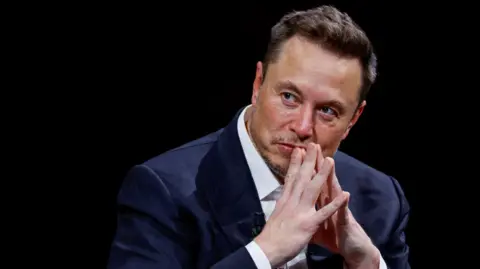
Reuters Elon Musk wearing a blue suit and white shirt with his fingertips touching and resting on his lips against a black backgroundReuters

“Let it sink in where Musk’s head is at,” wrote analyst Gene Munster, the managing partner at Deepwater Asset Management, on X.

“His vision of the ‘new book’ starts with Optimus. No mention of cars, FDS and robotaxi yet.”

Later, Musk did refer to FSD, shorthand for full-self driving, saying the company was “almost comfortable” allowing drivers to “text and drive essentially.”

US regulators are investigating Tesla’s self-driving feature after multiple incidents, in which the cars drove through red lights or on the wrong side of the road, some resulting in crashes and injuries.

Tesla shares were slightly higher in after hours trading but have risen more than 62% over the last six months.

Sales have slid in the year since Musk aligned himself with US President Donald Trump – a relationship that disintegrated this past spring.

Wedbush Securities’ Dan Ives, a tech analyst who has been a long-time advocate of Musk’s leadership of Tesla, called him “Tesla’s biggest asset” in a note published after the vote.

“We continue to believe that the AI valuation is getting unlocked, and we believe the march to an AI driven valuation for TSLA over the next 6-9 months has now begun,” Mr Ives added.
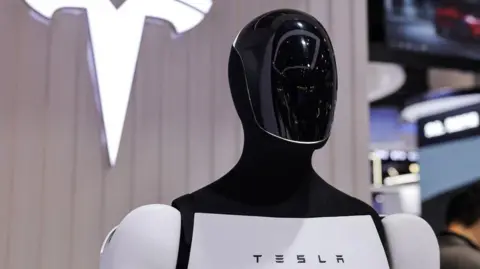
Reuters A Tesla Optimus robot next to a logo at the company’s booth at the 8th China International Import Expo in Shanghai, ChinaReuters

Musk already held 13% of Tesla shares. Shareholders had twice ratified a pay package worth tens of billions of dollars if he achieved a tenfold increase in the company’s market value – which he did.

But a Delaware judge rejected that pay deal on grounds that Tesla board members were too close to Musk.

Tesla reincorporated from Delaware to Texas, and the Delaware Supreme Court is currently reviewing the lower court judge’s decision.

The new pay package was rejected by several major insitutional investors including Norway’s sovereign wealth fund – the world’s largest national wealth fund – and the California Public Employees’ Retirement System (CalPERS) – the biggest public pension fund in the United States.

That left Musk more reliant on Tesla’s unusually large volume of retail investors.

Musk and his brother Kimbal, who also serves on the Tesla board, were both allowed to vote going into Thursdays meeting.

In recent weeks, members of Tesla’s board of directors have helped lobby for Musk’s new pay package with a marketing blitz that riled some corporate governance experts.

A video posted to votetesla.com showed board chair Robyn Denholm and director Kathleen Wilson-Thompson praising Musk.

Posted on

King handed Nvidia boss a letter warning of AI dangers

Zoe KleinmanTechnology editor

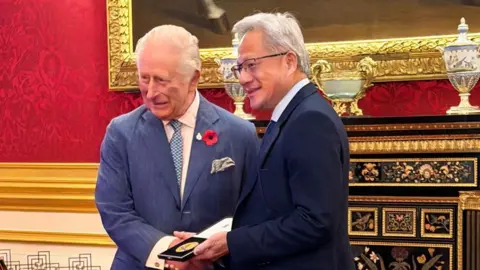
BBC King Charles handing a prize to Jensen Huang - the King is wearing a blue pinstripe suit and has a poppy on his lapel, Jensen Huang is holding the gold medal in its case and is wearing a dark suit and smiling with glasses on - the room they are in is very grand, with gold lining around a big mirror behind them, and red wall paper  BBC

Jensen Huang, the head of the world’s most valuable company Nvidia, says King Charles III personally handed him a copy of a speech he delivered in 2023 that included a warning about the dangers of artificial intelligence.

“He said, there’s something I want to talk to you about. And he handed me a letter,” Huang told the BBC, speaking after receiving the 2025 Queen Elizabeth Prize for Engineering in a ceremony at St James’s Palace.

The letter was a copy of the speech delivered by the King in 2023 at the world’s first AI Summit, held at Bletchley Park.

In it the monarch said that the risks of AI needed to be tackled with “a sense of urgency, unity and collective strength”.

“It was his speech on AI safety. He obviously cares very deeply about AI safety,” Mr Huang said.

Mr Huang said the King wrote in his speech that he believed in the “incredible capability” of the technology to transform the UK and the world.

“But he also wants to remind us that the technology could be used for good and for evil, and so to make sure we do everything we can to advance AI safety.”

In the King’s address he describes the development of advanced AI as “no less important than the discovery of electricity”.

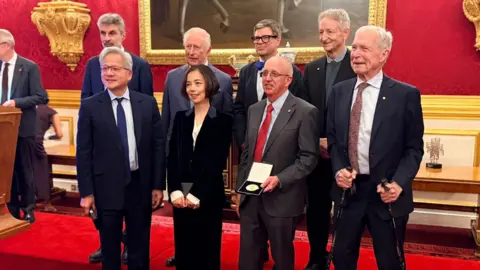
On Wednesday, Jensen Huang received the the 2025 Queen Elizabeth Prize for Engineering alongside six other foundational figures in AI, including Professors Yoshua Bengio and Geoffrey Hinton, who have warned that the technology poses an existential threat to humanity.

But US president Donald Trump has urged the AI sector to make rapid rather than cautious advances in the technology, and the AI Safety Summit was rebranded the AI Action Summit earlier this year.

The seven key figures in AI who received an award from the King - back row left to right: Yoshua Bengio; the King; Yan LeCunn; Geoffrey Hinton and front row, left to right: Jensen Huang; Fei-Fei Li; Bill Dally; and John Hopfield

Senator Howard Lutnick has discouraged the use of the word safety on the grounds that, “It makes us sound like we’re afraid”.

Mr Huang’s company, Nvidia, was valued at $5tn this week. It specialises in advanced computer chips including those which power AI.

Mr Huang added that in his view the UK is in a good position to take advantage of what he described as “an industrial revolution that’s happening right now.”

“It’s your opportunity to grasp,” he said.

Large US tech firms including Nvidia are investing billions of dollars in building AI infrastructure in the UK, in the form of enormous data centres, which Jensen Huang has called “AI factories”.

Posted on

Tesla says Musk should be paid $1tn – will shareholders agree?

Lily JamaliNorth America Technology Correspondent, San Francisco

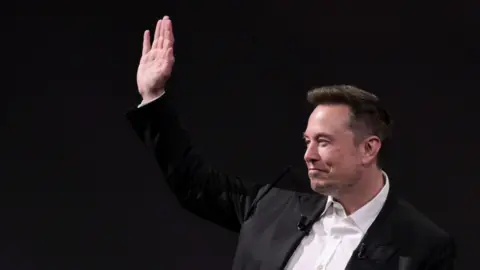
Getty Images Musk in a white shirt and black jacket with his hand raisedGetty Images

Ahead of Tesla’s annual general meeting (AGM) on Thursday there’s been one key message the electric car-maker has been hammering home to shareholders: the boss is worth $1tn.

It has taken out digital ads to make the case for Elon Musk’s proposed bumper pay package, while Votetesla.com features a video of board chair Robyn Denholm and director Kathleen Wilson-Thompson praising him, as triumphant music crescendos in the background.

It’s not clear that everyone is singing from the same hymn sheet though, meaning the AGM in Austin, Texas is set to become a referendum on Musk himself, after a rightward political turn which has made him one of the most polarising chief executives in recent memory.

Musk himself has taken to X – which he owns – to raise the stakes higher still, saying the fate of Tesla “could affect the future of civilization.”

He’s also used his social media megaphone to amplify some of the deal’s high-profile backers, including Dell Technologies’ Michael Dell, Ark Invest CEO Cathie Wood, and his brother, Kimbal, who sits on the Tesla board.

“There is no one remotely close to my brother,” Kimbal said, extolling his sibling’s leadership qualities.

“Thanks bro ❤️,” Musk replied.

Not everyone agrees.

For some, the focus on Musk and the soap opera around his pay is symptomatic of how the car firm – which has seen sales slide – has lost its way under his leadership.

“What’s amazing to me is a company struggling to sell cars spends money on advertising to sell a pay package,” said Ross Gerber, CEO of Gerber Kawasaki Wealth and Investment Management.

Mr Gerber has pared back his Tesla holdings in recent years – and turned up his criticism of the direction it’s heading in.

“[Tesla] needs to change the focus of the company back to its core – to selling EVs again,” he said.

The trillion dollar man

The deal Tesla wants shareholders to back is not a salary of a one followed by twelve zeroes.

Instead, it sets Musk the target of raising Tesla’s market value to $8.5tn, from $1.4tn at the time of writing.

He would also have to oversee a massive boom in the company’s self-driving “Robotaxi” cars, getting a million of them into commercial operation – no small deal given their underwhelming launch.

Do that, among meeting other benchmarks, and Musk would be given 423.7 million new shares, which would be worth nearly $1tn if the target valuation is reached.

Tesla did not respond to the BBC’s requests for comment about its strategy to garner support from shareholders.

Of course, this is not the first pay controversy Musk and Tesla have become embroiled in.

Previously, Tesla got shareholders to twice ratify a pay package for Mr Musk that was worth tens of billions of dollars if he achieved a tenfold increase in Tesla’s market value.

He met that milestone but, in 2024, a Delaware judge rejected the deal on the grounds that Tesla’s board members were too personally and financially enmeshed with the company’s boss.

The Delaware Supreme Court is reviewing that decision – even as deliberations continue over this even larger pay package.

“The strategy is more of the same from Tesla, which is not to say that this is normal. Nothing about Tesla is normal,” Dorothy Lund, a professor at Columbia Law School told BBC News.

“They’re not a poster child for good corporate governance.”

Professor Lund said get-out-the-vote campaigns like this sometimes take place when a company is worried, for example. about an activist shareholder forcing significant changes to how it operates, such as who is on its board of directors.

“[But] never in my life have I seen something like that happen in the context of a compensation decision,” Professor Lund said.

And unlike the vote on that earlier compensation package, Elon and Kimbal Musk will both get to vote as they push to reach the majority threshold required to seal the deal.

Mr Musk is already the world’s richest man, becoming the first known half-trillionaire earlier this year.

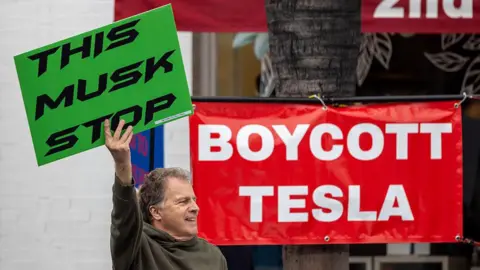
Getty Images A man holds a placard saying "This Musk Stop" in front of a banner reading "Boycott Tesla"Getty Images

A polarising figure

Tesla’s argument in support of the pay package rests on the idea that Musk might leave the company if shareholders don’t follow the board’s recommendation and approve the pay package.

It says it can’t afford to lose him, and that he “singularly possesses the leadership characteristics necessary to… realize its long-term mission”.

In the video posted to votetesla.com, Ms Wilson-Thompson said the board undertook a seven month process using legal and compensation experts to devise the compensation deal.

On last month’s earnings call, Musk minimised the focus on the payout, saying the real issue was ensuring he had adequate control in order to properly steer Tesla.

But – aside from the question of whether Musk, with his preoccupations with autonomous cars and humanoid robots, is the setting the right course – there is also the matter of whether championing the boss is the board’s job.

“The role of a board is to have fiduciary responsibility to shareholders and not to be advocating for a CEO,” said Yale School of the Environment’s Matthew Kotchen, an economics professor who co-authored a recent study attempting to quantify damage Mr Musk has done to Tesla of late.

It’s clear a number of key decision-makers are unpersuaded the deal represents value for money.

Proxy advisers Glass Lewis and Institutional Shareholder Services (ISS), which advise asset managers on how to vote on major corporate proposals, have recommended investors reject the pay package, saying it’s excessive and would dilute shareholder value.

Norway’s sovereign wealth fund, the world’s largest national wealth fund, has followed suit, as has the largest public pension fund in the US, CalPERS.

New York State Comptroller Thomas DiNapoli has urged investors to also reject directors up for re-election to the board, saying they’ve failed “to provide independent oversight and accountability.”

As some institutions balk, that might leave Mr Musk more reliant on Tesla’s unusually large volume of retail investors – who tend to support him – to get his wish.

It all means, in the words of Morgan Stanley analyst Adam Jonas, that Thursday’s vote is set to be one of “most important events” in Tesla’s history – with a “distinct possibility” the pay package won’t pass.

It doesn’t help Musk’s cause that protesters continue to organise anti-Tesla rallies, months after his controversial turn as US President Donald Trump’s government efficiency tsar crashed and burned in May.

“It’s hard for me to imagine that Elon Musk, in the very near term, shakes off the damage that he’s done to this brand,” said Mr Kotchen.

Others though would say Musk’s extraordinary track record of entrepreneurship would make it unwise to bet against him, even when the sum being staked is as dizzyingly high as $1tn.

“It’s hard to deny that Elon Musk’s larger-than-life personality has helped drive more interest and awareness for his organisation than almost any other corporate leader in the modern era,” said Edmunds’ head of insights Jessica Caldwell.

“He’s become a more polarizing figure over time, but there’s still a belief in his ability to deliver on bold, unconventional ideas,” she added.

The trillion dollar question now is – do Tesla shareholders agree?

A green promotional banner with black squares and rectangles forming pixels, moving in from the right. The text says: “Tech Decoded: The world’s biggest tech news in your inbox every Monday.”
Posted on

Online porn showing choking to be made illegal, government says

Online pornography showing strangulation or suffocation is to be made illegal, as part of government plans to tackle violence against women and girls.

It follows a review which found depictions of choking were “rife” on mainstream porn sites and had helped normalise the act among young people.

Both the possession and publication of such material will be a criminal offence, under amendments to the Crime and Policing Bill currently going through Parliament.

Online platforms would also be required to proactively detect and remove such material or face enforcement action via media regulator Ofcom.

The Department for Science, Innovation and Technology (DSIT) said the change would make choking in pornography a “priority offence” under the Online Safety Act, putting it on the same level as child sexual abuse material and terrorism content.

Technology Secretary Liz Kendall said: “Viewing and sharing this kind of material online is not only deeply distressing, it is vile and dangerous. Those who post or promote such content are contributing to a culture of violence and abuse that has no place in our society.

“We’re also holding tech companies to account and making sure they stop this content before it can spread,” she added.

Conservative peer Baroness Bertin warned earlier this year that there has been a “total absence of government scrutiny” of the pornography industry.

Her independent review, published in February, cited an account of a 14-year-old boy asking a teacher how to choke girls during sex and warned that people imitating such behaviour “may face devastating consequences”.

The government pledged in June to table amendments to the Bill which would outlaw showing choking in online pornography.

A BBC survey carried out in 2019 suggested 38% of women aged 18-39 had been choked during sex.

Bernie Ryan, chief executive of the Institute for Addressing Strangulation, welcomed the government’s amendment, saying choking can send “confusing and harmful messages” to women about what to expect in intimate relationships.

“Strangulation is a serious form of violence, often used in domestic abuse to control, silence or terrify,” she said.

Andrea Simon, director of the End Violence Against Women Coalition, described the amendments as “a vital step” towards tackling the normalisation of violence in online content.

“There is no such thing as safe strangulation; women cannot consent to the long-term harm it can cause, including impaired cognitive functioning and memory,” she said.

“Its widespread portrayal in porn is fuelling dangerous behaviours, particularly among young people.”

But campaigner Fiona Mackenzie, founder of the group We Can’t Consent To This, was less optimistic of the proposed law’s effectiveness.

She argued there were already existing laws against showing choking in pornography, but which were not enforced in practice.

This included the Criminal Justice and Immigration Act 2008, which criminalises the possession of extreme porn, including that showing life-threatening acts.

“More than five years ago, young women told us that social media sold strangulation of women as normal, as an expression of passion,” she said.

“The porn sites make this normal for men – and none of those sites have ever felt the impact of the existing law.

“So a change in law or practice is needed. It’s possible that this time the government might actually do something about this.

“However until we see otherwise, I don’t believe that any new law will actually be enforced.”

The government said in June, when the amendment was pledged, that it built on existing laws, including the Obscene Publications Act 1959 and the Criminal Justice and Immigration Act 2008.

Posted on

Will AI mean the end of call centres?

Jane WakefieldTechnology reporter

Getty Images A woman wearing a phone headset at a call centreGetty Images

Ask ChatGPT whether AI will replace humans in the customer service industry, and it will offer a diplomatic answer, the summary of which is “they will work side by side”.

Humans though, are not so optimistic.

Last year, the chief executive of Indian technology firm Tata Consultancy Services, K Krithivasan, told the Financial Times that AI may soon mean that there is “minimal need” for call centres in Asia.

Meanwhile, AI will autonomously resolve 80% of common customer service issues by 2029, predicts business and technology research firm Gartner.

There is currently a lot of hype around “AI agents”. That is the term given to AI systems that can operate more autonomously and make decisions.

They could turbo-charge current non-AI chatbots, known as “rule-based chatbots”, which can only answer a set list of questions.

My own recent experience with parcel delivery firm Evri’s chatbot illustrates the existing, non-AI state of play.

My parcel had not arrived, and Ezra (the name of the chatbot), offered to “get this resolved straight away”.

It asked for a tracking reference, and after I had typed that in, it told me that my parcel had been delivered.

I could request proof of delivery, and when I did so it showed me a photo of the package… at the wrong front door. And there was no option to advance the conversation after this “evidence” was shown.

In response, Evri tells the BBC it is investing £57m to further improve the service.

“Our intelligent chat facility uses tracking data to suggest the most helpful responses and ensure the customer’s parcel is delivered as soon as possible, if this has not happened as scheduled,” it says.

“Our data confirms the vast majority of people get the answers they need from our chat facility, first time, within seconds. We’re always reviewing feedback to ensure our services are as helpful as possible, and we continue to make enhancements on a rolling basis.”

On the flipside, rival parcel delivery firm DPD had to disable its less rule-bound AI chatbot after it criticised the company and swore at users.

Getty Images Close up of a chatbot screenGetty Images

Getting the balance right between being on brand and genuinely helping customers is a tricky one for businesses to grapple with as they migrate to AI.

Some 85% of customer service leaders are exploring, piloting or deploying AI chatbots, according to Gartner. But it also found that only 20% of such projects are fully meeting expectations.

“You can have a much more natural conversation with AI,” says Garner analyst Emily Potosky.

“But the downside is the chatbot could hallucinate, it could give you out-of-date information, or tell you completely the wrong thing. For parcel delivery I would say rules-based agents are great because there are only so many permutations of questions about someone’s package.”

Resources and money are among the key reasons businesses may be considering the move from human to AI customer service. But Ms Potosky points out that it isn’t a given that AI will be cheaper than human agents.

“This is a very expensive technology,” she says.

The first thing that any business wanting to replace humans with AI will have to do is ensure that they have extensive training data.

“There’s this idea that knowledge management becomes less important because generative AI can solve the fact that their knowledge is not particularly well organised, but actually the opposite is the case,” adds Ms Potosky.

“Knowledge management is more important when deploying generative AI.”

Joe Inzerillo, chief digital officer at software giant Salesforce, tells the BBC that call centres provide fertile training grounds for AIs, particularly ones that have been moved to low-cost areas such as the Philippines and India.

This is because a lot of staff training will have been done, which the AI can also learn from.

“You have a huge amount of documentation, and that’s all really great stuff for the AI to have when it is going to take over that first line of defence,” he says.

Salesforce’s AI-powered customer service platform, AgentForce, is currently being used by a range of customers from Formula 1, to insurance firm Prudential, restaurant-booking website Open Table, and social media site Reddit.

Mr Inzerillo says that when Salesforce first put the platform through its paces it learned some valuable lessons about how to make the AI seem more human-like.

“While a human might say ‘sorry to hear that’, the agent just opened a ticket,” says Mr Inzerillo.

So the AI was trained to show more sympathy, especially when a customer has a problem.

Salesforce also found that not allowing the agent to talk about competitors proved problematic.

“This backfired when customers asked legitimate questions about integrating Microsoft Teams with Salesforce,” says Mr Inzerillo. “The agent refused to help because Microsoft appeared on our competitor list.”

The firm subsequently replaced that rigid rule.

Salesforce has ambitious plans for the continuing rollout of its AI agents, and so far it claims that they are a hit with its customers. It also says that the vast majority of customers, 94%, are choosing to interact with AI agents when given the option.

“We’ve seen customer satisfaction rates that are in excess of what people get with humans – then AI can unlock the next level of customer service,” says Mr Inzerillo.

It has also meant that the firm has cut customer service costs by $100m, but he was keen to play down recent headlines that suggest this has led to 4,000 jobs being slashed.

“A very large percentage of those people got redeployed in other areas around customer service.”

Fiona Coleman Fiona ColemanFiona Coleman

Fiona Coleman runs QStory, a firm which is using AI to offer human call centre workers more flexibility in their shift patterns. Its customers include eBay and NatWest.

While she sees the value in AI improving working conditions, she is not sure the technology can ever replace humans entirely.

“There are times where I don’t want to have a digital engagement, and I want to speak to a human,” she says.

“Let’s see what it looks like in five years’ time – whether an AI can do a mortgage application, or talk about a debt problem. Let’s see whether the AI has got empathetic enough.”

The use of AI in customer service could, in fact, already be facing a backlash.

Legislation currently proposed in the US to move off-shore call centres back to America also requires businesses to disclose the use of AI, and transfer a caller to a human if asked to do so.

Meanwhile, Gartner predicted that by 2028 the EU may mandate what is called ‘the right to talk to a human” as part of its consumer protection rules.

Read more global business stories
Posted on

Pornhub says UK visitors down 77% since age checks came in

Chris VallanceSenior technology reporter

Getty Images A photograph of a computer screen showing the home page of pornhub with a notice obscuring most of the page which says "Please verify your age"Getty Images

Pornhub says the number of UK visitors to its website is down 77% compared with July, when more rigorous age checks for sexually explicit sites were introduced under the Online Safety Act.

It claims sites that are ignoring the new requirements are benefiting.

The BBC has not been able to independently verify Pornhub’s claim – however, data from Google shows searches for the site have decreased by almost half since the law came into effect.

This could be a consequence of people reducing their porn use but could also be partly explained by people visiting the site through alternative means such as a VPN, which masks a user’s location.

Pornhub is the most visited porn site in the world – and the 19th most visited on the entire web, according to data from Similarweb.

Under the OSA, anyone accessing such websites in the UK now has to prove they are over 18 with age checks such as facial identification.

The firm’s claim is the latest indication that people in the UK are changing how they use the internet since the Online Safety Act came into effect.

According to Ofcom, visits to pornography sites in general in the UK have reduced by almost a third in the three months since 25 July.

The regulator said the new law was fulfilling its primary purpose of stopping children from being able to “easily stumble across porn without searching for it”.

“Our new rules end the era of an age-blind internet, when many sites and apps have undertaken no meaningful checks to see if children were using their services,” the watchdog said.

Ofcom told the BBC it believed the number of people using VPNs for general use reached 1.5 million daily in July, after the law came in, but has since decreased to around one million.

Meanwhile, research by Cybernews counted more than 10.7 million downloads of VPN apps in the UK from the Google Play Store and Apple App Store across 2025.

“It is likely that people not wanting to verify their age or identity to access sexual content, for example because of privacy concerns, are using VPNs to get around this,” Dr Hanne Stegeman from the University of Exeter told the BBC.

“As the location of website visitors are usually determined through IP addresses, it could be that those figures are inaccurate when a portion of visitors are using VPNs.”

And Cybernews information security researcher Aras Nazarovas told the BBC people in the UK “can and do” use VPNs.

“After age checks kicked in, VPN apps jumped to the top of the UK App Store, and at least one provider saw a 1,800% surge in downloads,” he said.

“So part of Pornhub’s ‘missing’ UK audience hasn’t vanished – it’s being reclassified as non‑UK traffic.”

But he said he believed “the rest” was indeed “users shifting to sites that don’t require age checks”.

‘Exponential growth’

Alex Kekesi, an executive at Pornhub’s parent company Aylo, told the BBC the new rules were unenforceable.

She said Ofcom faced an “insurmountable task” trying to get an estimated 240,000 adult platforms – visited by eight million users per month in the UK – to follow the rules.

This compares with the regulator taking action against fewer than 70 sites for non-compliance.

Ofcom says it prioritises sites to be investigated based on how risky they are and their number of users.

And Ms Kekesi claimed some pornographic sites have benefited from flouting the rules. The BBC has not independently verified this.

“There are a number of sites whose traffic has grown exponentially, and these are sites that are not complying,” she said.

Ms Kekesi also has concerns about the content on some of these sites.

She told the BBC of one which seemed to encourage users to search for content featuring girls below the age of consent.

Aylo says it has shared details of this and other sites with Ofcom.

The regulator has defended the way it enforces the new rules, saying increasing traffic to sites can be one factor that triggers an investigation.

“Sites that don’t comply and put children at risk can expect to face enforcement action,” it told BBC News.

Ofcom’s data shows that the top 10 most popular sites all have age assurance deployed. These sites represent a quarter of all visits to adult sites from across the UK.

It adds that over three quarters of daily traffic to the top 100 most popular sites are going to sites that have age assurance.

The government has also defended the regulator, and said protecting children online was a “top priority” for ministers.

“Where evidence shows further intervention is needed to protect children, we will not hesitate to act,” it added in a statement.

Should devices do the checks?

Ms Kekesi spoke to the BBC while in the UK for a meeting with Ofcom and government officials, where she has been making Pornhub’s case that age checks should be done at device level, rather than by individual websites.

She said the UK stands out in having persuaded the platform to introduce age checks.

A number of jurisdictions have sought to compel Pornhub to check its users’ ages, but the response of the site has been to block users rather than comply.

Ms Kekesi said the UK was different because it allowed sites to offer a range of different solutions, meaning that Pornhub could use methods – such as email-based checks – which didn’t require collecting biometric data.

She denied that the threat of hefty fines for non-compliance had been the primary motive for complying, pointing to the contrast with France – its second biggest market – where it had cut off access rather than agreeing to what regulators demanded.

Ian Corby of the Age Verification Providers Association rejected calls for a switch to device-based verification.

But he added the group shared a desire for a “level playing field” meaning age checks should be “robust, not superficial or fake”.

Chelsea Jarvie, a cybersecurity company founder who has been researching methods of age assurance for a PhD at Strathclyde University, told the BBC both approaches to age checks would be needed – with neither age verification on platforms nor devices being a “silver bullet”.

“For somebody to truly be safe online we need different layers of controls throughout their browsing journey,” she said.

A green promotional banner with black squares and rectangles forming pixels, moving in from the right. The text says: “Tech Decoded: The world’s biggest tech news in your inbox every Monday.”
Posted on

Watchdog slams O2 over unexpected price rise

The UK’s media regulator has criticised O2 for raising its prices by more than it promised customers when they took out their phone contracts.

Ofcom said it was “disappointed” with the firm, and said it was going against “the spirit of our rules” around being transparent to customers about price rises.

In January, new rules were brought in to stop phone and broadband companies raising prices in the middle of a contract without warning.

O2 said it has not gone against the regulation and that Ofcom’s rules “do not prevent companies from increasing annual price changes – for example, to invest in improving networks”.

The company said it spends £700m a year on improving infrastructure and customers can leave their contracts without a penalty.

But consumer expert Martin Lewis said he was “up in arms” over the move, which was “making a mockery of Ofcom”.

He said on The Martin Lewis Podcast he believed this would lead to other companies following suit.

“O2 customers’ prices are going up – but likely it means the door is open for all of us to now see prices by more than we were told when we signed up,” he said.

O2 told its customers they had 30 days to leave their contracts without any termination charges – though if their plan included a handset, they would still have to pay that off in full.

But Mr Lewis said older and vulnerable customers tend not to switch and may miss the 30-day window, as the price rises do not come in until April 2026.

On Wednesday, O2 emailed its customers to say it would be increasing the price of their contracts by £2.50 a month from April.

It had previously advertised that monthly prices would only go up by £1.80.

“Today, we’ve written to the major mobile companies reminding them of their obligations to treat customers fairly,” Ofcom said.

“We encourage any customer who wants to avoid these price rises to exercise their right to exit without penalty and sign up to a new deal.”

Ofcom’s rules were brought in to protect consumers and stop unexpected price rises occurring in the middle of a contract.

They stated companies had to tell customers how much their bill would rise by “in pounds and pence” before they signed up.

At the time, Ofcom’s director for networks and communication, Natalie Black CBE, said: “Our new rules mean there will be no nasty surprises, and customers will know how much they will be paying and when, through clear labelling.”

But the rules only banned price hikes linked to inflation.

O2’s price increase is a flat fee rather than a percentage of the monthly bill.

Telecoms analyst Paolo Pescatore of PP Foresight said “O2 is pushing the boundaries” of the regulation.

“This is extremely unfortunate, given that the mobile operator should be focused on retaining customers in a cut-throat market,” he’d told BBC News.

Meanwhile Tom MacInnes, director of policy at Citizens Advice, said it showed Ofcom’s actions “haven’t gone far enough”.

“The regulator needs to wake up and make these essential markets work for everyone,” he said.

“Ofcom needs to go back to the drawing board and bring forward plans to stamp out mid-contract price rises once and for all.”

Mr Lewis also said he had written a letter about this addressed to the chancellor, the technology secretary and the head of Ofcom.

BBC News has contacted them for comment.

Ofcom did not comment on Mr Lewis’ letter.

Ernest Doku, telecoms expert at Uswitch, said while the regulator’s latest telecoms complaints figures were “at some of the lowest levels ever”, service issues were still the main driver of complaints about mobile and broadband providers.

“Against the backdrop of increasing annual price rises, providers need to recognise their responsibility to deliver corresponding improvements in service and value,” he said.

“For consumers, this data is a timely reminder to compare deals regularly and switch if their provider isn’t sufficiently meeting their needs.”

Posted on

Websites disabled in Microsoft global outage come back online

Imran Rahman-Jones,Technology reporter and

Lily Jamali,North America Technology correspondent

Getty Images A silhouetted hand holding a phone with the words "Microsoft Azure" on it. In the background is the red, green, blue and yellow Microsoft logo.Getty Images

Websites for Heathrow, NatWest and Minecraft returned to service late on Wednesday after experiencing problems amid a global Microsoft outage.

Outage tracker Downdetector showed thousands of reports of issues with a number of websites around the world over several hours.

Microsoft said some users of Microsoft 365 saw delays with Outlook among other services, but by 21:00GMT, many websites that went down were once again accessible after the company restored a prior update.

The company’s Azure cloud computing platform, which underpins large parts of the internet, had reported a “degradation of some services” at 16:00 GMT.

It said this was due to “DNS issues” – the same root cause of the huge Amazon Web Services (AWS) outage last week.

Amazon said AWS was operating normally.

Other sites that were impacted in the UK include supermarket Asda, M&S, and mobile phone operator O2 – while in the US, people reported issues accessing the websites of coffee chain Starbucks and retailer Kroger.

Microsoft said business Microsoft 365 customers experienced problems.

Some web pages on Microsoft also directed users to an error notifications that read “Uh oh! Something went wrong with the previous request.”

The tech giant resorted to posting updates to a thread on X after some users reported they could not access the service status page.

While NatWest’s website was temporarily impacted, the bank’s mobile banking, web chat, and telephone customer services remained available during the outage.

The UK consumer organisation Which? said businesses had an obligation to ensure customers were kept informed and supported as services were restored, and to compensate consumers impacted.

“Customers should keep evidence of any failed or delayed payments in case they need to make a claim,” advised Which? consumer law expert Lisa Webb.

“Those worried about missing a bill should contact the relevant company to explain the situation and request that any fees be waived,” Ms Webb added.

Meanwhile, business at the Scottish Parliament was suspended because of technical issues with the parliament’s online voting system.

The outage prompted a postponement of debate over land reform legislation that could allow Scotland to intervene in private sales and require large estates to be broken up.

A senior Scottish Parliament source told BBC News they believed the problems were related to the Microsoft outage.

Azure’s crucial role online

Exactly how much of the internet was impacted is unclear, but estimates typically put Microsoft Azure at around 20% of the global cloud market.

The firm said it believed the outage was a result of “an inadvertent configuration change”.

In other words, a behind-the-scenes system was changed, with unintended consequences.

The concentration of cloud services into Microsoft, Amazon and Google means an outage like this “can cripple hundreds, if not thousands of applications and systems,” said Dr Saqib Kakvi, from Royal Holloway University.

“Due to cost of hosting web content, economic forces lead to consolidation of resources into a few very large players, but it is effectively putting all our eggs in one of three baskets.”

Recent outages have laid bare the fragility of the modern-day internet, according to engineering professor Gregory Falco of Cornell University.

“When we think of Azure or AWS, we think of a monolithic piece of technology infrastructure but the reality is that it’s thousands if not tens of thousands of little pieces of a puzzle that are all interwoven together,” said Mr Falco.

He noted that some of those pieces are managed by the companies themselves while others are overseen by third parties such as CrowdStrike, which last year deployed a software update that affected more than eight million computers run on Microsoft systems.

A green promotional banner with black squares and rectangles forming pixels, moving in from the right. The text says: “Tech Decoded: The world’s biggest tech news in your inbox every Monday.”
Posted on

OpenAI completes shift to becoming for-profit

Lily JamaliNorth America Technology Correspondent, San Francisco

Reuters The ChatGPT logo, in white, is visible against the backdrop of a dark keyboardReuters

OpenAI has completed its conversion to a for-profit entity, a move that could allow it to raise billions of dollars in investment and potentially clear the way for a stock market debut.

As part of the arrangement, OpenAI and Microsoft announced changes to their partnership that leave the tech giant with a 27% stake in the ChatGPT-maker.

The deal changes the relationship between the two companies, which first partnered in 2019, when OpenAI was a non-profit artificial intelligence (AI) research organisation.

Under the terms, Microsoft can now pursue artificial general intelligence – sometimes defined as AI that surpasses human intelligence – on its own or with other parties, the companies said.

OpenAI also said it was convening an expert panel that will verify any declaration by the company that it has achieved artificial general intelligence.

The company did not share who would serve on the panel when approached by the BBC.

Microsoft will also support OpenAI’s board with the conversion to a for-profit entity, which the company has confirmed boss Sam Altman will not hold an equity stake in, as first reported by Bloomberg.

The original partnership between the companies gave Microsoft rights to much of what OpenAI produced at a time when the startup was hungry for cloud computing resources.

OpenAI has since gone on a deal spree with a host of other major tech players leading to speculation that an AI bubble may be in the offing.

The revised deal extends Microsoft’s rights to OpenAI’s AI models through to 2032 but excludes consumer hardware.

Microsoft’s market cap crossed the $4tn mark on Tuesday for the second time ever after the announcement.

It first reached that milestone in July, following chip designer Nvidia to become just the second publicly-traded company to do so.

OpenAI’s trajectory

OpenAI brought AI to the mainstream user in 2022 with the introduction of ChatGPT.

At the company’s DevDay event in San Francisco earlier this month, Mr Altman said the company had reached 800mn weekly active users.

OpenAI – now valued at $500bn – has released a slew of new products aimed at increasing engagement with its AI tools.

These include the AI-powered browser ChatGPT Atlas, which competes with Google Chrome, and a video generation tool called Sora.

But the company also routinely finds itself at the centre of controversy.

Last week, OpenAI blocked Sora 2 from creating deepfake videos portraying Dr Martin Luther King Jr after intervention from the late civil rights leader’s family.

OpenAI also recently said ChatGPT would soon start allowing erotica for verified adults.

Meanwhile, critics say OpenAI has downplayed the potential mental health implications of its AI tools which they charge are being built with few guardrails in the pursuit of profits.

A green promotional banner with black squares and rectangles forming pixels, moving in from the right. The text says: “Tech Decoded: The world’s biggest tech news in your inbox every Monday.”
Posted on

Turing AI Institute boss denies accusations of ‘toxic internal culture’

The Alan Turing Institute Chair has told the BBC there is “no substance” to a number of serious accusations which rocked the organisation in the summer.

In August, whistleblowers accused the charity’s leadership of misusing public funds, overseeing a “toxic internal culture”, and failing to deliver on its mission.

They said the Turing Institute, the UK’s national body for artificial intelligence (AI), was on the brink of collapse after Peter Kyle, the then technology secretary, threatened to withdraw its £100m funding.

But speaking exclusively to the BBC, Chair Dr Doug Gurr said the whistleblower claims were “independently investigated” by a third party which found them to have “no substance”.

“I fully sympathise that going through any transition is always challenging,” he said.

“It’s been challenging for a lot of people and a number of concerns have been raised.

“Every single one of those has been independently investigated and we’ve not found any substance.”

He did not name the third party which had carried out the investigation.

But the Turing’s woes go beyond the allegations themselves, with three senior directors, the chief technology officer and most recently the chief executive all leaving their jobs.

It is also under investigation by the Charity Commission – and Dr Gurr did not give any indication he would consider standing down himself if it concluded there were issues.

Instead, he said he loved his job and was proud of what the organisation had achieved under his tenure.

Dr Gurr acknowledged for some staff it had been a “tough” period, but said he believed the Turing was now “match fit”.

“There are two things that we have in the UK that are truly special,” he said.

“We have fantastic talent and we have unbelievable data sets – let’s get in, let’s focus on those areas that really matter.”

He said he sympathised with staff who had criticised their workplace under his leadership, but did not apologise.

And he agreed with Kyle, who is now business secretary, that the Institute should focus on defence – but added it would continue with other projects themed around the environment, sustainability and health.

Current projects include increasing the accuracy of weather forecasting, reducing transport emissions, and cardiac research on human hearts using digital twins.

Questions remain over how much overlap there will be between the Turing Institute’s new direction and other UK agencies carrying out similar work – such as UKRI and the MOD – in addition to commercial tech firms.

Dr Gurr acknowledged its defence work, which includes research on how best to secure the UK’s national critical infrastructure, was “not exclusive” but said it was responding to a request at a time of need.

“The world probably feels like it’s become a much more dangerous place over the last couple of years,” he said.

“I think the other thing that’s become very clear when you look at some of the theatres of conflict around the world is that data and technology is to play an increasingly critical role in whatever form of hostilities happen.

“The Turing has had a long track record of working in these spaces.”

But the original whistleblowers, who still remain working at the organisation, believe the reputation of the Institute is “in tatters” following recent events.

They spoke to me on the condition of anonymity because they fear losing their jobs.

“This is not a new chapter for the Turing,” they said.

“It is the same words under a new heading.”